



Hotel AI Booking Systems Case Studies: Boost Revenue & Delight

Discover how modern properties are transforming operations through hotel AI booking systems case studies, featuring real-world examples of revenue growth, automated guest service, and dynamic pricing strategies that are redefining hospitality in 2026.
The Quiet Revolution in Hotel Lobby Tech
Walking into a hotel today feels different than it did even five years ago. It is not just about the sleeker furniture or the faster Wi-Fi; there is an invisible layer of intelligence working behind the scenes. If you have ever wondered how that boutique hotel in the city always seems to have the perfect room available at a price that feels just right, or why a chatbot actually solved your problem without needing a human manager, you have witnessed the power of artificial intelligence in action.
For a long time, the hospitality industry was stuck in a bit of a manual rut. Front desk teams were buried under phone calls, and managers were guessing room rates based on gut feelings and last year’s spreadsheets. But we are moving into a new era. The shift toward hotel AI booking systems is not just a trend for the tech-obsessed; it is a survival strategy for a competitive market where travelers expect instant gratification and deeply personalized care.
In this guide, we are going to look past the marketing buzzwords. We will dig into actual success stories and practical implementations that show exactly how smart technology is helping hotels of all sizes fill more rooms while doing less of the heavy lifting. Whether you are a property owner looking to upgrade or a traveler curious about the “magic” behind your next booking, these insights will clear the air.
Beyond the Front Desk: What AI Actually Does for Hotels
When people hear “AI in hotels,” they often picture a clunky robot carrying luggage. While those exist, the real value is much less flashy but far more impactful. At its core, AI-driven booking technology acts like a 24/7 digital concierge that never sleeps, never gets tired, and can process thousands of data points in a heartbeat.
The primary goal is to remove friction. Think about the last time you tried to book a room late at night and had a specific question about parking. If you had to wait until 9 AM for a human to answer, you probably just booked somewhere else. AI changes that math. By providing instant, accurate answers and handling the transaction right then and there, hotels are capturing revenue that used to slip through the cracks.
The Pillars of Modern AI Implementation
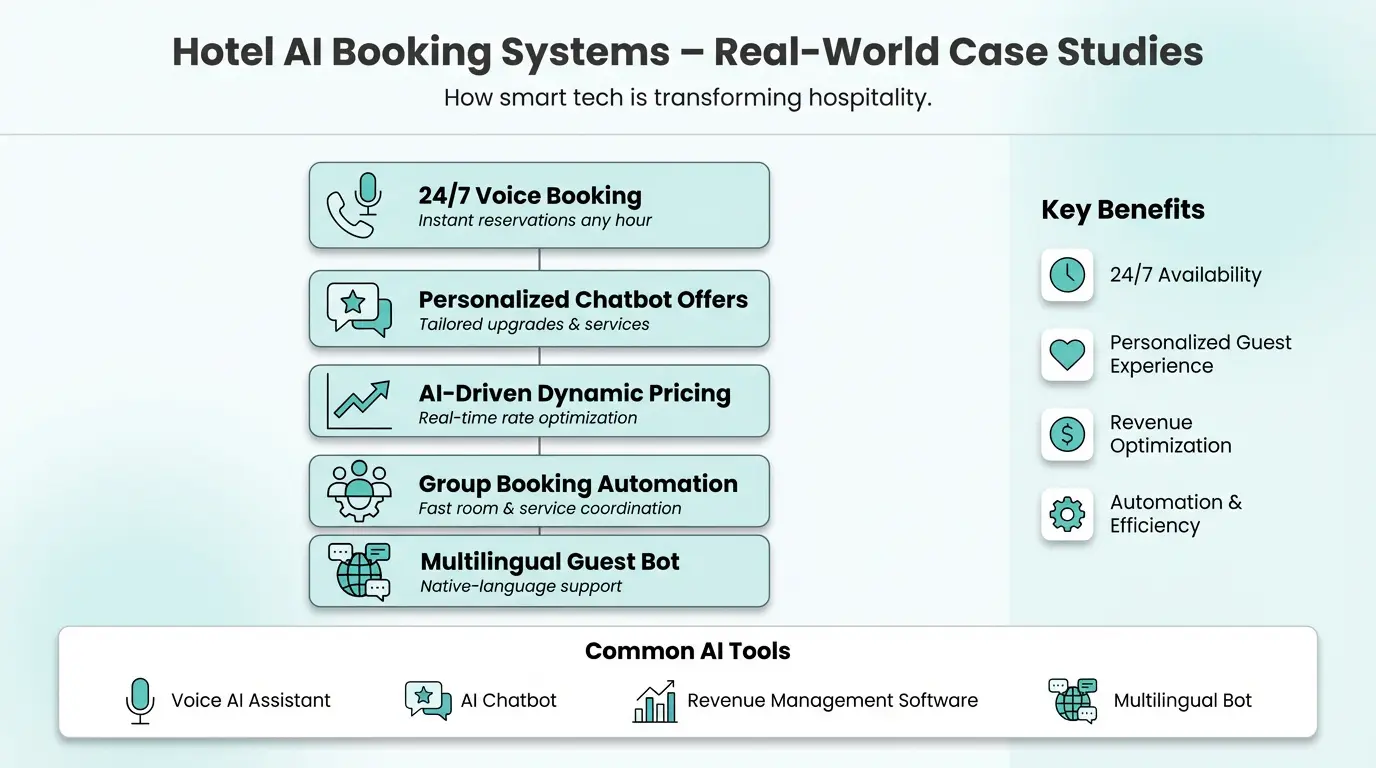
- 24/7 Availability: Handling global inquiries across every time zone without increasing payroll.
- Hyper-Personalization: Remembering that a guest prefers a quiet room or has a history of booking spa treatments.
- Operational Speed: Automating the “boring stuff” like confirmation emails, billing, and basic FAQs.
- Data-Driven Decisions: Using real-time market signals rather than historical guesses.
Case Study 1: Seamless 24/7 Reservations via Voice AI
One of the most compelling hotel AI booking systems case studies involves a boutique property that struggled with high “abandonment rates” on their phone lines during peak hours and late at night. They implemented a voice-based AI assistant designed to handle natural conversation. Unlike the frustrating “press 1 for reservations” menus of the past, this system understands intent.
A traveler calling at 2 AM to check if a suite is available for a last-minute anniversary trip no longer hits a voicemail. The AI checks the live Property Management System (PMS), confirms the availability, and can even process the deposit securely. For this specific hotel, the results were immediate. They saw a 20% increase in direct bookings within the first quarter because they were finally “open” for business every single minute of the day.
Why Voice AI Works for Small Teams
Small hotels often don’t have the budget for a night auditor who can also act as a high-level salesperson. The AI fills that gap, ensuring that every lead is pursued. It is a relatable problem: nobody wants to talk to a machine, but everybody wants their problem solved now. When the machine is smart enough to act like a human assistant, the guest wins.
Case Study 2: Personalized Guest Journeys at Luxury Chains
Luxury hospitality is all about making the guest feel like the center of the universe. A major global luxury chain utilized AI to analyze guest preferences across their entire portfolio. If a guest consistently orders a latte at their London property, the AI ensures the New York property knows about it before the guest even checks in.
In the booking phase, this translates to “Experience-Led Discovery.” Instead of showing a generic list of rooms, the booking engine suggests packages based on past behavior. If the data shows a guest usually travels with family, the system prioritizes connecting rooms and nearby kid-friendly activities. This tailored approach led to a significant jump in the Average Order Value (AOV) as guests were more likely to book “suggested” upgrades that actually matched their lifestyle.
Case Study 3: The Power of Dynamic Pricing and Revenue Management
Revenue management used to be a dark art. Managers would look at local events, like a major concert or a sports game, and manually hike prices. But humans are slow. AI-driven Revenue Management Systems (RMS) can monitor competitor pricing, weather patterns, flight delays, and local demand shifts in real-time.
Take the case of a city-center hotel during a major tech conference. While their competitors were still at their “standard” conference rate, the AI noticed that nearby hotels were selling out faster than usual. It automatically adjusted the rates upward by 5% every few hours as the supply dwindled. Conversely, on a rainy Tuesday when demand cratered, it pushed out “limited-time” offers to local loyalty members to keep occupancy high. This dynamic dance ensures the hotel never leaves money on the table.
Comparison of Manual vs. AI Revenue Management
| Feature | Manual Management | AI-Powered Management |
|---|---|---|
| Update Frequency | Daily or Weekly | Real-Time (Every few minutes) |
| Data Sources | Historical data, limited competitors | Weather, flights, local events, global trends |
| Error Margin | High (subject to human bias) | Low (based on statistical probability) |
| Revenue Impact | Standard growth | Often 10-15% increase in RevPAR |
Case Study 4: Automating the Complexity of Group Bookings
If you have ever organized a wedding or a corporate retreat, you know the nightmare of “room blocks.” It usually involves dozens of emails, spreadsheets, and manual tracking of who has paid and who hasn’t. A large resort recently automated this entire pipeline using AI. The system creates a dedicated portal for the group, manages the individual reservations, and automatically sends reminders to guests who haven’t booked by the cutoff date.
The AI handles the heavy lifting of inventory management. If the wedding block isn’t filling up, it can automatically “release” those rooms back to the general public to avoid empty beds. This implementation reduced administrative work for the sales team by nearly 40%, allowing them to focus on landing new contracts rather than chasing down credit card authorizations for a bridesmaids’ block.
Breaking the Language Barrier with Multilingual AI
For hotels catering to international travelers, language is often the biggest hurdle to a direct booking. Many guests feel more comfortable booking on third-party sites (OTAs) simply because those sites are translated into their native tongue. However, hotels lose a massive chunk of change to OTA commissions.
By implementing multilingual AI chatbots, hotels can now offer a native-level booking experience in dozens of languages. A guest from Tokyo can chat with a hotel in Paris, ask about breakfast options, and book a room—all in Japanese. The AI translates the request for the hotel staff and handles the response back to the guest. This accessibility has proven to be a major factor in driving direct, commission-free revenue from international markets.
Improving Marketing Attribution with AI Analytics
Many hotel owners feel like they are throwing money into a black hole when it comes to advertising. Is the Instagram ad working, or is it the Google search? AI tools are now providing much clearer answers. By using dynamic tracking and conversational analysis, AI can tell a manager exactly which touchpoint led to a booking.
For example, using tools like iovox, hotels can track phone calls back to specific digital ads. If a guest clicks a “Call Now” button on a Facebook ad, the AI identifies that specific path. This allows hotels to stop wasting budget on underperforming channels and double down on what actually fills rooms. It is about working smarter, not just spending more.
The Security and Privacy Aspect of AI Bookings
With great data comes great responsibility. One of the common concerns in artificial intelligence booking system examples is how guest data is handled. Modern AI platforms are built with privacy-first protocols. They can automatically “redact” or hide sensitive information like credit card numbers from chat transcripts or voice recordings, ensuring compliance with global regulations like GDPR.
Furthermore, AI helps with security through identity verification. Some high-tech hotels are now using AI-powered facial recognition for contactless check-in. The guest uploads a photo during the booking process, and the AI matches it at a kiosk upon arrival. This not only speeds up the process but also adds a layer of security that manual ID checks sometimes miss.
Common Challenges When Implementing AI
It is not all sunshine and rainbows. Transitioning to an AI-heavy system requires a change in mindset. The biggest hurdle is often integration. If your new AI doesn’t “talk” to your old Property Management System, you end up with more work, not less. The most successful hotels are those that choose AI hotel booking technology implementation partners who specialize in “stack integration”—making sure every piece of software works in harmony.
There is also the “uncanny valley” problem. If an AI tries too hard to sound human and fails, it can be off-putting. The key is transparency. Guests generally don’t mind talking to an AI if it is fast and helpful. The frustration only starts when the AI pretends to be human but can’t answer a basic question about the pet policy.
The ROI of AI: Is it Worth the Investment?
At the end of the day, hotel owners want to know the bottom line. Most case studies show that the initial setup cost of AI is recouped within the first 6 to 12 months. This comes from three main areas:
- Reduction in OTA Commissions: More guests booking directly through the AI-powered website.
- Labor Savings: Front desk staff spend less time on routine inquiries and more time on high-value guest interactions.
- Increased Occupancy: Dynamic pricing ensures rooms are priced to sell, even in low seasons.
According to a recent report by Databricks, travel brands leveraging unified AI platforms see a 20% boost in conversion rates. When you apply that to a 100-room hotel, the numbers become very significant, very quickly.
What Does the Future Hold for AI in Hospitality?
We are just scratching the surface. In the near future, we will see “Hyper-Agentic” AI that doesn’t just book a room but manages the entire trip. Imagine an AI that sees your flight is delayed and automatically calls the hotel to push back your check-in time and tells the restaurant to hold your dinner reservation. This level of interconnected service is the next frontier.
For now, the focus remains on making the booking process as human-centric as possible through technology. AI is moving from being a “tool” to being a “team member.” It is there to support the staff, delight the guests, and keep the business healthy in an ever-changing digital landscape.
Frequently Asked Questions (FAQs)
How do hotel AI booking systems improve guest experience?
AI systems provide instant, 24/7 support and personalized recommendations based on guest history. This eliminates wait times and makes the booking process feel tailored to the individual’s specific needs and preferences.
What are the main benefits of using AI in hotel revenue management?
The primary benefit is dynamic pricing. AI can adjust room rates in real-time by analyzing demand, local events, and competitor prices, ensuring the hotel maximizes both occupancy and profit margins automatically.
Can AI booking systems handle multilingual guests?
Yes, many modern AI platforms feature multilingual chatbots and voice assistants. They can communicate fluently in dozens of languages, allowing international travelers to book directly in their native tongue without confusion.
How do AI booking systems reduce administrative workload in hotels?
AI automates repetitive tasks like answering FAQs, managing room blocks, and processing confirmations. This frees up human staff to focus on complex guest needs and providing high-quality face-to-face hospitality.
What types of hotels can benefit from AI booking systems?
Properties of all sizes can benefit. Boutique hotels use AI to provide 24/7 coverage without extra staff, while large resorts use it to manage complex group bookings and massive data sets for marketing.
Also Read: AI GIS applications: Boost Spatial Insights for Smarter Decisions in 2026