



BigBear AI Shareholder Lawsuit: Risks and Portfolio Protection

Investors in the artificial intelligence sector are currently facing a turbulent landscape as the BigBear AI shareholder lawsuit gains momentum. This comprehensive guide breaks down the core allegations, the financial fallout involving $200 million in convertible notes, and the critical steps affected shareholders should take to protect their investments in 2026.
Understanding the BigBear AI Shareholder Lawsuit
The world of artificial intelligence moves fast, but sometimes corporate accounting doesn’t keep up. For investors in BigBear.ai Holdings, Inc. (NYSE: BBAI), the last few months have been a whirlwind of legal filings, stock price volatility, and difficult questions about financial transparency. What started as a promising AI-driven technology firm has recently become the center of a significant securities litigation battle.
If you have been following the tech markets, you know that AI stocks often trade on high expectations. When those expectations are met with news of accounting irregularities, the market reaction is rarely gentle. The current BigBear AI shareholder lawsuit isn’t just a minor legal hiccup; it is a complex case involving major law firms and allegations of material misstatements that go back years.
I have spent a lot of time looking into these types of corporate disputes, and this one stands out because of the specific nature of the financial instruments involved. We aren’t just talking about a simple math error. We are looking at how a company accounts for complex debt—specifically $200 million in convertible notes—and whether the public was given a clear picture of the company’s actual financial health.
The Core of the Controversy: $200 Million in Convertible Notes
To understand why this lawsuit is such a big deal, we have to look at how BigBear.ai raised money. When the company went public through a SPAC merger, it issued $200 million in unsecured convertible notes due in 2026. For those who don’t spend their days reading balance sheets, convertible notes are a type of debt that can be changed into stock later on.
The lawsuit alleges that BigBear.ai improperly accounted for these notes. Specifically, the legal complaints point to a failure to follow accounting standards known as ASC 815-40 and ASC 815-15. These rules govern how companies must report complex financial instruments and derivatives.
- The company allegedly failed to properly value the conversion options.
- Financial reports may have understated liabilities or misstated equity.
- Internal controls were reportedly too weak to catch these errors for several years.
When a company mismanages the accounting for $200 million, it doesn’t just stay on paper. It affects every person who bought a share based on those numbers. In this case, the legal teams argue that the financial statements released since 2021 should never have been relied upon by the public.
Timeline of the BigBear AI Securities Litigation
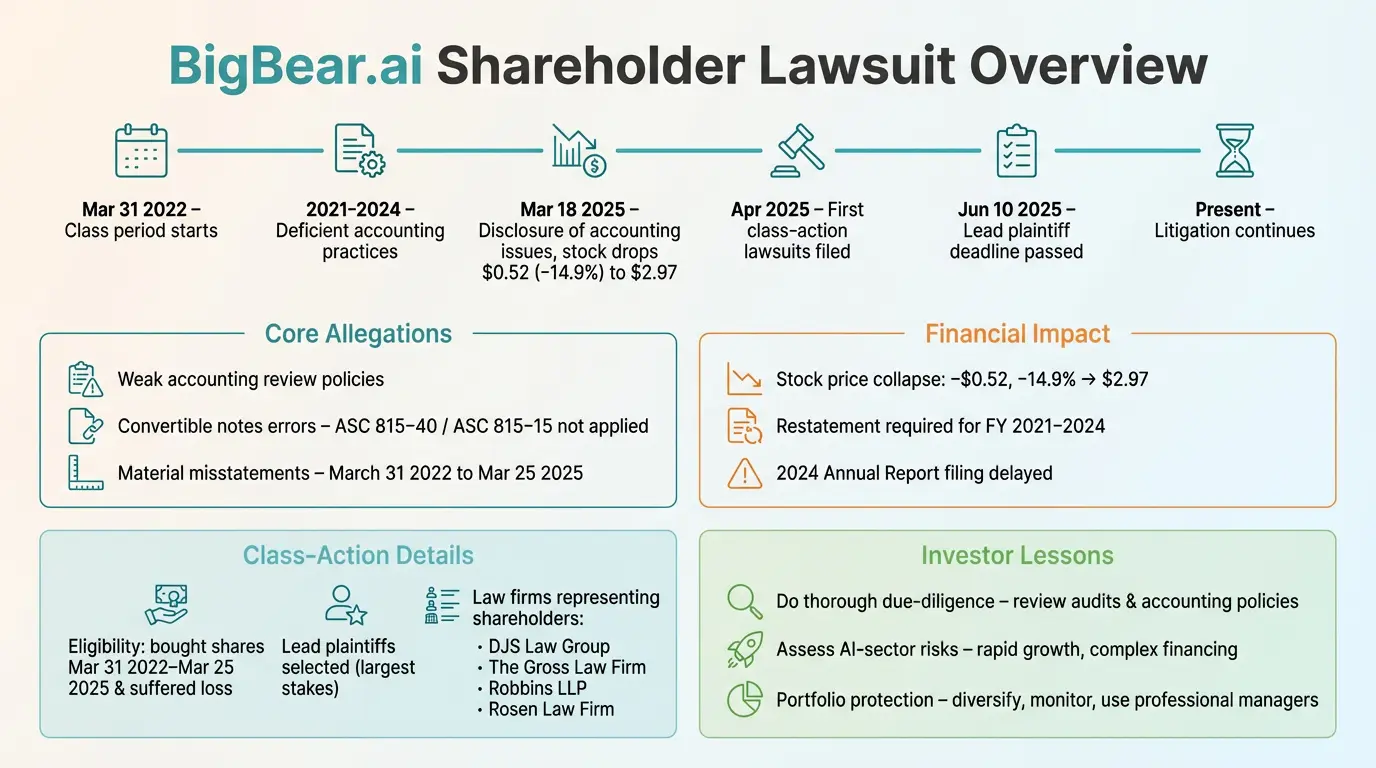
The timeline of this case is vital for any shareholder trying to determine if they are eligible for a claim. Most securities class actions have a “class period”—a specific window of time where the alleged fraud or misrepresentation took place. For BigBear.ai, this window is quite wide, stretching from March 31, 2022, all the way to March 25, 2025.
The real trouble started in mid-March 2025. On March 18, the company dropped a bombshell: they couldn’t file their annual report on time and admitted that their previous financial statements were essentially unreliable. The stock price didn’t just dip; it fell off a cliff, dropping nearly 15% in a single day. Another 9% drop followed just a week later when more details about the “material weaknesses” in their internal controls came to light.
By April 2025, the first major lawsuits were being filed in the U.S. District Court for the Eastern District of Virginia. Since then, the case has moved through the lead plaintiff selection process, a phase where the court chooses the investor with the largest loss to lead the charge for everyone else.
Key Allegations: What the Lawyers are Claiming
The lawyers representing the shareholders aren’t just unhappy about the stock price. They are making specific legal claims under the Securities Exchange Act of 1934. The primary argument is that BigBear.ai and its executives intentionally or recklessly misled the public. Below are the three main pillars of the BigBear AI class action lawsuit.
1. Deficient Internal Controls
In the corporate world, “internal controls” are the checks and balances that ensure financial data is accurate. The lawsuit claims BigBear.ai lacked these basic safeguards, especially for non-routine transactions. Imagine a bank that forgot to lock its vault every third Tuesday—that is essentially what the lawyers are claiming happened with the company’s accounting department.
2. Failure to Bifurcate Conversion Options
This is a technical term, but it’s the heart of the BigBear AI securities litigation. When you have a convertible note, the “option” to turn that debt into stock is often seen as a separate financial value. Accounting rules require companies to “bifurcate” or split these values on the books. The lawsuit alleges BigBear.ai failed to do this, leading to a distorted view of their financial obligations.
3. Materially False and Misleading Statements
Because the accounting was allegedly wrong, every quarterly and annual report issued during the class period is now under fire. Investors who bought shares between 2022 and 2025 did so under the impression that the company’s debt and equity were being reported accurately. The lawsuit argues that if the truth had been known, the stock would never have traded at those higher prices.
Financial Impact on BBAI Shareholders
The numbers involved in this case are sobering. When the news of the restatements hit the wires, the market cap of the company shrank by millions of dollars in a matter of hours. For a retail investor holding a few hundred shares, the loss might be a few thousand dollars. For institutional investors, the damages are in the millions.
One of the most frustrating parts of a situation like this is the “waiting game.” Once a lawsuit is filed, it can take years for a settlement or a verdict to be reached. In the meantime, the company has to spend enormous amounts of money on legal fees and restating their old financials, which takes even more focus away from their actual AI business.
| Event Date | Disclosure Type | Stock Price Reaction |
|---|---|---|
| March 18, 2025 | Delay of 10-K \& Non-reliance on old data | -14.9% Decline |
| March 25, 2025 | Official restatement \& Material weakness admit | -9.0% Decline |
| April 27, 2025 | Initial Fraud Lawsuit Filing | Market Volatility |
| June 10, 2025 | Lead Plaintiff Deadline | Legal Consolidation |
Law Firms Involved in the Litigation
Because the BigBear AI shareholder lawsuit involves such a high dollar amount and complex accounting, several of the top securities firms in the country have jumped in. These firms work on a contingency basis, meaning they only get paid if they win a settlement for the investors. Some of the most active firms include:
- Bleichmar Fonti \& Auld LLP (BFA Law): One of the lead firms pushing for accountability.
- The Rosen Law Firm: Well-known for representing individual retail investors in tech cases.
- Robbins LLP: Focused heavily on the fiduciary duties of the board of directors.
- Glancy Prongay \& Murray LLP: Investigating the 2026 note controversy specifically.
If you are an investor, you might have seen “press releases” from these firms urging you to contact them. This is standard procedure in a class action. They are looking for the “Lead Plaintiff,” which is usually the person or entity that lost the most money and is willing to represent the entire group in court.
What This Means for the Future of BigBear.ai
It is important to remember that a lawsuit doesn’t automatically mean a company is going under. BigBear.ai is still an active player in the AI space, providing services for national security and supply chain management. However, a shareholder lawsuit against BigBear AI of this magnitude creates a massive “cloud” over the company’s future.
Future investors will likely be much more cautious. The company will need to prove that they have completely overhauled their accounting department and that their 2026 obligations are fully understood. For more context on how companies manage these types of crises, you can look at resources like the U.S. Securities and Exchange Commission or professional analysis on Nasdaq.
I often tell people that the tech is only half the story in an AI company. The other half is the business infrastructure. If the “plumbing” of the company—the accounting and legal compliance—is broken, it doesn’t matter how good the AI is. The stock will still suffer.
Investor Rights and Eligibility for Recovery
If you held BBAI stock during the period in question, you might be wondering if you are part of this. Generally, if you bought shares between March 2022 and March 2025 and sold them at a loss (or still hold them at a significantly lower value), you are likely a member of the “class.”
You don’t necessarily have to hire your own lawyer to be part of the class action. If a settlement is reached, the law firm in charge will typically send out notices to all known shareholders with instructions on how to claim a piece of the settlement. However, if your losses are substantial—say, over $100,000—it is often worth speaking with a firm directly to discuss your options.
Common Pitfalls in Tech Sector Investing
The shareholder lawsuit against BigBear AI is a perfect example of why “due diligence” is more than just a buzzword. When we see a company growing fast in a hot sector like AI, it is easy to ignore the boring stuff like debt covenants and derivative accounting. But as we’ve seen here, those boring details are exactly what can sink a stock.
Many investors got caught in this because they focused on BigBear’s contracts with the government and ignored the red flags in the financial footnotes. Always look for:
- Consistent delays in filing annual reports.
- High turnover in the CFO or accounting positions.
- Complex debt instruments that aren’t clearly explained in plain English.
Conclusion: The Road Ahead for Shareholders
The BigBear AI shareholder lawsuit is far from over. As we move through 2026, we will likely see more discovery—the phase where lawyers get to look at the company’s internal emails and records. This often leads to either a dismissal of the case or a settlement offer.
For now, the best thing an investor can do is stay informed and keep records of all their trades. The AI sector remains one of the most exciting areas of the market, but it is also one of the most dangerous if you don’t keep an eye on the corporate governance behind the scenes. We will be watching the court filings closely as the BigBear AI class action lawsuit progresses toward a resolution.
Frequently Asked Questions (FAQs)
What is the main reason for the BigBear AI shareholder lawsuit?
The lawsuit alleges that BigBear.ai mismanaged its accounting for $200 million in convertible notes and lacked proper internal controls, leading to false financial statements and a massive stock price drop in early 2025.
Am I eligible to join the BigBear AI class action lawsuit?
If you purchased BigBear.ai (BBAI) securities between March 31, 2022, and March 25, 2025, and suffered a financial loss, you are generally considered part of the class and may be eligible for a future recovery.
How much did the stock drop because of these allegations?
The stock fell approximately 15% on March 18, 2025, after the company revealed it could not file its annual report and that previous financials were unreliable. It dropped another 9% shortly after following more disclosures.
Do I need to pay a lawyer to join the lawsuit?
No. Most securities class action firms work on a contingency fee basis. They only get paid a percentage of the final settlement or court award, so there is typically no out-of-pocket cost for the shareholders.
When is the deadline to take legal action?
The deadline to apply as a “Lead Plaintiff” was June 10, 2025. However, even if you missed that date, you can still participate as a class member in any eventual settlement reached by the lead counsel.
Also Read: AI GIS applications: Boost Spatial Insights for Smarter Decisions in 2026