



AI Food Description Generator: Boost Engagement and Sales in 2026

Discover how an AI food description generator can create mouth-watering menu items, boost SEO, and save time. Learn to use this powerful tool effectively.
The Dawn of Culinary Storytelling Through Artificial Intelligence
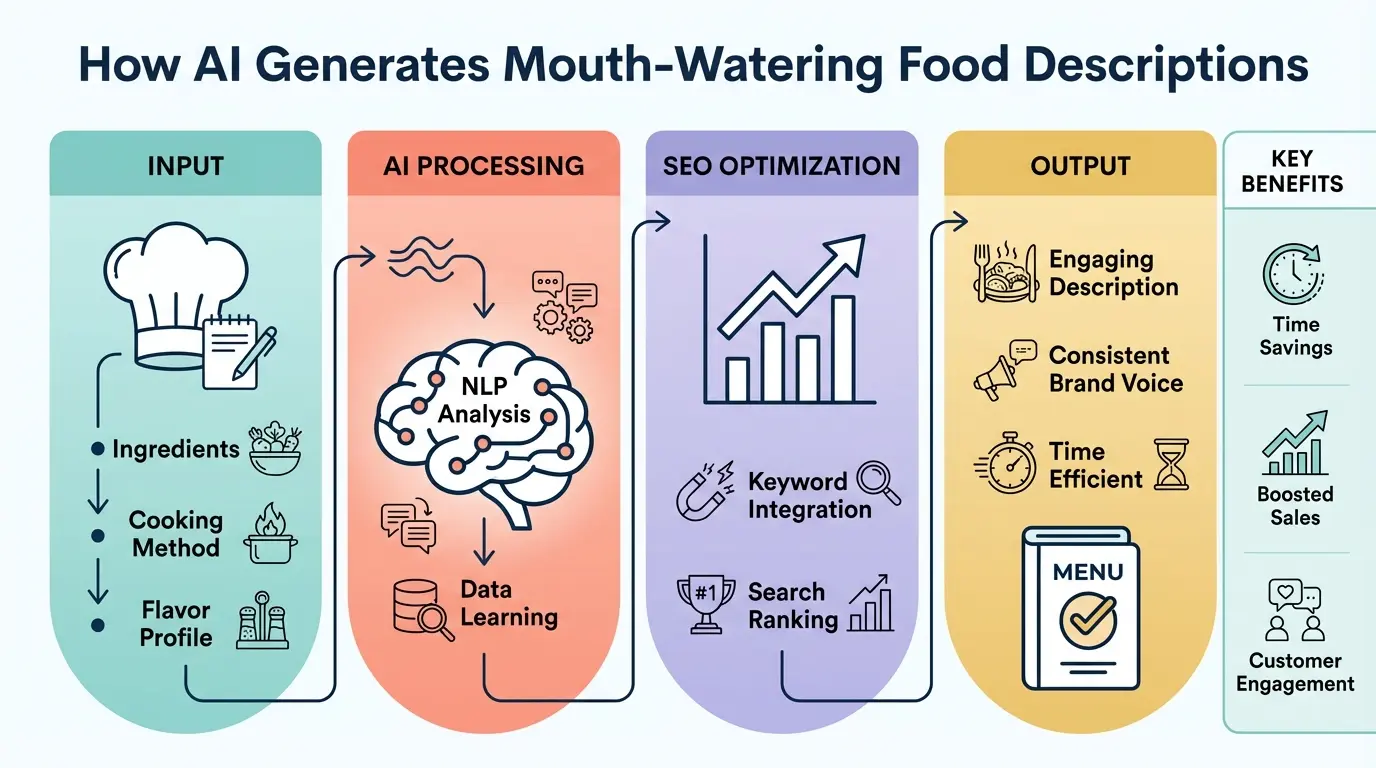
Artificial intelligence has permeated every aspect of the food industry, revolutionizing how we describe and present culinary creations. An AI food description generator represents a sophisticated fusion of natural language processing (NLP), machine learning algorithms, and vast culinary databases. These remarkable tools analyze diverse data points including ingredients, cooking techniques, cultural contexts, flavor profiles, and visual presentation to craft descriptions that rival those written by professional culinary writers.
The integration of image recognition capabilities takes this technology to astonishing heights. When presented with a photo of lasagna, the AI doesn’t merely identify it as pasta—it meticulously analyzes layering techniques, cheese browning patterns, sauce viscosity, and herb garnishes to spin descriptions like “oven-baked lasagna featuring five layers of hand-rolled pasta sheets interleaved with rich meat ragù and velvety béchamel sauce, crowned with a golden crust of aged Parmigiano-Reggiano and fresh basil chiffonade.” This precision transforms mundane menu listings into multisensory culinary journeys.
From Labor-Intensive Crafting to Intelligent Automation
Before the AI revolution, crafting compelling food descriptions demanded specialized skills and countless hours. Restaurant owners and marketers would agonize over individual menu items, testing adjectives and refining phrasing through endless iterations. Challenges included maintaining consistency across menu sections, scaling descriptions for extensive offerings, and balancing SEO requirements with engaging content—pain points that template-based automation failed to address with its generic, repetitive outputs.
The landscape transformed dramatically with breakthrough language models like GPT-3.5 and GPT-4. These transformer-based systems demonstrated unprecedented ability to generate human-like text tailored to specific contexts. Where manual processes required hours, AI accomplishes similar tasks in seconds—while maintaining brand voice consistency and built-in SEO optimization. Though early adopters faced challenges with overly artificial descriptions or missing dietary information, current iterations have overcome these hurdles through culinary-specific training datasets.
| Aspect | Manual Creation | AI Generation |
|---|---|---|
| Time per description | 15-45 minutes | 15-45 seconds |
| Consistency across menu | Variable | High |
| SEO optimization | Requires separate effort | Built-in |
| Multilingual capabilities | Requires translation services | Instant translation |
| Cost per 100 descriptions | $500-$2000 | $10-$50 |
Technological Underpinnings of Modern Food AI
Beneath the user-friendly interface of contemporary food description tools lies a sophisticated technological architecture. The foundational layer comprises extensive culinary databases containing millions of ingredient pairings, cooking methods, regional flavor profiles, and historical dish backgrounds—compiled from cookbooks, restaurant menus, food science publications, and crowd-sourced platforms. Layered atop this is specialized natural language processing trained exclusively on food writing, from Michelin-starred menus to popular food blogs, enabling nuanced understanding of culinary terminology.
State-of-the-art systems incorporate computer vision models that analyze food photography through convolutional neural networks (CNNs). When you upload a dish image, these networks identify components down to specific herb varieties and cooking techniques, combining visual analysis with NLP to generate descriptions referencing appearance. For instance, analyzing baked goods might yield descriptors like “a crisp, caramelized exterior giving way to a soft, air-centered crumb.” Some platforms even integrate nutritional databases to automatically include calorie counts and allergen information.
Deep Learning Architectures Powering Culinary Descriptions
The machine learning framework employs a hybrid approach—transformer models handle language generation while specialized classifiers ensure precision. A dish classifier might determine whether “tikka masala” should be presented as Indian or British-Indian based on recipe analysis. Flavor profile predictors analyze ingredient combinations to suggest optimal adjectives, distinguishing between “earthy” and “woodsy” for various mushroom preparations.
Training these systems requires massive, carefully curated datasets. Developers utilize techniques like few-shot learning to teach AI regional specialties with limited examples. Through reinforcement learning from human feedback (RLHF), professional culinary writers rate generated descriptions, progressively enhancing output quality. Contemporary systems capture subtle brand voice distinctions—producing playful, emoji-filled descriptions for food trucks versus formal French-accented text for fine dining establishments.
Transformative Impacts Across the Food Ecosystem
Adoption of AI description tools creates substantial value across the food industry spectrum. Restaurant owners experience dramatic reductions in content creation costs and accelerated menu development cycles. Marketing agencies serving the food sector can scale services without proportional staffing increases. Delivery platforms like Uber Eats leverage these tools to standardize merchant menu displays while preserving local character. Even food manufacturers benefit when generating e-commerce product descriptions where compelling copy directly impacts conversion rates.
The time savings prove revolutionary. Consider a mid-sized restaurant chain updating season menus across 50 locations—creating 30 new descriptions manually would consume 75-150 hours, while AI reduces this to 25 minutes of input plus one hour for review. Cost implications are staggering—reducing expenses from $0.50-$2 per word to pennies per item. For franchises operating on razor-thin margins, these efficiency gains significantly impact profitability.
Measurable Enhancements in Customer Engagement
Well-crafted descriptions extend beyond aesthetics to measurable outcomes. A/B testing by major food delivery platforms reveals AI-optimized descriptions increase order conversion by 12-18% compared to basic listings. Items with vivid descriptions receive 23% more digital menu clicks. Remarkably, establishments using sensory-rich AI descriptions see 15% higher average order values as customers gravitate toward premium-priced items perceived as higher quality.
These improvements stem from AI’s ability to trigger sensory imagination. Neuroscience research shows vivid food descriptions activate the same brain regions as actual tasting experiences. Descriptions like “the audible crunch of freshly toasted pecans” or “the velvety cascade of molten chocolate” create anticipatory pleasure that ingredient lists alone can’t match—directly translating to enhanced business performance.
Tailored Implementation Strategies Across Business Models
While core technology remains consistent, optimal implementation varies across food industry segments. Fine dining establishments should prioritize customization aligning with culinary philosophy—tools must understand nuanced concepts like “New Nordic cuisine” or “neo-bistro” approaches, providing appropriate descriptive outputs. Solutions offering style parameters prove most effective, allowing chefs to highlight seasonal sourcing or modernist techniques.
Quick-service restaurants (QSRs) require speed and standardization, focusing on rapid menu updates and consistent brand voice across locations. Integration with POS systems becomes critical—menu item updates in backend systems should auto-generate descriptions across digital platforms. Ideal QSR tools offer centralized control with regional customization options for localized variations.
Special Considerations for E-commerce Food Retailers
Selling food products online introduces additional complexity—descriptions must satisfy human readers and search algorithms simultaneously. Successful implementations balance SEO keyword integration with readability, employing schema markup for enhanced search visibility. AI must address regulatory requirements, automatically including FDA nutrition facts, allergen warnings, and compliant health claims.
Subscription meal kits benefit from AI-generated consistency across channels. The same system producing website copy can adapt descriptions for Instagram posts, email newsletters, and third-party marketplace listings while maintaining brand identity. Advanced users integrate AI tools with CMS platforms like Shopify for automatic description generation when adding new products.
Advanced Capabilities in Modern Culinary AI Platforms
Contemporary food AI tools offer capabilities exceeding basic text generation. Multi-modal systems combine image analysis with recipe data to suggest complementary menu items. Some platforms integrate nutritional calculators, automatically adding calorie counts and macronutrient breakdowns. International businesses benefit from real-time translation preserving nuances—distinguishing Mexican “crema” from French “crème fraîche” across markets.
Predictive analytics represent the cutting edge—analyzing historical sales data to identify converting phrases. The system might detect that “indulgent” outperforms “decadent” in dessert descriptions by 17%, auto-adjusting future outputs accordingly. Enterprise platforms integrate with inventory systems, highlighting ingredients needing promotion based on stock levels.
| Feature | Entry-Level Tools | Professional Tools | Enterprise Solutions |
|---|---|---|---|
| Core Description Generation | ✓ | ✓ | ✓ |
| Image Recognition | Basic | Advanced | Custom Models |
| Multilingual Support | 5-10 Languages | 20-30 Languages | 50+ Languages |
| POS Integration | ✗ | Limited | Full API Access |
| Predictive Analytics | ✗ | Basic | Advanced + Custom |
| SEO Optimization | Basic Keywords | Full SEO Suite | Competitor Analysis |
Brand Voice Personalization and Control
Advanced platforms address brand uniqueness concerns through robust customization options. Users upload style guides, sample menus, or existing marketing materials to train custom models. Tone adjustment sliders shift descriptions from casual to formal, while learning algorithms adopt editors’ persistent changes—such as consistently altering “delicious” to “delectable”—across future generations.
Multi-concept restaurant groups benefit most from enterprise solutions managing distinct brand voices. A hospitality group might operate a luxury steakhouse needing rich, opulent descriptions alongside a fast-casual taco chain requiring vibrant, energetic language. Leading solutions handle these variations through separate brand profiles within centralized dashboards.
Strategic SEO Implementation for Food Content
Food-centric SEO presents unique challenges distinct from standard practices. Food searches often involve long-tail queries (e.g., “gluten-free vegan desserts near me”) or seasonal trends (e.g., “summer BBQ sides”). Advanced AI tools incorporate location-based SEO, naturally integrating neighborhood references without artificiality. They also monitor trending ingredients (like “za’atar” or “yuzu”) to organically incorporate contemporary culinary movements.
Technical SEO requires equal attention. AI platforms should automate schema markup for recipes, including cook times and nutritional data where available. E-commerce products benefit from structured data enhancing search visibility via rich snippets and recipe carousels. Superior tools analyze competitors’ high-ranking pages to identify semantic keyword clusters, seamlessly integrating them without compromising readability.
Local SEO Techniques for Restaurants
Local search presents exclusive opportunities—AI description generators with local SEO features automatically incorporate regional landmarks and specialties. An Austin BBQ joint might reference “perfect pairing with a Shiner Bock” while Kansas City establishments mention “signature burnt ends.” These localized touches improve “near me” search performance while strengthening community ties.
These tools assist Google Business Profile optimization by generating post descriptions highlighting daily specials. Some platforms integrate with review systems, crafting responses incorporating frequent praise into updated menu items. Multi-location businesses maintain both local relevance and brand consistency geographically.
Ethical Implications and Potential Challenges
AI food description tools raise significant ethical considerations, particularly regarding accuracy. Descriptions must honestly represent dishes without misleading diners—overly enthusiastic text risks unrealistic expectations and customer dissatisfaction. Responsible platforms implement safeguards flagging claims exceeding input data support, such as questioning “rich truffle essence” for dishes containing minimal truffle oil.
Allergen information presents special challenges—while AI flags common allergens based on ingredients, it shouldn’t replace human verification. Best practices involve clear disclaimers requiring chef review for allergies. Emerging regulations increasingly govern AI-generated content in food contexts, necessitating awareness of evolving requirements.
Cultural Sensitivity in Global Culinary Marketing
Food descriptions navigate complex cultural landscapes—systems trained predominantly on Western cuisine may mishandle traditional dishes from other cultures. The term “authentic” proves problematic, potentially mislabeling fusion dishes or ignoring regional variations. Responsible platforms involve cultural consultants in training and allow specifying cultural context markers.
Culinary terminology translation requires special attention—direct translations often miss nuances. Sophisticated systems employ contextual explanations preserving terms like Italian “al dente” while describing the concept where equivalents lack. They balance preserving original terms (“dolcelatte—a sweet Italian blue cheese”) with finding appropriate cultural equivalents.
Restaurant Technology Stack Integration
Optimal value comes from seamless POS and CMS integrations. APIs enable two-way data flows—menu updates trigger description regeneration, while top-selling items highlighted by AI analytics prompt inventory notifications. Marketing stacks benefit similarly through native connections to email platforms and social media managers.
Browse AI drafting menu descriptions can simultaneously generate email campaigns and social media posts from singular inputs. This unified approach maintains cross-channel messaging consistency while saving workflow hours. Modern integrations now extend to review management systems and loyalty programs.
CRM Integration for Personalized Experiences
Forward-thinking establishments merge AI tools with CRM systems to personalize menus using order history. Regular spicy dish customers might see menu items emphasizing heat levels, while gluten-sensitive diners receive filtered listings. This hyper-personalization increases engagement while accommodating dietary needs.
Customer reactions provide valuable feedback—descriptions generating higher conversion rates inform future outputs. Over time, these systems evolve to match unique customer preferences, creating self-optimizing menu engines. Sales data linked to descriptive phrases enables continuous refinement.
Future Frontiers in Culinary AI
Emerging technologies promise continued food content revolution. Voice-to-text functionality will let chefs verbally describe dishes converted to polished descriptions. Augmented reality integrations may overlay menus with 3D visualizations accompanying AI-narrated descriptions. The next evolution involves multisensory descriptions incorporating sound and haptic feedback.
Generative AI will expand beyond text, creating complete marketing assets from single inputs. Inputting a dish photo could yield social media captions, blog post outlines, and even food styling advice. As accessibility grows, these tools democratize high-quality marketing—enabling street food vendors to craft descriptions rivaling Michelin establishments at minimal cost.
Sustainability and Traceability Narratives
Future systems will better articulate sustainability stories consumers crave. Integration with supply chain data allows automatic descriptors like “line-caught Alaskan cod” or “regeneratively farmed grains.” This transparency builds trust while rewarding ethical practices. Leading platforms now incorporate certifications and sourcing details into engaging descriptions rather than dry footnotes.
Blockchain verification may validate claims in real-time—a description stating “grass-fed beef” could link to ranch blockchain records verifying authenticity. For premium establishments, this justifies higher pricing while combating greenwashing—elevating AI from mere writer to ethical claims validator.
Practical Implementation Framework
Implementing AI description tools demands strategic execution beyond software purchase:
- Content Audit: Catalog existing descriptions noting strengths and gaps
- Voice Definition: Establish style guidelines with tone parameters
- System Integration: Connect POS, inventory, and nutritional databases
- Pilot Testing: Generate AI descriptions for select menu items
- Human Refinement: Culinary and marketing teams polish outputs
- Feedback Systems: Implement description performance tracking
- Complete Deployment: Roll out across entire menu ecosystem
- Continuous Optimization: Regular analytics reviews to refine strategy
Budget strategically—while AI slashes per-description costs, optimal results combine automation with human expertise. Allocate 20-30% of AI savings to professional editing of flagship items—ensuring premium quality where it matters most. Factor integration costs—while some tools plug easily into existing systems, complex tech stacks may require professional implementation assistance.
Staff Training for Maximum Impact
Successful deployment requires workforce adaptation. Front-of-house teams must understand how to verbally reinforce AI-generated phrases for menu consistency. Marketing staff need prompt engineering training—learning which inputs (ingredient lists, chef notes) yield best results. Establish clear oversight protocols—especially for dietary restrictions requiring absolute human verification.
Breaking Language Barriers: Multilingual Applications
AI food description generators demonstrate unparalleled value in multilingual environments. Unlike traditional translation that fails culinary terms (it’s “umami,” not simply “savory”), advanced systems adapt rather than literally translate. They might explain “je ne sais quoi” as “indescribable delight” in English while preserving original phrases in target languages.
Cultural adaptation transcends linguistics—descriptions successful in America may overwhelm Japanese diners with adjectives while German customers prefer technical precision. Superior platforms offer cultural parameters adjusting descriptive approaches—enabling global chains to maintain core messaging with regional presentations from single content databases.
| Culinary Term | Direct Translation | AI-Adapted Version |
|---|---|---|
| Al dente (Italian) | “To the tooth” | “Perfectly tender with pleasurable resistance” |
| Wok hei (Chinese) | “Wok breath” | “Distinctive smoky essence from searing heat” |
| Maillard reaction | Chemical process | “Flavor-enhancing caramelization from perfect searing” |
| Mise en place (French) | “Putting in place” | “Artfully arranged ingredients ready for preparation” |
Legal Compliance in AI-Generated Descriptions
AI food descriptions introduce special legal responsibilities. Menu claims (like “organic” or “gluten-free”) constitute legal representations requiring verification—top AI tools cross-reference ingredient databases to flag compliance issues. If describing a dish as “vegan” while containing honey, the system suggests alternatives like “plant-focused (contains honey).”
Nutritional labeling demands caution—even accurate AI estimates require professional verification per regulations. Safest approaches use AI descriptions alongside validated nutrition data with clear disclaimers where needed. Emerging compliance features will need vigilant tracking as food labeling regulations evolve globally—particularly regarding AI content disclosures.
Intellectual Property Protection Strategy
Businesses must clarify ownership rights to AI-generated content. Current U.S. copyright law doesn’t protect purely AI-generated text, but human-refined versions may qualify. AI service terms vary—some grant full user rights while others retain usage permissions. For signature dishes or proprietary recipes, consider trademarking distinctive descriptive phrases that become brand identifiers through consistent use.
Case Studies: Transformative Success Stories
A regional bakery chain with 12 locations implemented AI descriptions, transforming generic listings into artisanal narratives. “Chocolate chip cookie” became “hand-crafted chocolate chunk cookies featuring 72% single-origin Ecuadorian dark chocolate and sea-salted caramel swirls.” This rebranding supported 22% price increases alongside 15% sales growth, with website traffic surging 40% from improved SEO performance.
In meal kit delivery, a startup used AI to dynamically adapt descriptions to supply changes. When summer squash shortages occurred, the system automatically emphasized alternative vegetables in appetizing language—maintaining stable conversion rates during supply fluctuations. This adaptability proved invaluable in volatile markets.
Fine Dining Renaissance Through Narrative AI
A revered restaurant struggling with outdated menus used AI to weave history into contemporary presentations—describing “your grandmother’s beef Wellington reimagined with sous-vide precision and black truffle Périgueux sauce.” This storytelling approach boosted media coverage by 35% and pre-theater menu sales by combining culinary innovation and tradition.
Frequently Asked Questions (FAQs)
How do AI food description generators manage dietary restrictions accurately?
Contemporary systems integrate allergen databases flagging common restrictions like nuts or gluten based on ingredient inputs. Descriptions highlight allergy-friendly attributes where applicable, though human verification remains essential. Advanced platforms integrate with POS systems to flag potential cross-contamination risks needing disclosure.
Can AI food descriptions improve restaurant website SEO rankings?
Absolutely—AI tools optimize for food-specific search terms like “best [dish] in [city]” while balancing readability. Restaurant websites implementing AI-optimized descriptions typically see 25-50% organic traffic increases within months alongside higher rankings for competitive local searches.
What cost savings do AI food description generators provide?
Savings are dramatic—professional food writing costs $0.50-$2 per word versus $0.10-$0.50 per AI-generated description. Beyond cost reductions, AI delivers entire menus in minutes rather than days. Hybrid models combining AI efficiency with human editing maximize quality while preserving savings.
How do AI systems handle different culinary traditions accurately?
Leading platforms utilize specialized cultural datasets and user-controlled parameters. When describing Mexican mole, AI references authentic techniques learned from Oaxacan culinary texts. Global business solutions prevent generic approaches while maintaining brand voice—ensuring local resonance without appropriation.
Can AI food tools integrate with inventory management systems?
Yes—API integrations enable real-time descriptor updates when ingredients change. Modern systems predict shortages and pre-generate substitute descriptions. The most sophisticated platforms use sales data from description performance to trigger inventory alerts for popular items.
Also Read: AI Resume Screening in 2026: A Practical Guide to Navigating the Change