




ChatGPT Need Birthday: Hidden Privacy Risks & Simple Protection Tips

Wondering why ChatGPT suddenly needs your birthday? ChatGPT Need Birthday and you are not alone. It feels a bit like a digital surprise party where you were not exactly expecting an invite. This guide breaks down why OpenAI asks for your birthdate, the legal safety nets behind it, and how it actually changes your experience with the AI.
The Real Reasons Behind the ChatGPT Birthday Prompt
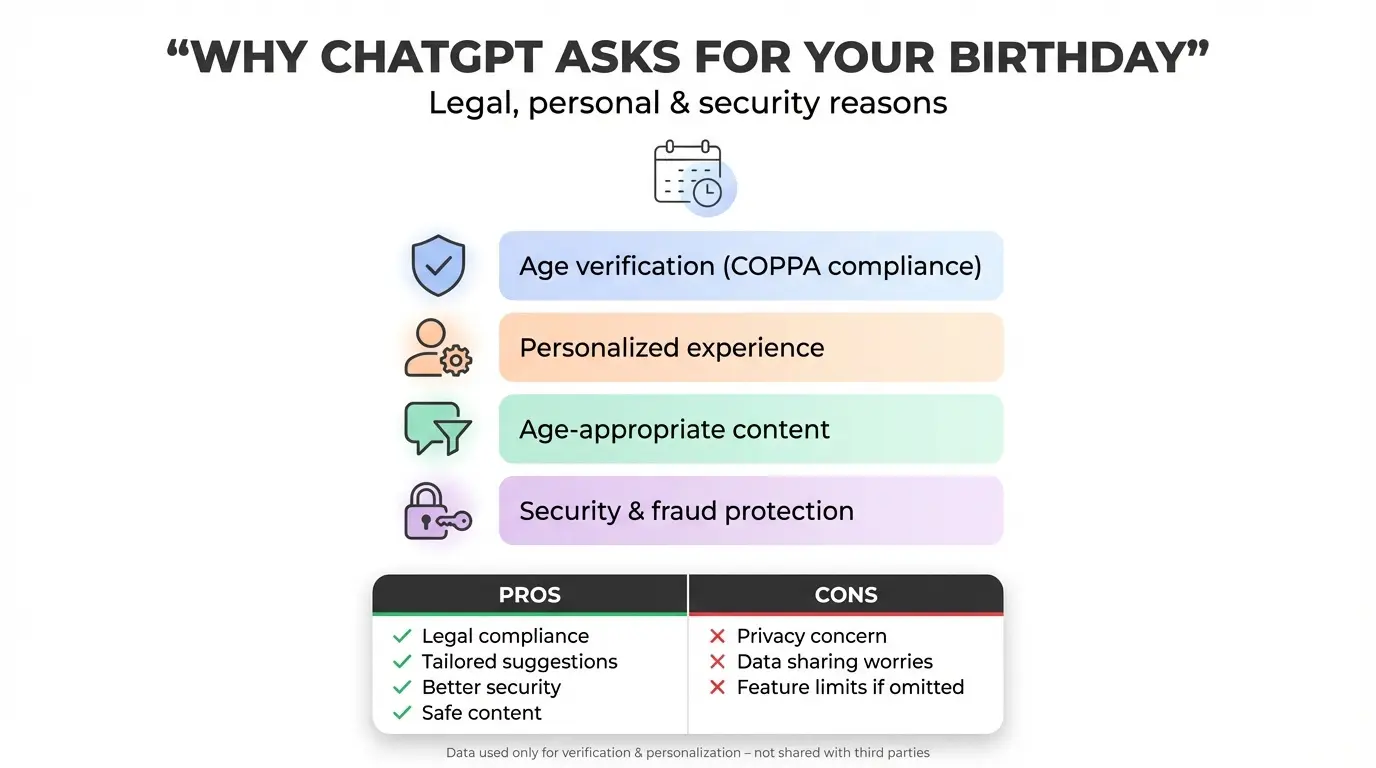
If you have logged into OpenAI recently, you might have been met with a pop-up asking for your date of birth. While it might feel like another piece of data being collected, there is a very specific set of reasons why this is happening now. It is less about being nosy and more about staying on the right side of global laws.
Digital privacy is a hot topic, and for a massive platform like ChatGPT, knowing the age of its users is no longer optional. Let us look at the core drivers behind this requirement.
1. Legal Compliance and COPPA
The biggest driver is a law called the Children’s Online Privacy Protection Act, or COPPA. This is a U.S. federal law designed to protect the privacy of children under 13. It requires companies to get verifiable parental consent before collecting any personal info from kids. By asking for your birthday, OpenAI is essentially drawing a line in the sand to ensure they are following these strict legal frameworks.
2. Safety and Age-Appropriate Content
AI can talk about almost anything, but that does not mean everything is suitable for everyone. A 14-year-old using the tool for homework needs a different safety layer than a 40-year-old researcher. Knowing your age helps the system apply the right filters so that younger users are not exposed to sensitive or mature topics accidentally.
How Age Verification Changes the User Experience
When you provide your birthdate, the AI does not just store it in a vault. It actually uses that data to “contextualize” your account. Think of it like a movie rating system; it ensures the “rated R” parts of the internet do not bleed into a “PG” user session.
Beyond safety, there is a functional side to this. For example, if the system knows you are a student, it might prioritize educational resources. If it knows you are an adult, it won’t be as restrictive when you ask for complex medical or legal summaries (though it still isn’t a substitute for a professional).
Does OpenAI Share This Data?
Privacy is the elephant in the room. According to OpenAI’s current policies, your birthday is used for verification and safety, not for building an advertising profile to sell you birthday cake 11 months from now. They use high-level encryption to keep this data secure, which is a standard practice for tech giants handling millions of users.
Practical Implications of Providing Your Birthday
You might be thinking, “What if I just put in a fake date?” While people do this all the time on the internet, it can lead to some annoying issues down the road. If you ever lose access to your account, your birthday is often used as a secondary verification method to prove you are the real owner.
If you put in a random date and forget it, you might find yourself locked out of your own account permanently. It is a small detail that has a big impact on account security.
Table: Comparing the Pros and Cons of Sharing Your Birthday
Is it worth it? Let’s look at the breakdown of what you get versus what you give up.
| Aspect | Benefits of Providing Birthday | Potential Concerns |
|---|---|---|
| Legal | Ensures your account stays active and compliant. | Feeling like “Big Tech” knows too much. |
| Security | Acts as a backup for account recovery. | Risk of data breach (though encrypted). |
| Experience | Tailored, age-appropriate content filters. | Stricter limits for younger users. |
| Reliability | Prevents accidental bans for age violations. | Inability to change it easily later. |
Why ChatGPT Asks for Birthday Verification Now
You might wonder why this wasn’t always a thing. In the early days, ChatGPT was more of a “beta” experiment. As it has become a household name used by millions of students and professionals, the scrutiny from regulators in the EU and the US has skyrocketed. Regulators want to ensure that AI companies are not scraping data from minors without a clear audit trail.
International Laws and GDPR
While COPPA covers the US, the GDPR (General Data Protection Regulation) in Europe has its own set of rules. In some regions, the age of consent for data collection is 16. By implementing a global birthday prompt, OpenAI creates a unified way to handle these varying international requirements without having to build a different version of the site for every country.
What Happens If You Skip the Birthday Prompt?
Eventually, the “Skip” button usually disappears. If you choose not to provide your birthday, you will likely find your account temporarily suspended or restricted. This isn’t OpenAI being mean; it’s them protecting themselves from massive fines. If they can’t prove you are of legal age to use the service, they can’t legally provide it to you.
A Real-World Example
I recently spoke with a user who tried to bypass the prompt by entering a date that made them appear under 13. Their account was instantly locked. They had to go through a lengthy process with support to prove their actual age just to get their chat history back. It is a lot of headache for a five-second task.
Protecting Your Privacy on ChatGPT
If you are still nervous about sharing personal details, there are ways to keep your footprint small. You don’t have to give your life story in your prompts. Use the birthday verification to secure the account, but then utilize the “Temporary Chat” feature or turn off “Chat History & Training” in your settings. This ensures that while they know your age for legal reasons, they aren’t using your private conversations to train the next model.
For more details on how these laws work, you can check out the Official FTC COPPA FAQ or read through OpenAI’s Privacy Policy to see exactly how they handle your data.
Frequently Asked Questions (FAQs)
Why does ChatGPT need my birthday?
ChatGPT asks for your birthday primarily to comply with online privacy laws like COPPA and GDPR. It ensures that the platform is not illegally collecting data from children under the age of 13 without parental consent.
Can I change my birthday after I enter it?
Currently, it is quite difficult to change your birthdate once it is set in your OpenAI account. You may need to contact their support team and provide verification if you made a mistake during the initial setup.
What is the minimum age to use ChatGPT?
In most regions, the minimum age is 13. However, if you are between 13 and 18, you technically need parental permission to use the service, depending on your local jurisdiction’s specific regulations.
Does providing my birthday affect the AI’s answers?
Yes, to an extent. The AI uses your age to apply safety filters. Younger users will have more restrictive filters to prevent exposure to mature or inappropriate content that an adult might otherwise be able to access.
Is my birthdate visible to other users?
No, your birthday is private data used only for account verification and legal compliance. It is not displayed on your profile or shared with other people you might interact with on the platform.
Also Read: AI Writing vs Human Writing: The Critical Choice for 2026