




AI 5 340 vs i3 1315U: The Critical Flaw in Budget Laptops for 2026
AMD Ryzen AI 5 340 vs Intel Core i3-1315U: Comprehensive Processor Comparison
Choosing between the AMD Ryzen AI 5 340 and Intel Core i3-1315U processors can be challenging, especially when you’re looking for the perfect balance of performance, efficiency, and value in your next laptop. This comprehensive comparison will help you understand the key differences, strengths, and ideal use cases for each processor, ensuring you make an informed decision for your specific needs.
Understanding the Processor Landscape
Before diving into the specifics, it’s important to understand where these processors fit in the current market. The AMD Ryzen AI 5 340 represents AMD’s latest generation of mobile processors, incorporating advanced AI capabilities and efficient architecture. The Intel Core i3-1315U, on the other hand, is part of Intel’s Raptor Lake-U series, designed for budget-friendly and ultraportable laptops.
The fundamental difference between these processors lies in their target audience and design philosophy. AMD’s Ryzen AI 5 340 is built for users who need more processing power, while Intel’s i3-1315U focuses on energy efficiency and affordability for everyday computing tasks.
Architecture and Manufacturing Process
AMD Ryzen AI 5 340 Architecture
The AMD Ryzen AI 5 340 is built on TSMC’s 4nm process technology, representing the cutting edge of semiconductor manufacturing. This advanced process node allows for better power efficiency, higher clock speeds, and improved thermal performance. The processor features a sophisticated chiplet design that separates different components for optimal performance and efficiency.
AMD’s Zen 4 architecture, which powers the Ryzen AI 5 340, includes significant improvements in instruction per clock (IPC) performance compared to previous generations. This means the processor can complete more tasks in less time, making it more efficient overall. The architecture also includes dedicated AI accelerators that can handle machine learning tasks without burdening the main CPU cores.
Intel Core i3-1315U Architecture
The Intel Core i3-1315U utilizes Intel’s 7nm Enhanced SuperFin process, which is actually a refined 10nm process. While this is a mature and reliable technology, it doesn’t offer the same power efficiency benefits as AMD’s more advanced 4nm process. The processor uses Intel’s Raptor Lake-U architecture, which builds upon the previous Alder Lake design with some optimizations.
The i3-1315U features a hybrid architecture with Performance-cores (P-cores) and Efficient-cores (E-cores). This design allows the processor to handle different types of workloads more efficiently by assigning tasks to the appropriate core type based on their requirements.
Core Configuration and Thread Count
Ryzen AI 5 340 Core Layout
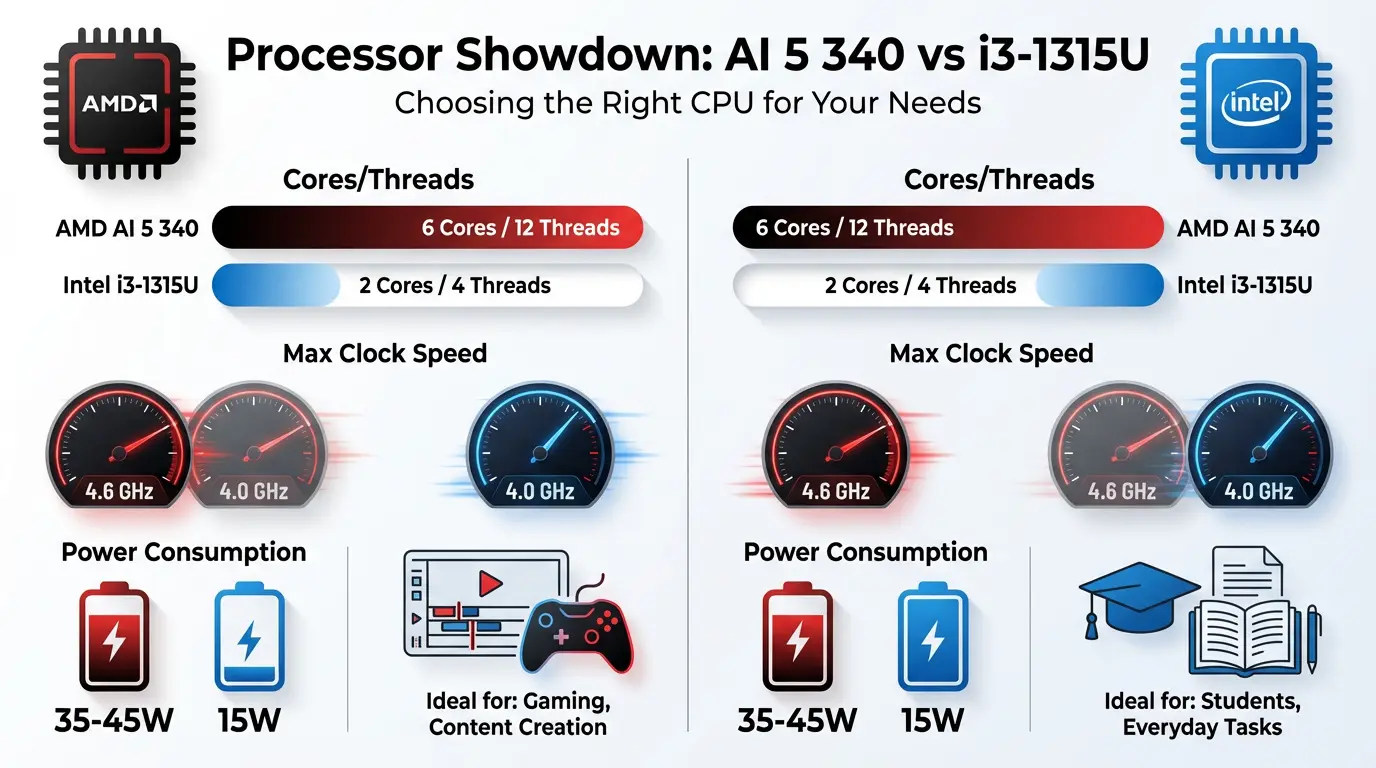
The AMD Ryzen AI 5 340 features 6 cores and 12 threads, utilizing simultaneous multithreading (SMT) technology. This configuration provides excellent multitasking capabilities and can handle demanding applications with ease. The processor includes a balanced mix of high-performance and efficiency cores, though AMD doesn’t use the same P-core/E-core terminology as Intel.
The 6-core, 12-thread configuration is particularly beneficial for users who frequently run multiple applications simultaneously or work with software that can utilize multiple CPU threads effectively. This includes video editing, 3D rendering, and modern gaming applications.
i3-1315U Core Layout
The Intel Core i3-1315U features 2 Performance-cores and 4 Efficient-cores, totaling 6 cores with 8 threads. This hybrid architecture allows the processor to handle basic tasks efficiently while still providing some capability for more demanding workloads when needed.
The 2+4 core configuration is designed for ultrabooks and budget laptops where battery life and thermal efficiency are prioritized over raw performance. While this setup can handle everyday computing tasks well, it may struggle with more demanding applications that benefit from higher core counts.
Clock Speeds and Performance
Ryzen AI 5 340 Clock Specifications
The AMD Ryzen AI 5 340 features a base clock speed of 2.0 GHz, with the ability to boost up to 4.8 GHz under optimal conditions. This high boost clock speed allows the processor to deliver excellent single-threaded performance, which is crucial for many applications and games.
The processor also includes Precision Boost technology, which dynamically adjusts clock speeds based on workload, temperature, and power constraints. This intelligent boosting system ensures that the processor delivers optimal performance while maintaining thermal efficiency.
i3-1315U Clock Specifications
The Intel Core i3-1315U has a base clock speed of 1.2 GHz for the Performance-cores and 0.9 GHz for the Efficient-cores. The processor can boost up to 4.5 GHz on the P-cores, which is slightly lower than the Ryzen AI 5 340’s maximum boost clock.
While the lower base clock might seem concerning, Intel’s turbo boost technology ensures that the processor can still deliver adequate performance when needed. The i3-1315U’s clock speed characteristics make it well-suited for light workloads and extended battery life scenarios.
Cache Memory and Storage
Ryzen AI 5 340 Cache Configuration
The AMD Ryzen AI 5 340 features a sophisticated cache hierarchy designed to minimize latency and maximize performance. The processor includes 80KB of L1 cache per core, 1MB of L2 cache per core, and 16MB of shared L3 cache. This generous cache configuration helps reduce the need to access slower main memory, improving overall system responsiveness.
The large L3 cache is particularly beneficial for applications that work with large datasets or require frequent access to the same data. This includes content creation applications, databases, and some gaming scenarios where quick access to game assets is crucial.
i3-1315U Cache Configuration
The Intel Core i3-1315U features 80KB of L1 cache per core, 1.25MB of L2 cache per Performance-core, and 10MB of shared L3 cache. While the L1 cache is comparable to the Ryzen AI 5 340, the i3-1315U has slightly less L2 cache per core and a smaller total L3 cache.
The cache configuration of the i3-1315U is still adequate for its target use cases, providing good performance for everyday computing tasks and light productivity work.
Power Consumption and Thermal Design
Ryzen AI 5 340 Power Characteristics
The AMD Ryzen AI 5 340 has a Thermal Design Power (TDP) of 28 watts, which is relatively modest for a processor of its capabilities. However, the actual power consumption can vary significantly based on workload, with the processor potentially consuming more power during intensive tasks.
The 4nm manufacturing process helps keep power consumption in check, but users should expect some trade-offs in terms of battery life compared to more power-efficient processors. Laptops with the Ryzen AI 5 340 typically include robust cooling solutions to handle the processor’s thermal output during sustained workloads.
i3-1315U Power Characteristics
The Intel Core i3-1315U has a TDP of just 15 watts, making it an extremely power-efficient processor. This low power consumption is ideal for ultrabooks and budget laptops where battery life is a primary concern. The processor’s efficient design allows it to deliver adequate performance while consuming minimal power.
The lower TDP means that laptops with the i3-1315U can be designed with thinner, lighter cooling solutions, contributing to more portable and affordable devices. The power efficiency also translates to longer battery life in typical usage scenarios.
Integrated Graphics Capabilities
Ryzen AI 5 340 Integrated Graphics
The AMD Ryzen AI 5 340 features the Radeon 840M integrated graphics solution, which provides significantly better graphics performance compared to Intel’s UHD Graphics found in the i3-1315U. The Radeon 840M includes 12 compute units and can boost up to 2.5 GHz, offering substantial graphics processing capabilities.
This integrated graphics solution is capable of handling light gaming, video playback at higher resolutions, and some content creation tasks without requiring a dedicated graphics card. The improved graphics performance makes the Ryzen AI 5 340 a more versatile option for users who occasionally need graphics processing power.
i3-1315U Integrated Graphics
The Intel Core i3-1315U features Intel UHD Graphics, which provides basic graphics capabilities suitable for everyday tasks like web browsing, document editing, and video playback. While adequate for these use cases, the UHD Graphics solution is not designed for demanding graphics applications or gaming.
The UHD Graphics in the i3-1315U can handle up to 4K resolution output and supports hardware acceleration for video decoding, making it suitable for media consumption. However, users who need more graphics processing power will likely need to consider a processor with better integrated graphics or a dedicated graphics card.
Memory Support and Configuration
Ryzen AI 5 340 Memory Support
The AMD Ryzen AI 5 340 supports DDR5 memory with speeds up to 5600 MT/s, as well as LPDDR5 for mobile devices. This support for the latest memory technologies ensures that the processor can take advantage of faster memory speeds for improved overall system performance.
The processor supports dual-channel memory configuration, which provides better memory bandwidth compared to single-channel setups. This is particularly beneficial for applications that are sensitive to memory bandwidth, such as content creation software and some games.
i3-1315U Memory Support
The Intel Core i3-1315U supports DDR5-5200 and DDR4-3200 memory, providing flexibility in terms of memory choice. The processor also supports LPDDR4x-4267, which is commonly used in ultrabooks for its power efficiency benefits.
Like the Ryzen AI 5 340, the i3-1315U supports dual-channel memory configuration. The memory support is adequate for the processor’s target use cases, though the maximum supported memory speed is slightly lower than what the Ryzen AI 5 340 can achieve.
Connectivity and Expansion
Ryzen AI 5 340 Connectivity Features
The AMD Ryzen AI 5 340 includes support for PCIe 4.0, which provides faster data transfer speeds for compatible devices like NVMe SSDs and graphics cards. The processor supports up to 16 PCIe lanes, offering good flexibility for system expansion and high-speed storage options.
The processor also includes support for the latest USB standards, including USB 4.0, which provides versatile connectivity options and high data transfer rates. The comprehensive connectivity support makes the Ryzen AI 5 340 suitable for a wide range of computing scenarios.
i3-1315U Connectivity Features
The Intel Core i3-1315U supports PCIe 4.0 with up to 8 lanes, which is adequate for most laptop configurations but less than what the Ryzen AI 5 340 offers. The processor includes support for modern USB standards and other connectivity features expected in contemporary laptops.
While the connectivity options are sufficient for the processor’s target market, users who need maximum expansion capabilities or the fastest storage options might find the Ryzen AI 5 340 more suitable.
AI and Machine Learning Capabilities
Ryzen AI 5 340 AI Features
One of the standout features of the AMD Ryzen AI 5 340 is its dedicated AI processing capabilities. The processor includes a built-in AI engine that can accelerate machine learning tasks, providing benefits for applications that utilize AI features.
These AI capabilities can enhance various aspects of computing, including improved video conferencing with background blur and auto-framing, better power management through intelligent workload distribution, and enhanced security features like facial recognition. The AI engine can also accelerate certain creative applications that support AI-powered features.
i3-1315U AI Features
The Intel Core i3-1315U includes Intel’s AI Boost technology, which provides some level of AI acceleration. However, the AI capabilities are not as advanced or as powerful as those found in the AMD Ryzen AI 5 340.
While the i3-1315U can still handle basic AI-enhanced features, it may struggle with more demanding AI workloads or applications that heavily rely on machine learning acceleration. This is an area where the Ryzen AI 5 340 has a clear advantage.
Performance in Real-World Scenarios
Productivity and Office Work
For everyday productivity tasks like document editing, web browsing, and email management, both processors perform adequately. However, the AMD Ryzen AI 5 340 provides a more responsive experience when handling multiple applications simultaneously or working with larger files.
The i3-1315U is perfectly capable of handling basic office work and is well-suited for users who primarily use their laptops for document creation, spreadsheet work, and web-based applications. The lower power consumption also means longer battery life during these tasks.
Content Creation and Media Editing
When it comes to content creation tasks like photo editing, video editing, or audio production, the AMD Ryzen AI 5 340 significantly outperforms the i3-1315U. The additional cores, higher clock speeds, and better integrated graphics make a substantial difference in these applications.
Video editing in particular benefits greatly from the Ryzen AI 5 340’s capabilities, with faster rendering times and smoother playback of high-resolution content. The i3-1315U can handle basic photo editing but may struggle with more demanding creative tasks or longer video projects.
Gaming Performance
For gaming, the AMD Ryzen AI 5 340 is the clear winner due to its superior integrated graphics and overall processing power. While neither processor is designed for high-end gaming, the Ryzen AI 5 340 can handle many modern games at lower settings, whereas the i3-1315U is limited to very basic or older games.
The Radeon 840M integrated graphics in the Ryzen AI 5 340 provides a significantly better gaming experience compared to Intel’s UHD Graphics, making it a more versatile option for users who want some gaming capability without a dedicated graphics card.
Price and Value Considerations
Ryzen AI 5 340 Pricing
The AMD Ryzen AI 5 340 typically comes in slightly more expensive laptops compared to those with the Intel i3-1315U. However, the price premium is often justified by the significantly better performance and features offered by the processor.
When considering the total value proposition, the Ryzen AI 5 340 provides better long-term value for users who need more processing power or plan to keep their laptop for several years. The more advanced architecture also means the processor is better equipped to handle future software requirements.
i3-1315U Pricing
The Intel Core i3-1315U is found in more budget-friendly laptops, typically starting at lower price points than those with the Ryzen AI 5 340. This makes it an attractive option for users who need basic computing capabilities without a significant investment.
For users with limited budgets or those who only need a laptop for basic tasks, the i3-1315U offers excellent value. The lower price point also makes it a good choice for students, casual users, or as a secondary device.
Ideal Use Cases for Each Processor
Best Applications for Ryzen AI 5 340
The AMD Ryzen AI 5 340 is ideal for users who need a balance of performance and efficiency. This includes content creators who work with photos and videos, students who run multiple applications simultaneously, professionals who need reliable performance for productivity software, and anyone who wants a laptop that can handle both work and entertainment effectively.
The processor is also well-suited for users who want some gaming capability without investing in a dedicated gaming laptop, as well as those who work with AI-enhanced applications or want to future-proof their purchase.
Best Applications for i3-1315U
The Intel Core i3-1315U is perfect for users with basic computing needs. This includes students who primarily use their laptops for note-taking and research, office workers who mainly use productivity software, seniors who need a simple and reliable device for web browsing and communication, and anyone looking for an affordable laptop for everyday tasks.
The processor is also ideal for users who prioritize battery life and portability over raw performance, as well as those who want a reliable device for media consumption and light productivity work.
Future-Proofing and Longevity
Ryzen AI 5 340 Longevity
The AMD Ryzen AI 5 340 offers better future-proofing due to its more advanced architecture and capabilities. As software becomes more demanding and incorporates more AI features, the additional processing power and AI acceleration will become increasingly valuable.
The processor’s support for the latest memory technologies and connectivity standards also means it can accommodate future upgrades and peripherals more effectively. Users who choose the Ryzen AI 5 340 can expect their laptop to remain capable for a longer period before feeling outdated.
i3-1315U Longevity
While the Intel Core i3-1315U is perfectly capable of handling current software requirements, it may show its limitations sooner as applications become more demanding. The processor’s more modest specifications mean it might struggle with newer software releases or more complex workloads in the coming years.
However, for users with basic computing needs, the i3-1315U should remain adequate for its intended use cases for several years. The lower power consumption also means the battery should maintain good health over time.
Heat Generation and Cooling Requirements
Ryzen AI 5 340 Thermal Management
The AMD Ryzen AI 5 340 generates more heat than the i3-1315U due to its higher performance capabilities and TDP. This means laptops with this processor typically require more robust cooling solutions, which can impact the device’s size, weight, and noise levels.
Under heavy workloads, users might notice more fan activity or higher surface temperatures on laptops with the Ryzen AI 5 340. However, modern cooling solutions are generally effective at managing the processor’s thermal output without causing significant discomfort.
i3-1315U Thermal Management
The Intel Core i3-1315U generates less heat due to its lower power consumption, allowing for simpler and quieter cooling solutions. This contributes to thinner, lighter laptop designs and can result in devices that run cooler and quieter during typical usage.
The lower heat generation also means the processor is less likely to experience thermal throttling under sustained workloads, maintaining consistent performance without the need for aggressive cooling measures.
Software Compatibility and Optimization
Ryzen AI 5 340 Software Support
The AMD Ryzen AI 5 340 benefits from good software support, with most modern applications optimized to take advantage of its capabilities. The processor’s architecture is well-supported by popular operating systems, productivity suites, and creative applications.
AMD’s software ecosystem includes tools for monitoring and optimizing performance, as well as drivers that ensure compatibility with a wide range of hardware and peripherals. The processor’s advanced features are increasingly being utilized by software developers, particularly for AI-enhanced applications.
i3-1315U Software Support
The Intel Core i3-1315U enjoys excellent software compatibility due to Intel’s dominant market position. Most software is thoroughly tested on Intel processors, ensuring reliable performance across a wide range of applications.
Intel’s extensive software support includes optimization tools, drivers, and compatibility layers that ensure smooth operation with various operating systems and applications. The processor’s architecture is particularly well-optimized for Windows-based systems.
Environmental Impact and Sustainability
Ryzen AI 5 340 Environmental Considerations
The AMD Ryzen AI 5 340’s 4nm manufacturing process is more efficient in terms of the number of transistors per wafer, potentially reducing the environmental impact per unit of performance. However, the higher performance capabilities may lead to increased energy consumption during intensive tasks.
AMD has made commitments to sustainability, including goals for reducing greenhouse gas emissions and improving energy efficiency across their product lines. The company also focuses on responsible sourcing of materials and improving the recyclability of their products.
i3-1315U Environmental Considerations
The Intel Core i3-1315U’s lower power consumption contributes to reduced energy usage over the lifetime of a device, which can have positive environmental implications. The processor’s efficiency also means less cooling is required, potentially reducing the overall environmental impact of the laptop.
Intel has also implemented various sustainability initiatives, including efforts to reduce their carbon footprint and improve the energy efficiency of their processors. The company focuses on creating products that balance performance with environmental responsibility.
Making Your Decision: Which Processor is Right for You?
Choosing between the AMD Ryzen AI 5 340 and Intel Core i3-1315U ultimately depends on your specific needs, budget, and priorities. To help you make the best decision, consider the following factors:
Choose AMD Ryzen AI 5 340 if:
- You need better performance for multitasking and demanding applications
- You work with content creation, media editing, or other processor-intensive tasks
- You want some gaming capability without a dedicated graphics card
- You value advanced AI features and future-proofing
- You’re willing to invest in better performance for long-term value
Choose Intel Core i3-1315U if:
- You have basic computing needs like web browsing, document editing, and media consumption
- You prioritize battery life and portability over raw performance
- You’re working with a limited budget
- You need a reliable device for everyday tasks without complexity
- You prefer a simpler, more straightforward computing experience
Conclusion: The Processor That Fits Your Needs
The comparison between the AMD Ryzen AI 5 340 and Intel Core i3-1315U reveals two processors designed for different market segments and user needs. The Ryzen AI 5 340 offers superior performance, better integrated graphics, and advanced AI capabilities, making it ideal for users who need more processing power and versatility. The i3-1315U, while more modest in its specifications, provides excellent value for users with basic computing needs and prioritizes efficiency and affordability.
Both processors represent the current state of mobile computing technology, each excelling in their respective target markets. By understanding your specific requirements and considering factors like performance needs, budget constraints, and future usage plans, you can choose the processor that will provide the best experience for your computing needs.
Remember that the processor is just one component of a laptop, and factors like display quality, storage type, RAM capacity, and build quality also significantly impact the overall user experience. Consider the complete package when making your final decision to ensure you get a device that meets all your requirements.
Frequently Asked Questions (FAQs)
Which processor is better for everyday use?
For basic everyday tasks like web browsing, email, and document editing, both processors perform adequately. However, the Intel Core i3-1315U is more than sufficient for these tasks and offers better battery life. The AMD Ryzen AI 5 340 provides more headroom for multitasking and occasional demanding tasks, making it a better choice if you want a more responsive experience for everyday use.
Can the Intel i3-1315U handle gaming?
The Intel Core i3-1315U has very limited gaming capabilities due to its basic integrated graphics. It can handle very simple or older games at low settings, but struggles with modern titles. For any serious gaming, you would need a dedicated graphics card or a more powerful processor with better integrated graphics like the AMD Ryzen AI 5 340.
Is the Ryzen AI 5 340 worth the extra cost?
The AMD Ryzen AI 5 340 is worth the extra cost if you need the additional performance for tasks like content creation, multitasking with demanding applications, or want some gaming capability. If your computing needs are basic and you prioritize battery life and affordability, the Intel Core i3-1315U offers better value for money.
How long will these processors remain relevant?
The AMD Ryzen AI 5 340 should remain relevant for 4-6 years for most users due to its more advanced architecture and capabilities. The Intel Core i3-1315U may show its limitations sooner, potentially within 3-4 years, especially as software becomes more demanding. However, for basic computing tasks, the i3-1315U will likely remain adequate for its intended use cases for a similar timeframe.
Which processor is better for students?
For students, the choice depends on their specific needs. The Intel Core i3-1315U is excellent for students who primarily need a laptop for note-taking, research, and basic productivity tasks. The AMD Ryzen AI 5 340 is better for students who work with multimedia, run demanding applications, or want a more versatile device that can handle both academic and entertainment needs effectively.
Can I upgrade from one processor to another later?
In most laptops, the processor is soldered to the motherboard and cannot be upgraded. If you think you might need more performance in the future, it’s better to choose the more capable processor (AMD Ryzen AI 5 340) from the beginning rather than planning to upgrade later.
How do these processors compare in terms of heat generation?
The AMD Ryzen AI 5 340 generates more heat due to its higher performance capabilities and 28W TDP compared to the Intel Core i3-1315U’s 15W TDP. This means laptops with the Ryzen AI 5 340 typically require more robust cooling solutions and may run warmer or louder under heavy loads. The i3-1315U runs cooler and quieter, making it more suitable for thin and light designs.
Which processor is better for video editing?
The AMD Ryzen AI 5 340 is significantly better for video editing due to its higher core count, better multi-threaded performance, and superior integrated graphics. It can handle 4K video editing more smoothly and provides faster rendering times. The Intel Core i3-1315U can handle basic 1080p editing but struggles with more demanding video projects.