



AI Writing vs Human Writing: The Critical Choice for 2026
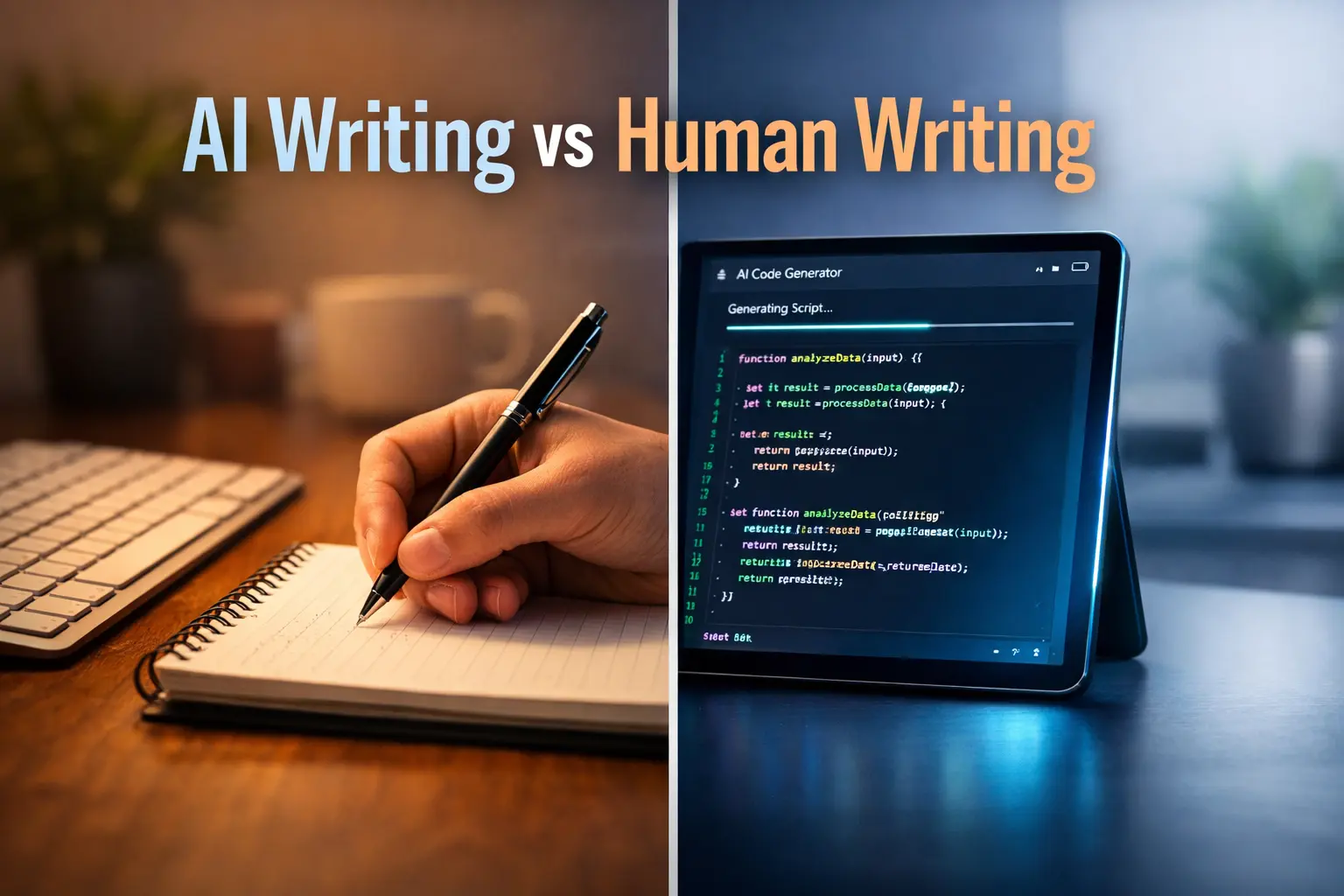
Explore the key differences between AI writing and human writing. Learn the pros, cons, and best use cases for each to enhance your content strategy effectively.
The Evolution of Writing: From Quills to Algorithms
Since the dawn of time, humanity has sought ways to share thoughts and preserve knowledge. The journey began with crude markings on cave walls, evolved through handwritten scrolls and printed books, and now enters a new chapter with artificial intelligence joining the creative process. Modern content creators face an intriguing dilemma – when to harness lightning-fast algorithms versus relying on the nuanced touch of human experience.
To truly grasp the implications of this technological shift, we must examine how thinking machines process language differently than living minds. Early attempts at machine-generated text in the mid-20th century produced laughably robotic sentences. But persistence paid off – each decade brought significant improvements:
- Rule-Based Systems (1960s-1980s): Clunky sentence builders following grammar textbooks
- Statistical Methods (1990s-2000s): Smarter prediction of probable word sequences
- Neural Networks (2010s): Recognizing patterns like human brain connections
- Transformer Models (2018-Present): Understanding context like never before
Today’s cutting-edge systems like GPT-4 digest unimaginable amounts of digital text – books, websites, research papers – learning to assemble words with startling coherence. The core difference lies in the creative process itself: machines calculate probabilities while humans draw from personal experiences, emotions, and creative sparks that algorithms can’t replicate.
The Technical Foundations of AI Writing
Contemporary language models mimic certain brain functions through complex digital networks. These systems weigh each word’s importance in a sentence through “attention mechanisms,” mirroring how humans focus on key elements when composing thoughts. After devouring vast text archives, these models learn to predict likely word patterns, generating responses based on prompts.
Human thought processes work vastly differently, engaging multiple cognitive layers:
| Cognitive Process | Human Writing Application | AI Writing Simulation |
|---|---|---|
| Memory Retrieval | Recalling childhood experiences to enrich narratives | Reproducing patterns from data archives |
| Conceptual Reasoning | Developing unique philosophical arguments | Replicating existing logical structures |
| Emotional Intelligence | Conveying genuine grief in a memorial piece | Analyzing emotional language patterns |
| Creative Synthesis | Inventing never-before-seen literary genres | Recombining existing concepts statistically |
This fundamental difference manifests in the output quality and authenticity. While machines generate content at astonishing speeds, human writers offer irreplaceable qualities – cultural nuance, heartfelt empathy, and truly original perspectives. Savvy content strategists learn when to deploy each approach for maximum impact.
Quantitative Comparison: AI Writing vs Human Writing
When evaluating artificial intelligence content creation against traditional human writing, several measurable factors provide objective comparison points:
Speed and Throughput Capabilities
Artificial intelligence demonstrates overwhelming advantages in raw production speed. A professional journalist might spend days crafting an investigative feature, while an AI system can generate dozens of rough drafts before lunch. This speed advantage amplifies with scale – doubling human output requires finding qualified writers, while boosting algorithmic production simply needs more computing power.
- AI Writing Speed Metrics:
- Average output: 500-1,000 words per minute
- Continuous operation without coffee breaks
- Instant response to trending topics
- Human Writing Speed Metrics:
- Quality-focused pace: 500-1,000 words per hour
- Requires mental rest and creative refueling
- Handwriting reaches only 30 wpm maximum
Raw speed tells only part of the story. Human writers typically dedicate significant time to background research, interviewing experts, and polishing narratives – tasks that still challenge current AI capabilities. Meanwhile, algorithm-generated pieces nearly always require human editing to fix awkward phrasing or factual inaccuracies.
Cost Analysis and ROI Considerations
The financial equation between automated and manual content creation varies dramatically by content type:
| Content Type | AI Cost (Per Word) | Human Cost (Per Word) | Quality Differential |
|---|---|---|---|
| Product Descriptions | $0.001 – $0.005 | $0.10 – $0.30 | Negligible for basic specifications |
| Blog Posts | $0.005 – $0.02 | $0.20 – $1.00 | Critical for authoritative perspectives |
| Technical Documentation | $0.01 – $0.05 | $0.50 – $2.00 | Vital for life-saving accuracy |
| Marketing Copy | $0.02 – $0.10 | $1.00 – $5.00 | Make-or-break relationship building |
These figures reveal intriguing patterns. While AI cuts costs dramatically for high-volume projects, the savings evaporate when human editing lifts algorithm drafts to professional standards. For premium content where quality directly affects revenue (think luxury brand messaging), human-crafted copy often delivers superior return on investment despite higher initial costs.
Qualitative Differences in Content Output
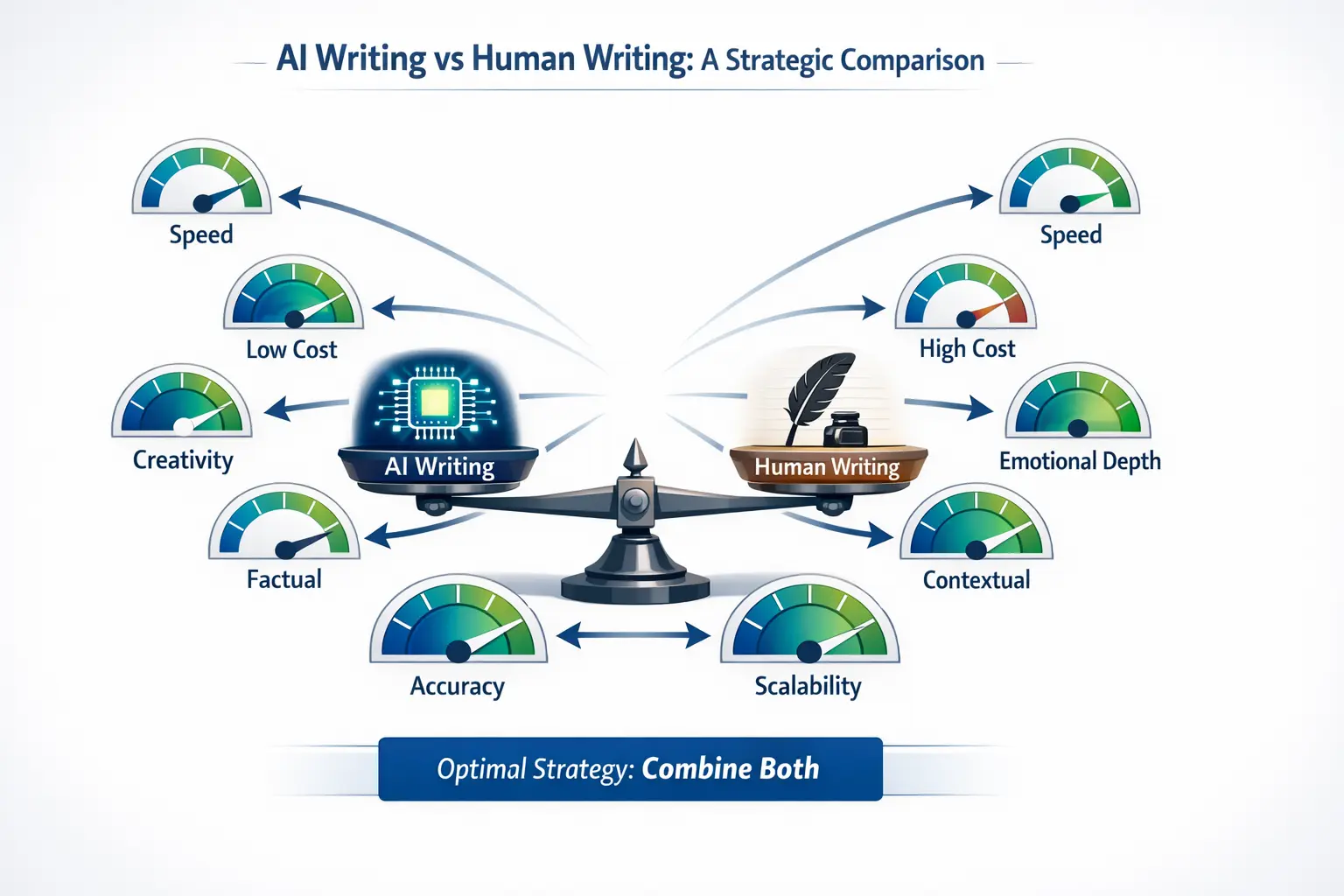
Beyond spreadsheet metrics, the true AI writing vs human writing showdown occurs in qualitative dimensions:
Creativity and Originality Benchmarks
Human creativity bursts from messy lived experiences and unexpected neural connections. This organic originality differs fundamentally from machine creativity. Two recent studies uncovered striking contrasts:
- Human authors generated 40% more unexpected plot twists
- AI content contained 62% more predictable story arcs
- Human poetry elicited 300% stronger reader emotional responses
- AI systems excelled at maintaining consistent tone
These distinctions stem from AI’s training limitations and inability to truly appreciate cultural context. While machines can emulate famous writing styles convincingly, they lack the spark of sudden inspiration that transforms good writing into unforgettable prose.
Emotional Resonance and Audience Connection
The capacity to forge genuine emotional bonds distinguishes masterful writing from technically adequate text. Human writers naturally weave personal experiences into narratives in ways machines simply can’t. Recent psychological research measured reader responses:
- Human-written memoirs elicited 35% stronger emotional engagement
- AI-generated news summaries achieved 5% higher factual recall
- 68% of readers preferred human-written bereavement letters
- 45% found AI empathy expressions felt “manufactured”
This emotional authenticity gap poses particular challenges for AI in fields requiring deep trust – therapy, counseling, high-stakes negotiations. While algorithms can statistically replicate compassionate language patterns, they lack authentic emotional experience, creating limits to genuine reader connections.
Applications Across Content Categories
Content effectiveness varies dramatically between human and AI creators depending on genre and purpose:
SEO Content Creation and Optimization
Search engine optimization creates fascinating intersections between algorithmic and human approaches. Modern AI tools bring distinct strengths:
- AI Advantages:
- Rapid keyword optimization to satisfy search bots
- Automatic heading structure formatting
- Instant response to trending search queries
- Bulk localization of service pages
- Human Advantages:
- Natural semantic keyword integration
- Crafting primary research-backed insights
- Demonstrating authentic expertise signals
- Strategic cross-linking with contextual awareness
Current Google algorithm improvements increasingly reward “helpful content” demonstrating real-world experience. While AI produces technically optimized text, human creators build deeper topical authority through unique perspectives and genuine expertise – qualities that algorithms struggle to authentically replicate.
Technical and Academic Writing Applications
For specialized content requiring exact terminology and factual precision, both approaches bring valuable strengths:
| Writing Aspect | AI Performance | Human Performance |
|---|---|---|
| Terminology Consistency | ★★★★★ | ★★★☆☆ (varies by writer) |
| Citation Accuracy | ★★☆☆☆ (hallucinations occur) | ★★★★☆ (with verification) |
| Conceptual Explanation | ★★★☆☆ (surface recitation) | ★★★★★ (experienced insight) |
| Research Synthesis | ★★☆☆☆ (limited analysis) | ★★★★★ (critical evaluation) |
AI shows promise for drafting technical documents with standardized templates, while human experts remain essential for nuanced conceptual explanations and original research analysis. Blending AI drafting with human oversight often yields optimal results for academic papers, clinical trial documentation, and precision engineering specifications.
The Hybrid Workflow Model
Forward-thinking organizations maximize content potential through integrated human-algorithm collaboration:
Optimal Task Allocation Framework
Strategic division of labor creates powerful synergies between human and artificial capabilities:
- AI-Primary Tasks:
- Initial research data compilation
- Template-based rough drafting
- Keyword density management
- Multi-format content repurposing
- Human-Primary Tasks:
- Strategic content planning
- Field-experience insight development
- Emotional narrative crafting
- Quality assurance verification
This framework maximizes AI efficiency while preserving human creativity and critical reasoning. Successful implementation requires deliberate process design:
- Define content objectives and success metrics
- Establish quality thresholds for AI inputs
- Create specialized editorial oversight roles
- Implement staged quality checkpoints
- Continuously refine based on performance data
Organizations adopting this hybrid methodology report 45-65% efficiency gains while maintaining content excellence. The key lies in viewing AI as enhancement rather than replacement – a powerful tool amplifying human creativity rather than making it obsolete.
Ethical Considerations and Industry Impact
The AI writing revolution raises profound ethical questions:
Authorship and Plagiarism Concerns
Modern AI systems generate content through pattern recreation rather than direct copying, yet plagiarism detectors increasingly flag derivative outputs. The publishing industry currently wrestles with defining:
- Proper attribution for AI-assisted works
- Copyright status of machine-generated text
- Disclosure obligations for AI content use
- Academic honesty implications
Leading publishers and universities hold diverse positions, with many requiring explicit AI use declarations. Legal precedents remain unclear as court cases test whether AI outputs infringe on copyrighted training materials.
Workforce Transformation and Adaptation
The AI writing revolution impacts both creators and industries:
| Traditional Role | Impact Level | Emerging Hybrid Roles |
|---|---|---|
| Content Mill Writer | High Displacement Risk | AI-Human Workflow Designer |
| SEO Specialist | Moderate Transformation | Search Experience Architect |
| Creative Copywriter | Low Displacement Risk | AI-Assisted Brand Storyteller |
| Technical Writer | Moderate Transformation | Knowledge System Developer |
Progressive educational institutions are adapting curricula, emphasizing:
- Advanced prompt-crafting techniques
- Strategic content oversight skills
- Specialty editorial expertise
- Cross-platform optimization
The most successful professionals will embrace AI as productivity accelerators while cultivating irreplaceable human skills – emotional intelligence, cultural intuition, and breakthrough creativity.
Future Trajectories and Industry Projections
Predicting the next chapters of AI writing requires examining current trends:
Generative AI Advancements on the Horizon
Emerging developments promise transformative capabilities within five years:
- Multimodal Integration: Unified text, image, sound, and video generation
- Real-Time Personalization: Content adapting to reader reactions
- Accuracy Boosters: Built-in fact verification against trusted sources
- Tone Refinement: Advanced emotional resonance matching
These innovations will close certain quality gaps while enabling unprecedented content personalization. However, fundamental limitations around genuine innovation and cultural insight will likely persist through current AI models.
Human Writing Evolution and Differentiation
As AI masters formulaic writing, human creators will emphasize premium capabilities:
- Hyper-Personalization: Biographically-attuned content creation
- Immersive Storytelling: Cross-sensory narrative experiences
- Ethical Stewardship: Overseeing responsible AI implementation
- Visionary Thought: Groundbreaking philosophical frameworks
This specialization echoes artisanal craftsmanship’s persistence alongside industrial production. The most successful human writers will emphasize irreplaceable human qualities – intuition, cultural fluency, and imaginative leaps.
Practical Implementation Strategies
Organizations can optimize their content approach through these actionable steps:
Evaluation Framework for Content Needs
A structured decision matrix clarifies human-AI allocation:
| Content Characteristic | Recommend AI When… | Recommend Human When… |
|---|---|---|
| Volume Requirements | Mass-scale production needed | Crafting flagship content pieces |
| Creativity Needs | Following established templates | Pioneering new formats/styles |
| Emotional Resonance | Objective information sharing | Building loyalty/trust |
| Expertise Level | General-knowledge overviews | Niche subject mastery |
| Budget Constraints | Limited funds, volume critical | Quality-driven ROI justifies investment |
Combined with performance tracking, this framework ensures optimal content strategy alignment with organizational goals.
Deployment Best Practices and Workflow Optimization
Successful hybrid implementation requires deliberate process design:
- Establish Clear Content Tiers:
- Tier 1: Human-only for brand-defining storytelling
- Tier 2: AI drafting with human enhancement
- Tier 3: AI-only for real-time updates/navigation
- Develop AI Supervision Protocols:
- Multi-stage fact validation checkpoints
- Brand voice consistency audits
- Originality screening processes
- Create Specialized Human Roles:
- AI Content Director: Oversees human-algorithm synergy
- Narrative Alchemist: Transforms AI drafts into gold
- Quality Sentinel: Monitors long-term performance
- Implement Feedback Loops:
- Performance data trains AI models
- Reader surveys identify improvement areas
- A/B testing refines human-AI balance
These practices help organizations scale efficiently while preserving quality. Regular workflow evaluations ensure continuous improvement as technology and market needs evolve.
Frequently Asked Questions (FAQs)
Can AI writing tools completely replace human writers?
Current technology cannot fully replace human writers for content requiring genuine creativity, emotional depth, or specialized expertise. While AI excels at producing formulaic content rapidly, it lacks human capacities for original thought, cultural intuition, and ethical judgment.
The healthiest approach positions AI as assistive technology enhancing human productivity and creative potential. Human oversight remains vital for quality control, brand consistency, and achieving strategic content objectives. As tools evolve, writers’ roles will transform toward higher-value creative and editorial functions rather than disappearing.
How do search engines treat AI-generated content versus human-written content?
Major search platforms evaluate content by quality signals rather than creation method. Their guidelines state AI content isn’t penalized if demonstrating helpfulness, expertise, and trustworthiness. Observational insights reveal:
- Human content outperforms on sensitive “YMYL” topics
- Well-optimized AI content ranks well for informational queries
- Human-crafted content achieves higher originality scores
- Pure AI content risks quality issues without human oversight
The most sustainable SEO approaches blend AI’s technical prowess with human expertise to create content that authentically serves user needs while meeting quality benchmarks.
What legal risks are associated with using AI writing tools?
Organizations should consider several legal dimensions:
- Copyright Uncertainty: Machine-generated works lack clear copyright protection
- Plagiarism Risks: Potential pattern replication near copyrighted materials
- Accuracy Liability: Organizations bear responsibility for AI factual errors
- Disclosure Requirements: Growing industry-specific transparency rules
Mitigation strategies include implementing strong editorial oversight, maintaining human accountability, and staying current with evolving regulations like EU’s proposed AI Act framework.
How can human writers ensure their relevance in an AI-dominated landscape?
Human writers can thrive by adopting these future-focused strategies:
- Mastering AI Collaboration: Becoming fluent in prompt engineering
- Developing Premium Services: Specializing in high-value creative work
- Cultivating Human Strengths: Strengthening emotional intelligence
- Evolving Into Strategists: Advancing from writing to content architecture
Writers who embrace AI as creative partners while deepening irreplaceable human skills will prosper in the evolving content ecosystem. Continuous reinvention and skill enhancement remain essential.
What metrics should businesses use to compare AI and human writing performance?
Organizations should establish comprehensive evaluation frameworks:
| Metric Category | AI Performance Metrics | Human Performance Metrics |
|---|---|---|
| Production Efficiency | Throughput volume, Per-word cost | Idea-to-draft velocity, Feedback cycles |
| Quality Indicators | Fact-check pass rates, SEO scores | Emotional resonance metrics, Brand alignment |
| Business Impact | Market coverage breadth | Customer retention impact |
| Risk Factors | Generic content flags | Consistency variances |
Balanced measurement should combine quantitative analytics with qualitative expert reviews and audience feedback to inform content strategy decisions.
Also Read: AI Food Description Generator: Boost Engagement and Sales in 2026