
AI Companies Boston 2026: Key Players Shaping the Future
In this post you will get to know about AI Companies Boston. Explore the leading AI companies in Boston driving innovation. Discover startups, research hubs, and career opportunities shaping the future of technology.
The Historical Context of Boston’s AI Ecosystem
Boston’s journey in becoming a major hub for artificial intelligence innovation reflects decades of academic excellence and technological advancements. The city’s AI landscape has evolved through strategic investments in education and collaborative efforts between research institutions and industries.
Foundations in Academic Research
The Massachusetts Institute of Technology (MIT) played a pioneering role in AI research starting in the 1950s with its Artificial Intelligence Laboratory. Visionaries like Marvin Minsky and John McCarthy developed foundational concepts in machine learning that influenced generations of researchers. Harvard University contributed significantly through its cognitive science and computational linguistics programs. These institutions continue attracting top talent, with MIT consistently ranked first in computer science globally.
During the 1970s, breakthroughs in computer vision and natural language processing emerged from Boston’s academic labs. Boston University became renowned for neural network research while MIT focused on robotics and algorithms. These innovations created fertile ground for commercial applications, leading to the first wave of AI startups in Cambridge during the 1980s.
Commercialization and Growth
The 1990s witnessed Boston’s transition from research to practical AI implementations. Companies like iRobot (founded in 1990) and Nuance Communications (1992) demonstrated viable commercial applications in consumer robotics and speech recognition. This era established Boston’s strengths in healthcare AI diagnostics and financial technology solutions.
| Era | Key Development | Impact |
|---|---|---|
| 1950s-1970s | Formation of MIT AI Lab | Establishing fundamental AI research |
| 1980s-1990s | First commercial ventures | Market validation across industries |
| 2000s-Present | Rapid startup expansion | Industry diversification |
Contemporary AI Landscape
Today’s ecosystem features over 300 AI-focused organizations according to Mass Technology Leadership Council. Modern initiatives include MIT’s $1 billion Schwarzman College of Computing and Harvard’s Kempner Institute for interdisciplinary intelligence studies. These institutions fuel collaborations between academia and industry, accelerating real-world AI implementations.
Key Industries Utilizing AI Technology
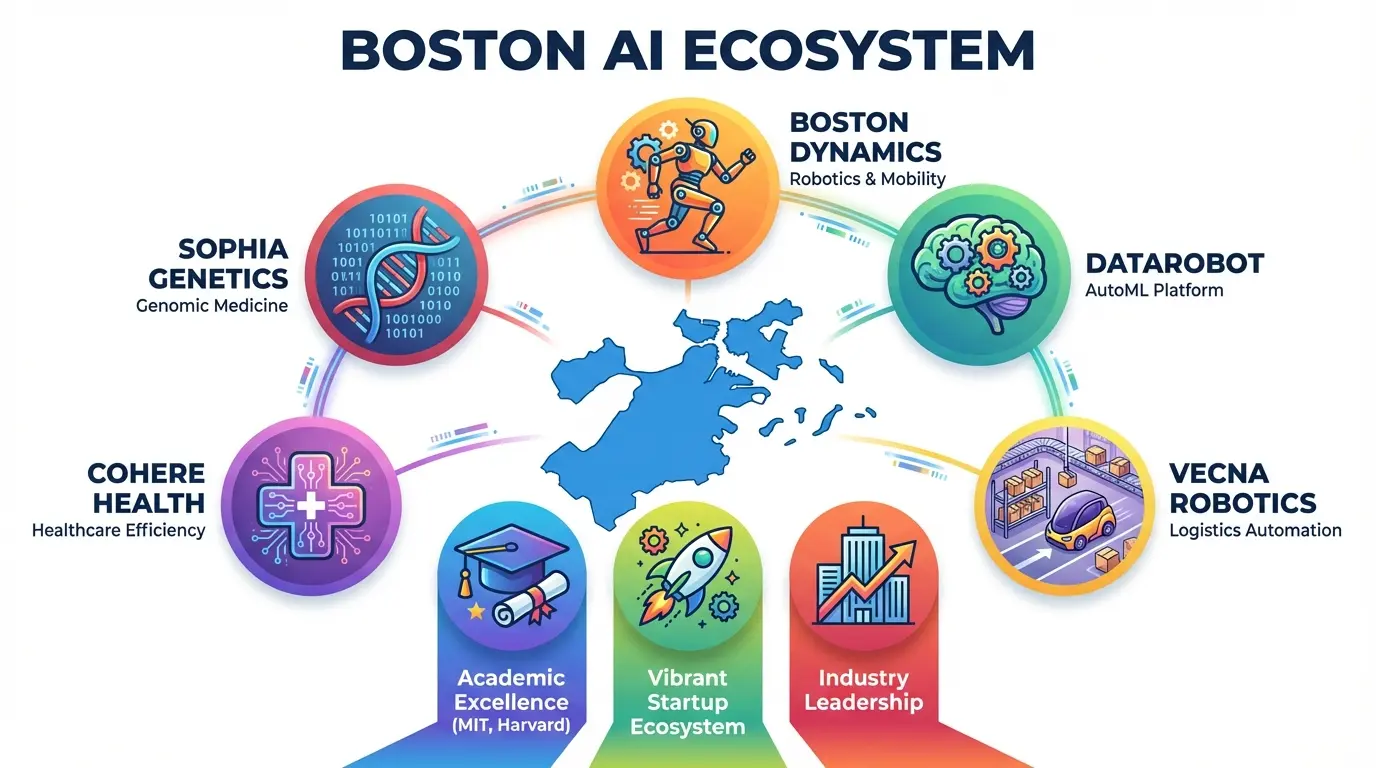
Boston’s AI applications span multiple sectors, with particular strengths in healthcare innovation, robotic systems, and financial technology solutions. The convergence of these industries creates unique opportunities distinguishing Boston from other tech hubs.
Healthcare Innovations
Boston’s world-renowned medical institutions partner with AI companies to develop transformative solutions. PathAI creates diagnostic systems that improve pathology accuracy by 50%, while Caption Health’s FDA-approved ultrasound technology enables non-specialist operation. Over 75 AI medical devices from Boston companies received regulatory approval since 2020.
Robotics Advancements
Boston Dynamics exemplifies robotic innovation with its advanced mobility systems used in industrial inspection and logistics. Veo Robotics develops safety systems enabling human-robot collaboration in manufacturing, while RightHand Robotics automates warehouse operations with 400% efficiency gains. Massachusetts leads in robotics patents with over 500 filings in 2025.
Financial Technology
AI transforms financial services through platforms like Kensho’s real-time document analysis and Circle’s cryptocurrency monitoring systems. Carerity’s computer vision streamlines insurance claim processing from days to minutes. Fintech AI companies secured $4.2 billion in Boston venture funding during 2025.
Academic and Corporate Collaboration Frameworks
Boston’s innovation ecosystem thrives through structured partnerships between universities and commercial enterprises, enabling research translation into market-ready products.
Intellectual Property Commercialization
MIT’s Technology Licensing Office completed 120 AI-related agreements in 2025, generating $98 million through patent licensing. Harvard’s technology transfer office focuses on biomedical AI applications, creating pathways from laboratory research to commercial deployment.
Corporate Research Initiatives
Major tech firms maintain Boston research facilities adjacent to universities. Google’s 500-person Cambridge team collaborates on protein folding research with MIT, while Amazon partners with Boston University on robotics control systems. IBM committed $50 million for hybrid cloud AI research with Northeastern University.
Entrepreneurial Development Programs
Academic institutions foster commercialization skills through programs like Harvard’s Business of Science initiative and MIT’s delta v accelerator. These programs dramatically increase startup formation rates, with MIT graduates founding 200+ AI companies since 2020.
Investment Landscape and Funding Opportunities
Boston’s AI sector benefits from diverse funding sources including specialized venture capital, corporate investment arms, and government grants.
Venture Capital Focus
Flagship Pioneering manages $5 billion for AI biotech ventures like Generate Biomedicines. Firms like Flybridge Capital and Hyperplane VC specialize in applied AI solutions, fueling companies including DataRobot and PathAI. Total 2025 VC investments reached $9.7 billion, a 34% year-over-year increase.
| Firm | AI Focus Area | Notable Investments |
|---|---|---|
| Pillar VC | Infrastructure | Wallaroo, Neural Magic |
| The Engine | Deep Tech | Shield AI, QuEra |
| General Catalyst | Enterprise Solutions | Wasabi, DataRobot |
Corporate Investment Strategies
Salesforce Ventures allocates $250 million annually to Boston AI companies in marketing technology sectors. Johnson & Johnson Innovation focuses on medical AI applications, supporting companies like Viz.ai. Corporate participation in AI funding rounds increased to 43% by 2025.
Public and Nonprofit Support
The Massachusetts Technology Collaborative administers grant programs including the $25 million AI Research Fund. Federal agencies award substantial contracts with MIT Lincoln Lab securing $812 million in defense AI research during 2025. Nonprofits like CIMIT provide prototyping funds for medical AI devices.
Talent Development and Educational Pathways
Boston’s academic institutions create comprehensive talent pipelines through degree programs, certifications, and corporate partnerships.
University Degree Programs
MIT’s AI undergraduate program receives 1,500 annual applications for 120 positions. Harvard’s computational science program offers specializations in natural language processing and computer vision. Northeastern University reports 92% job placement rates within three months of graduation for its AI-focused MSCS program.
Professional Development Programs
Harvard Extension School offers AI certificates featuring instruction from industry leaders at Microsoft and Google. MIT Professional Education provides hands-on implementation training for working professionals. These $4,000-$8,000 programs can be completed alongside full-time employment.
Corporate Training Initiatives
Companies partner with educational institutions for tailored programs. Amazon’s Machine Learning University delivers free courses through Bunker Hill Community College partnerships. Google’s AI Residency Program provides research experience prior to full-time hiring.
Technological Infrastructure and Capabilities
Boston maintains cutting-edge computing resources supporting advanced AI research and development activities.
Advanced Computing Resources
MIT’s SuperCloud system offers 20,000 specialized GPUs for large language model training. Harvard’s Odyssey cluster provides 9 petaflops of optimized processing power. The renewable-powered Massachusetts Green High Performance Computing Center supports startup computational needs.
Quantum Computing Integration
MIT and Harvard lead quantum AI research through institutes developing next-generation algorithms. Startups like QuEra Computing emerged from this ecosystem, securing $92 million for commercializing quantum AI solutions.
Edge Computing Innovations
Companies like Mythic AI create low-power processors enabling onboard AI processing for autonomous systems. Neural Magic’s software enhances deep learning efficiency on standard CPUs, facilitating industrial IoT applications.
Ethical Frameworks and Governance
Boston institutions pioneer responsible AI development through research initiatives and industry standards.
The Ethics and Governance Initiative
This joint Harvard-MIT program develops algorithmic auditing frameworks adopted globally. Their assessment toolkit helps companies ensure fairness in AI systems, with implementations at Boston-based Wayfair.
Regulatory Compliance
Massachusetts passed the 2024 Algorithmic Accountability Act, requiring impact assessments for AI in critical decision-making. Legal firms like Goodwin Procter developed specialized practices advising companies on compliance.
Industry Self-Regulation
The Boston AI Council established voluntary standards covering privacy, transparency, and human oversight. Members undergo third-party audits through MIT’s certification program.
Representative Company Case Studies
Examining Boston’s AI leaders demonstrates successful commercialization pathways within the ecosystem.
Boston Dynamics: Commercial Robotics Evolution
Originating from MIT research, Boston Dynamics transitioned through three phases:
- Research & Military Applications (1992-2013)
- Early Commercialization (2013-2020)
- Industrial Expansion (2020-Present)
Today’s $500 million revenue comes from industrial clients like National Grid utilizing robots for hazardous inspections.
DataRobot: Enterprise AI Democratization
Founded by MIT Lincoln Lab alumni, DataRobot’s AutoML platform features:
- AI Expert Guidance models
- Automated MLOps monitoring
- Specialized time-series forecasting
After achieving unicorn status, DataRobot’s 2023 IPO valued the company at $6.7 billion.
Emerging Technology Developments
Boston companies pioneer next-generation AI applications combining domain expertise with novel approaches.
Generative AI in Biotechnology
Generate Biomedicines creates novel therapeutic proteins through generative models. Jnana Therapeutics applies similar techniques to small molecule drug discovery.
Hybrid AI Architectures
MIT’s neurosymbolic research combines neural networks with logical reasoning. Spinoff Geminus.ai reduced industrial failure predictions by 40% at NSTAR Electric.
Multimodal System Integration
Percepto AI’s inspection platform analyzes visual, thermal, and sensor data during drone flights, delivering results 99% faster for CVS Health infrastructure assessments.
Career Opportunities and Professional Pathways
Boston’s AI sector offers diverse roles requiring varying technical expertise.
Technical Positions
Machine learning engineer demand tripled from 2020-2025 with $180,000 median salaries. Research scientists in healthcare AI earn up to $250,000, often requiring computational biology doctorates.
Non-Technical Roles
Product managers with domain expertise earn $150,000+ overseeing development. AI ethicists start at $120,000 ensuring regulatory compliance.
Sector Challenges and Future Directions
Maintaining leadership requires addressing talent retention, infrastructure needs, and emerging fields.
Talent Retention Strategies
With AI unemployment at 0.8%, companies offer innovative benefits including immigration support and four-day workweeks.
Infrastructure Expansion
The $700 million AI Compute Initiative will triple processing capacity by 2027 to meet increasing model training demands.
Emerging Specializations
- Climate AI for environmental modeling
- Semiconductor manufacturing integration
- Advanced AI safety research
Frequently Asked Questions (FAQs)
Why is Boston considered a global AI leader?
Three factors create Boston’s advantage: academic leadership with institutions like MIT and Harvard, diverse industry applications across healthcare and finance, and specialized venture funding. The region produces 18% of global AI patents, exceeding other hubs in research depth and commercialization support.
How do Boston AI compensation packages compare nationally?
Senior researchers average $325,000 total compensation – slightly below Silicon Valley but with significantly lower living costs. Machine learning engineers earn $195,000 with superior job stability compared to West Coast counterparts. Remote work options increasingly supplement competitive salary structures.
What’s the success rate for Boston AI startups?
Five-year survival rates exceed the national average by 22%, with 57% of 2018-2020 startups operational in 2025. Corporate partnership opportunities and mentorship programs like MassChallenge AI contribute to higher scaling success rates among Series A companies.
How do Boston medical centers implement AI?
Mass General Brigham’s comprehensive framework includes diagnostic platforms analyzing 15,000+ pathology slides weekly, predictive ER optimization models reducing wait times 30%, and AI sensors preventing hundreds of critical patient events annually. These systems demonstrate measurable outcome improvements like 27% faster complex diagnoses.
Which Boston companies focus on climate technology?
- Via Separations reduces industrial energy consumption by 90%
- Boomitra verifies carbon sequestration through satellite analysis
- Seurat Technologies cuts manufacturing emissions by 90%
MIT’s Climate Grand Challenges program provides research support for these ventures, which collectively raised $1.2 billion since 2023.