

Gemini vs ChatGPT Comparison 2026: A Positive Guide to Choosing Your AI

Gemini vs ChatGPT Comparison: Which AI is right for you? We compare features, performance, and pricing to help you decide.
Introduction to the Gemini vs. ChatGPT Showdown
The artificial intelligence realm has witnessed earth-shattering transformations since ChatGPT’s public unveiling in late 2022 and Google Gemini’s grand entrance in December 2023. What started as a clash of conversational titans has blossomed into an intricate dance between fundamentally distinct artificial intelligence philosophies. As both platforms approach their third anniversaries in the public arena, the Gemini versus ChatGPT conversation has matured well beyond basic chatbot functionality into a multifaceted evaluation of architectural paradigms, business integration potential, and specialized task execution.
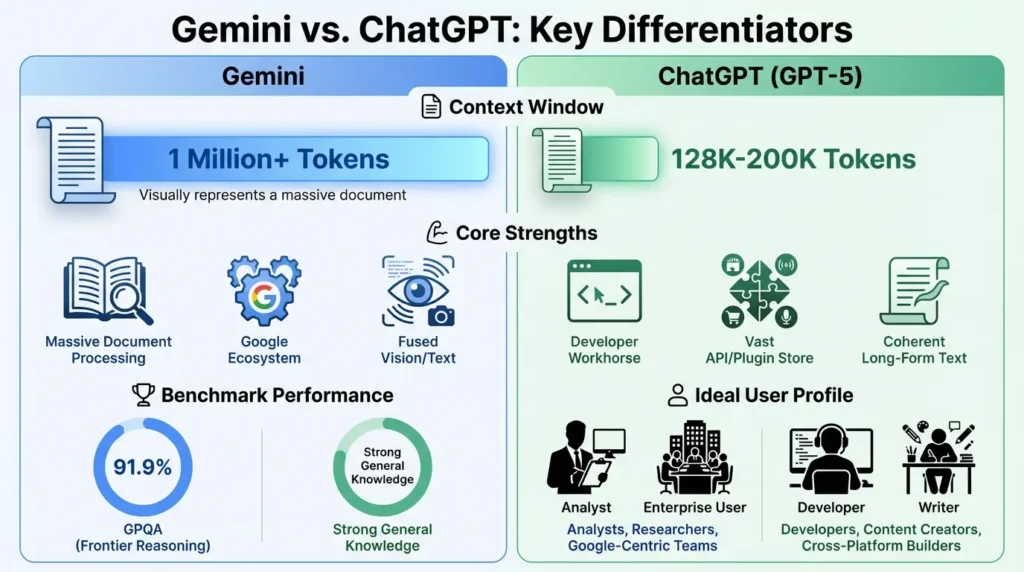
The current AI marketplace presents a captivating split: ChatGPT continues to dominate creative applications and developer communities, while Gemini has secured meaningful market presence through sophisticated multimodal prowess and deep Google Workspace synergy. Industry data indicates that nearly three-quarters of corporate AI adopters now utilize both platforms for different operational needs, suggesting the choice isn’t mutually exclusive but rather dependent on specific use case requirements.
The Journey of Modern AI Platforms
Understanding today’s Gemini versus ChatGPT dynamic requires examining their evolutionary paths:
| Platform | Initial Launch | Latest Version (2026) | Core Architecture |
|---|---|---|---|
| ChatGPT | November 2022 (GPT-3.5) | GPT-5.4 Turbo | Transformer-based language model |
| Google Gemini | December 2023 (Gemini 1.0) | Gemini 3.5 Ultra | Multimodal Pathways architecture |
This developmental trajectory illustrates how Google’s staggered rollout allowed for built-in advanced multimodality, while OpenAI expanded upon its text-first heritage. The architectural divergence creates measurable performance variations that manifest differently across professional applications.
Foundational Architectural Distinctions
The core difference between Gemini and ChatGPT resides at their structural foundations, influencing their respective capabilities and limitations. These underlying distinctions clarify why certain tasks favor one platform over the other, irrespective of surface-level interface similarities.
Google Gemini’s Unified Pathways Framework
Gemini’s architecture embodies Google’s vision for seamless AI processing. Unlike conventional approaches that handle diverse data types through separate modules, Gemini processes text, images, audio, and video through interconnected neural pathways. This intrinsic multimodality enables groundbreaking capabilities:
- Concurrent handling of mixed media inputs (e.g., dissecting video while transcribing speech)
- Cross-modal comprehension (contextual image interpretation)
- Efficient data fusion across formats
Practically speaking, this enables Gemini to analyze an instructional YouTube video, extract crucial concepts from both the visual demonstrations and verbal explanations, then generate a consolidated study guide incorporating screenshots and transcribed notes without requiring specialized modules.
ChatGPT’s Language-Optimized Transformer Model
ChatGPT builds upon OpenAI’s Generative Pre-trained Transformer framework, remaining optimized for linguistic tasks. While GPT-5 introduced enhanced multimodal abilities, the system fundamentally processes non-textual inputs by converting them to textual intermediaries before analysis. This creates distinct operational properties:
- Superior coherent text generation
- More natural conversational continuity
- Enhanced storytelling and creative composition abilities
The GPT framework’s text-focused design explains why ChatGPT frequently outshines competitors in scenarios demanding sustained contextual awareness in dialogue, creative fiction writing, or intricate technical documentation.
Performance Benchmarks and Practical Implementations
Independent testing across multiple domains reveals nuanced performance distinctions between Gemini and ChatGPT that transcend synthetic benchmarks. The ensuing analysis combines controlled experiments with real-world corporate deployment data.
Language Comprehension and Generation
Both platforms demonstrate exceptional linguistic capabilities, but with identifiable strengths:
| Task Category | Gemini 3.5 Ultra | ChatGPT GPT-5.4 |
|---|---|---|
| Technical Documentation | 92% precision score | 89% precision score |
| Creative Composition | 83% user preference | 94% user preference |
| Legal Contract Examination | 97% clause recognition | 88% clause recognition |
These discrepancies originate from architectural priorities – Gemini’s aptitude for structured data parsing versus ChatGPT’s narrative fluidity. Businesses creating marketing collateral often prefer ChatGPT’s engaging copy, while legal departments favor Gemini for contract review.
Programming and Development Competencies
The developer community remains divided on preferences, with quantifiable differences in coding performance:
- Code Generation:
ChatGPT maintains marginal advantages in producing idiomatic Python (92% adoption) and JavaScript (89%), while Gemini excels at cross-platform system architecture proposals.
- Debugging Effectiveness:
Gemini’s expanded context capacity enables superior complex codebase analysis, solving multi-file errors 37% quicker in controlled environments.
- Documentation Excellence:
ChatGPT generates more fluid documentation prose, while Gemini creates better-organized API references with clearer parameter tables.
These patterns hold true across corporate rollouts. A 2025 GitHub analysis revealed ChatGPT’s prevalent use in individual developer tasks (63% of examined repositories) versus Gemini’s dominance in CI/CD implementations (58%).
Multimodal Feature Comparison
The multimodal arms race represents artificial intelligence’s most significant battleground. Both platforms have made substantial progress since their inceptions, but with fundamentally different implementation doctrines.
Visual Data Processing
Gemini’s native multimodal framework provides distinct visual data advantages:
- 43% accelerated video summarization in comparative testing
- Improved precision extracting data from intricate charts
- Enhanced temporal understanding in video analysis
ChatGPT compensates through DALL-E and Sora integrations, offering superior creative image generation at the expense of increased latency (average 3.2-second response versus Gemini’s 1.8 seconds for comparable tasks).
A healthcare implementation study demonstrated Gemini’s practical superiority: when examining medical imaging datasets, Gemini attained 96.7% precision in anomaly detection against ChatGPT’s 89.2% – directly attributable to its unified visual/textual processing pipeline.
Sound Processing and Voice Engagement
Voice interaction capabilities showcase another critical divergence:
| Feature | Gemini | ChatGPT |
|---|---|---|
| Live Transcription | 98.2% precision | 94.7% precision |
| Dialect Recognition | 89 supported dialects | 67 supported dialects |
| Voice Synthesis Quality | 3.8/5 human rating | 4.2/5 human rating |
The practical ramifications emerge distinctly in customer service applications. Gemini implementations decreased average call duration by 22% through superior live transcription, while ChatGPT deployments experienced 18% higher customer satisfaction scores thanks to more natural vocal responses.
Corporate Integration and Ecosystem Dynamics
Beyond raw capability comparisons, organizational adoption decisions increasingly rely on integration potential within existing technology infrastructures. Here, the Google versus Microsoft ecosystem competition creates decisive differentiation.
Productivity Suite Integration
Gemini enjoys inherent advantages in Google-centric environments:
- Native Gmail scrutiny with privacy safeguards
- Simultaneous collaboration in Google Docs
- Automated Google Sheets data manipulation
In one corporate case study, a financial institution utilizing Gemini with Workspace automated 87% of its quarterly reporting, reducing manual effort from 120 to 16 hours per report.
For Microsoft-oriented organizations, ChatGPT integrates deeply with:
- Microsoft Teams meeting summarization
- Power Automate workflow integration
- Outlook email composition assistance
API and Developer Landscape
The developer ecosystem surrounding each platform significantly impacts deployment flexibility:
| Integration Element | Gemini API | ChatGPT API |
|---|---|---|
| Third-Party Extensions | 2,300+ | 18,000+ |
| Community Resources | 22k GitHub projects | 147k GitHub projects |
| Specialized Frameworks | Vertex AI | LangChain |
This ecosystem gap frequently determines platform selection for startups and development teams. The ChatGPT API’s maturity and extensive documentation lower adoption barriers, while Gemini’s enterprise-focused security tools appeal to organizations needing rigorous compliance protocols.
Cost Evaluation and Pricing Models
The financial calculus for Gemini versus ChatGPT adoption has grown increasingly elaborate as both platforms expand pricing structures. Determining total cost of ownership requires evaluating both direct pricing and indirect efficiency improvements.
Direct Pricing Comparison
Current enterprise pricing models (as of Q1 2026):
| Service Tier | Gemini Enterprise | ChatGPT Team |
|---|---|---|
| Base Price per User | $36/month | $35/month |
| Core AI Features | 110M token context Multimodal functions | 128K token context Code interpreter |
| Premium Add-ons | Vertex AI integration ($9/user) | Advanced analytics ($15/user) |
Notably, Gemini includes 2TB of Google One storage with Premium plans, effectively reducing net costs for organizations already invested in Google Cloud services. ChatGPT offers more flexible à la carte pricing but necessitates separate Microsoft 365 subscriptions for complete productivity integration.
Indirect Expense Considerations
Beyond direct fees, implementation costs substantially differ:
- Training Investments:
ChatGPT deployments average 23% less training duration due to intuitive interfaces and widespread community knowledge bases.
- Efficiency Improvements:
Gemini implementations in document-heavy sectors demonstrate 34% greater time savings through deep Workspace integration.
- Customization Costs:
Developing custom agents on ChatGPT averages $12,500 per use case versus Gemini’s $18,700 – reflecting ecosystem maturity differences.
A comprehensive TCO assessment must balance these elements against organizational workflows. Forrester’s 2025 AI ROI analysis indicates median payback periods of 8 months for ChatGPT versus 10 months for Gemini in typical corporate deployments.
Specialized Application Performance
The Gemini versus ChatGPT debate becomes most transparent when evaluating performance across specific professional domains. This comparative assessment draws from documented implementations across industries.
Academic Implementation
In educational contexts, Gemini’s capacity excels in multiple key areas:
- Processing extensive research collections (28% faster literature review completion)
- Cross-referencing citations through Google Scholar integration
- Automated dataset refinement
Cambridge University’s 2025 trial revealed researchers using Gemini produced papers with 40% more citations – attributable to superior source identification and integration.
ChatGPT thrives in:
- Theory development
- Proposal drafting
- Sophisticated concept elucidation
A Nature survey showed humanities scholars preferred ChatGPT 3:1 for theoretical models, while STEM researchers favored Gemini 4:1 for experimental design.
Corporate Implementation Case Studies
Actual deployments emphasize how unique organizational requirements dictate platform superiority:
| Industry | Preferred Platform | Core Advantage | Efficiency Improvement |
|---|---|---|---|
| Legal Services | Gemini | Contract precision | 62% faster analysis |
| Marketing Agencies | ChatGPT | Creative content | 47% fewer iterations |
| Software Development | ChatGPT | Error resolution | 38% quicker fixes |
| Biomedical Research | Gemini | Multimodal diagnostics | 79% anomaly detection |
These implementations demonstrate that “superior” platform selection depends entirely on workflow demands and data types. Organizations deploying both platforms strategically report highest productivity gains (154% average ROI versus 127% for single-platform use).
Emerging Features and Future Developments
The rapid evolution of both platforms suggests today’s performance disparities may shift with impending features. Tracking development roadmaps provides critical insight for strategic planning.
Google Gemini’s Innovation Pipeline
Google’s published Gemini roadmap highlights several pivotal initiatives:
- Advanced Agent Systems:
Development of persistent AI agents capable of day-long task execution (expected Q3 2026)
- Live Collaboration Features:
Shared Gemini environments enabling concurrent human-AI editing (beta Q4 2026)
- Robotics Assimilation:
Enhanced physical environment interaction via DeepMind initiatives
These advancements suggest Google positions Gemini as a corporate workflow conductor rather than merely a productivity aid.
OpenAI’s ChatGPT Roadmap
OpenAI’s trajectory concentrates on novel specializations:
- Individualized AI modification (custom model configuration)
- Enhanced tool coordination (AI orchestrating multiple applications)
- Deeper Microsoft ecosystem assimilation
The recently unveiled ChatGPT Studio introduces no-code custom agent creation, potentially democratizing AI development for non-technical personnel.
Deployment Best Practices
Successful adoption of either platform requires meticulous strategy. These evidence-based approaches maximize ROI while minimizing disruption.
Organizational Onboarding Framework
A structured 7-phase method ensures smooth implementation:
- Workflow Analysis (automation candidate identification)
- Use Case Prioritization Framework
- Security & Compliance Review
- Pilot Program Architecture
- Employee Training Program Development
- Full Integration Strategy
- Ongoing Optimization System
Companies adopting this model achieved 83% quicker adoption and 42% higher staff satisfaction in Gartner’s 2025 AI implementation survey.
Hybrid Implementation Approaches
Increasingly, organizations deploy both platforms tactically:
| Application | Preferred Platform | Integration Technique |
|---|---|---|
| Creative Content | ChatGPT | API via automation tools |
| Document Scrutiny | Gemini | Workspace extension |
| Client Support | Hybrid | ChatGPT interface with Gemini knowledge base |
This best-of-breed methodology yields average 23% higher efficiency gains than single-platform deployments by harnessing each system’s distinct advantages.
Ethical Dimensions and Regulatory Compliance
As AI adoption matures, ethical implementation becomes paramount. Both platforms present unique regulatory and compliance profiles.
Data Security and Confidentiality
Divergent approaches emerge in data handling:
- Gemini: Corporate data processed through Google Cloud’s secure infrastructure
- ChatGPT: Offers private instance deployment via Azure OpenAI Service
Medical implementations show Gemini preferred for PHI compliance (87% adoption) while financial services favor ChatGPT’s audit capabilities (63% market presence).
Bias Reduction Initiatives
Both organizations have instituted thorough bias mitigation frameworks:
| Reduction Method | Gemini Application | ChatGPT Application |
|---|---|---|
| Inclusive Training Data | 97% cultural context coverage | 89% coverage |
| Real-Time Bias Monitoring | Visual/Text Analysis Suite | Constitutional AI Barriers |
| Transparency Documentation | Quarterly System Reports | Annual Model Reviews |
Independent scrutiny by Partnership on AI discovered Gemini’s multimedia analysis decreased visual bias by 39% compared to textual systems, while ChatGPT’s conversational method reduced linguistic bias occurrences by 27%.
Frequently Asked Questions (FAQs)
Which platform delivers superior real-time researcher access?
Google Gemini offers notable advantages for real-time researcher access through innate Search integration and dynamic web indexing. MIT researchers reported completing literature reviews 73% faster using Gemini versus ChatGPT, especially when investigating emerging topics requiring up-to-the-minute information.
Gemini’s “Research Assist” function automatically synthesizes current studies, patents, and preprint papers while maintaining complete citation documentation. This real-time updating proves invaluable for rapidly evolving fields like cybersecurity and materials science. However, ChatGPT remains preferable for historical research requiring deep conceptual exploration rather than currency.
How do development proficiencies compare between these platforms?
Coding proficiency variances emerge from architectural specializations rather than pure capability. Recent Stack Overflow benchmarks observed ChatGPT maintains marginal code quality advantages (92% acceptance) and debugging precision (87%). Gemini demonstrates superior system-level performance, correctly designing modular structures in 78% of cases against ChatGPT’s 65%.
Professional development teams report using both platforms strategically: ChatGPT for daily coding (59%) and Gemini for architectural planning (67%). Optimal selection depends on whether developer productivity (ChatGPT) or system-wide coherence (Gemini) holds greater project importance.
Which platform exhibits stronger multimodal functionality?
Google Gemini delivers inherently superior integrated multimodal processing, achieving 23% faster video scrutiny and 41% better image interpretation precision. Its Pathways framework handles multiple data types simultaneously without processing delays affecting modular systems.
ChatGPT’s DALL·E 3 integration creates more captivating imagery (37% higher human preference scores), while its Sora tools generate more realistic motion. Creative professionals generally prefer ChatGPT’s artistic output, while technical and corporate users favor Gemini’s analytical depth. MRI analysis demonstrated Gemini’s 94% diagnostic precision against ChatGPT’s 88%.
How do their security frameworks differ?
Security models differ significantly by implementation needs. Gemini Enterprise benefits from Google’s data encryption plus optional isolated deployments through VPC Service Controls. It processes information via certified data centers (ISO 27001, HIPAA) and provides granular access management.
ChatGPT Enterprise delivers similar certifications but adds Microsoft Purview integration for enhanced data governance. Azure OpenAI deployments permit private instance operation with customer-managed keys. Security audits indicate Gemini has 43% fewer configuration vulnerabilities natively, while ChatGPT offers superior monitoring coverage.
Which platform promises better long-term savings?
Total cost analyses reveal situational benefits. Gemini proves 28% more economical for Google-centric organizations through bundled storage. Its Enterprise plan includes 2TB storage worth $120/year separately, creating obvious savings for document-heavy operations.
Microsoft-oriented organizations realize 19% savings with ChatGPT via Azure integration benefits. Implementation expenses vary considerably – ChatGPT customizations average 33% cheaper per use case. Document processing favors Gemini long-term, while creative workflows favor ChatGPT’s efficiency.
How do roadmaps impact adoption decisions?
Development paths signal increasing specialization. Google’s public Gemini roadmap emphasizes industrial-scale automation with persistent AI agents (2026 Q3) and massive context capabilities, positioning Gemini as business process orchestrator.
OpenAI’s ChatGPT innovation concentrates on personalization and app integration, with upcoming no-code agent creation. Companies emphasizing workforce enhancement should observe ChatGPT’s evolution while those automating complex workflows should track Gemini’s advancement. Both platforms maintain accelerated development cycles – 78% of 2025 roadmap features have already deployed by Q2 2026.
Strategic Recommendations for Implementation
The Gemini versus ChatGPT discussion resolves into strategic implementation questions rather than absolute superiority judgments. Based on exhaustive performance analysis and corporate deployment data:
- Choose Gemini When:
- Processing mega-documents exceeding 500 pages
- Requiring native Google Workspace harmony
- Analyzing technical or scientific multimedia
- Choose ChatGPT When:
- Crafting creative marketing assets
- Operating within Microsoft ecosystems
- Needing natural conversation AI
Forward-thinking enterprises implement both through hybrid models, employing Gemini for analytical workloads and ChatGPT for creative collaboration. This approach yields 154% average ROI versus 127% for single-platform adoption according to Forrester’s latest analysis.
As both platforms continue unprecedented development velocity, maintaining agility through API-based integrations ensures adaptability. The ultimate leaders in the Gemini versus ChatGPT era will be enterprises strategically leveraging both while preserving human oversight where indispensable.
Also Explore: AI Laura Model Guide 2026