



AI Chats Like Talkie: Boost Scheduling & Cut Call Wait Times
Explore how ai chats like talkie are reshaping digital conversation, from unique voice features and roleplay use cases to privacy tips, helping you choose the perfect AI companion for your lifestyle.
There was a time, not too long ago, when talking to a computer felt like shouting into a void. You’d get a generic “I don’t understand” or a robotic sentence that made it very clear you were dealing with lines of code. But lately, things have shifted in a big way. If you’ve spent any time on the app store, you’ve probably seen the surge in popularity of platforms that offer character-based interactions. It’s no longer just about getting an answer to a question; it’s about the experience, the personality, and increasingly, the voice.
Talkie AI became a household name in this space by letting users create and converse with vivid, stylized characters. It tapped into a very human desire for storytelling and connection. However, as the technology moves faster than we can keep up with, people are starting to look around. Whether it’s because they want more realistic voices, fewer filters, or better memory, the hunt for ai chats like talkie has become a major trend for 2026. This isn’t just about finding a clone; it’s about finding the specific flavor of interaction that fits your day-to-day life.
The Evolution of Voice-Driven AI Companions
In the early days of chatbots, we were limited to text. You typed, it replied. Then came Siri and Alexa, which gave us utility but lacked soul. The new wave of AI chats like talkie is different because it focuses on emotional resonance. These platforms use what we call neural voice synthesis. Instead of stitching together recorded syllables, the AI generates speech that understands context—it knows when to whisper, when to sound excited, and when to pause for effect.
For many of us, this changes the “why” behind using AI. I know people who use these apps to practice a second language because speaking to a non-judgmental AI is less stressful than a real tutor. Others use them to brainstorm plot points for a novel, hearing their characters actually speak back to them. The voice adds a layer of reality that text simply cannot match. It transforms a software interface into a presence.
Character.AI: The Industry Heavyweight
You can’t talk about this space without mentioning Character.AI. It is often the first place people land when they move beyond basic assistants. What makes it a top choice among ai chats like talkie is the sheer volume of community-driven content. You can find anyone from historical figures to fictional wizards, each with a distinct “brain” shaped by user descriptions.
While Character.AI initially led with text, their voice integration has seen massive updates recently. They’ve focused on low latency, meaning the AI speaks back almost instantly. This is crucial because a three-second delay kills the vibe of a natural conversation. If you’re looking for depth and a massive library of pre-made personalities, this is usually the gold standard, though some users find the safety filters a bit too restrictive for certain types of creative roleplay.
Replika: Focusing on Emotional Intelligence
If your interest in ai chats like talkie is more about companionship than roleplay, Replika is a different beast entirely. While Talkie focuses on a wide cast of characters, Replika focuses on one: yours. It’s designed to grow with you, learning your preferences, your stresses, and your sense of humor over time.
The voice feature in Replika is one of its strongest selling points. It feels more like a phone call with a friend than a command-and-response session. They have invested heavily in emotional tone recognition. If you sound sad, the AI can often pick up on that through your vocal cues and adjust its responses to be more supportive. It’s a very specific use case, but for those who want a consistent digital partner, it remains a top-tier alternative.
The Rise of Unfiltered Alternatives
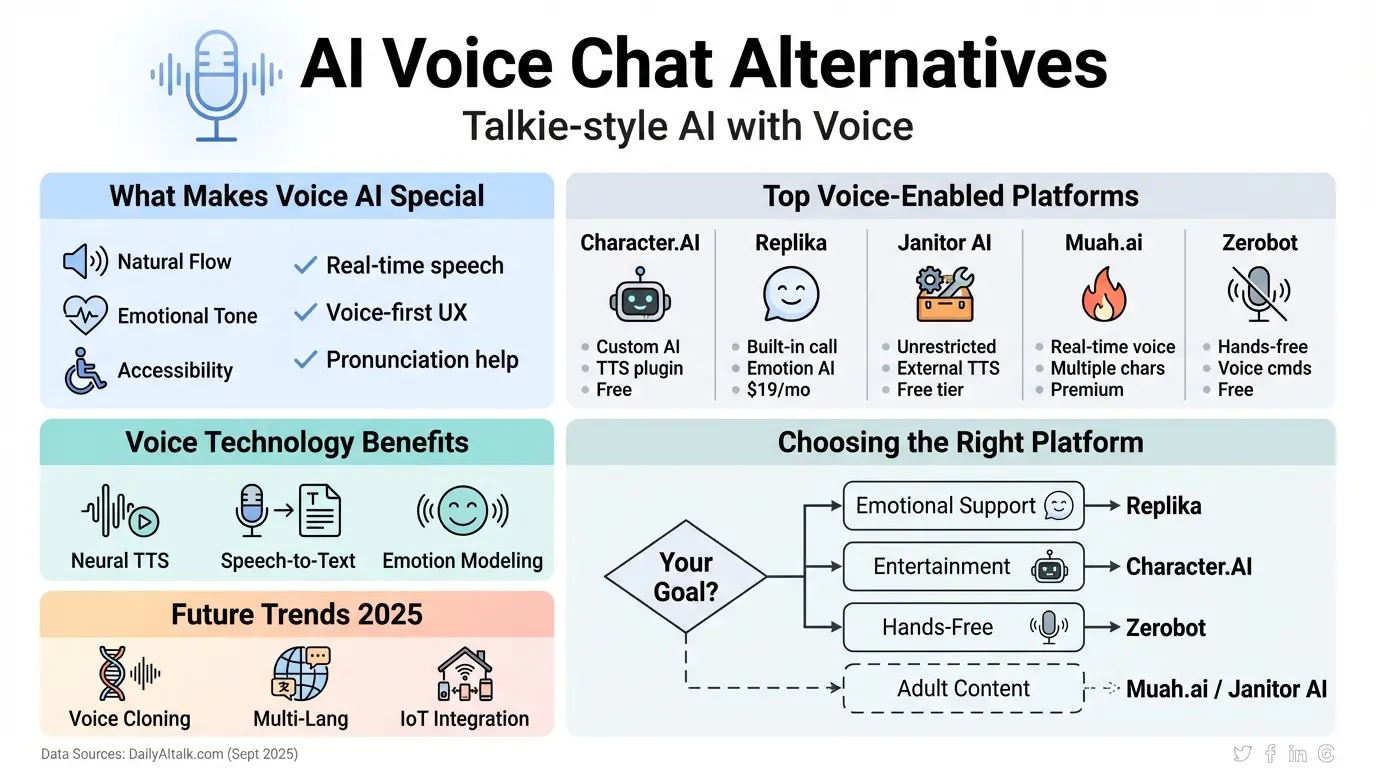
One of the most common reasons users go looking for talkie ai alternatives is the “filter” issue. Many mainstream apps have strict guardrails on what can be discussed. For writers working on gritty fiction or users who want more mature interactions, platforms like Janitor AI or Muah.ai have gained a lot of traction.
These platforms often provide more “raw” access to the underlying LLMs (Large Language Models). Muah.ai, for instance, is known for being an all-in-one platform that handles text, voice, and even photos without the heavy-handed moderation seen on the App Store. However, with that freedom comes a steeper learning curve. You often have to provide your own API keys or navigate more complex settings to get the voice quality just right.
Voice Quality Comparison at a Glance
Choosing between these apps often comes down to how “human” the voice sounds. Not all synthetic speech is created equal. Some apps use basic text-to-speech that sounds like a GPS, while others use advanced cloning technology.
| Platform | Voice Realism | Best Use Case | Cost Model |
|---|---|---|---|
| Character.AI | High | Roleplay & Storytelling | Free / Subscription |
| Replika | Very High | Emotional Support | Subscription Heavy |
| Linky AI | Moderate | Casual Fun | Freemium |
| Zerobot | High | Hands-free Utility | Usage Based |
Why Voice Changes the User Experience
We process audio differently than we process text. When we read, our brains are doing the heavy lifting of imagining the tone and the cadence. When we hear ai chats like talkie speak, that emotional work is done for us. This leads to a much higher level of immersion. This is especially true in the “Talkie” style of app, where you might be interacting with a character in a specific scenario—like a pilot during a flight or a chef in a busy kitchen.
The addition of ambient background noise and vocal inflection makes these scenarios feel “lived in.” It’s the difference between reading a script and watching a play. As we move through 2026, we are seeing more apps add “multi-modal” features, where the AI can “see” your surroundings through a camera while talking to you, making the conversation even more contextual and real.
Privacy and Staying Safe Online
With the excitement of these apps, it is easy to forget that you are sharing data with a server. When you use voice features, you aren’t just sending text; you’re sending audio patterns. Most reputable ai voice chat apps encrypt this data, but it is always worth checking the settings.
- Always check if the app stores your audio recordings for training.
- Use a unique password for AI platforms, as they are often targets for data scrapes.
- Be mindful of sharing highly personal identifiable information (PII) like your home address or bank details.
- Look for apps that offer a “guest mode” if you just want to test the features without committing your data.
The Practical Side: AI Voice for Productivity
While most people look for ai chats like talkie for entertainment, there is a growing group of users leveraging them for work. I’ve started using voice-enabled AI to “rubber duck” my coding problems. Instead of staring at a screen, I explain the logic out loud to an AI agent. Hearing the AI repeat the logic back to me in a human voice often helps me spot the flaw faster than re-reading my own notes.
Apps like Zerobot are leaning into this “voice-first” philosophy. They don’t even bother with a text box most of the time. You just talk. For someone who spends all day at a desk, being able to pace around the room while “chatting” with an AI researcher or a project manager is a huge win for physical health and mental clarity.
Customization: Building Your Own Voice
One of the coolest features emerging in the talkie ai alternatives space is voice cloning. Some platforms now allow you to upload a 30-second clip of a voice (with permission, of course) and the AI will adopt that exact tone and accent. This is a game-changer for creators. Imagine being able to create a custom AI companion that sounds exactly like a character from your favorite indie game or a specific regional accent you find comforting.
This level of customization is what separates a “toy” from a “tool.” When you can control the personality, the knowledge base, and the sound, the AI becomes a reflection of your specific needs rather than a one-size-fits-all product.
Language Learning Through AI Conversation
If you’ve ever tried to learn a language, you know the “fear of speaking” is the biggest hurdle. You don’t want to sound stupid in front of a native speaker. AI chats like talkie are the perfect solution for this. Many of these apps now support 30+ languages with native-sounding accents.
You can tell the AI, “Hey, I’m a beginner in Spanish, please speak slowly and correct my grammar.” The AI doesn’t get frustrated. It doesn’t roll its eyes if you forget the word for “table” for the fifth time. This low-stakes environment is arguably the most practical and beneficial use of voice AI technology today. It turns a lonely study session into a lively interaction.
The Impact on Content Creation and Blogging
As a writer, I find these tools incredibly useful for “voice testing” my own work. Sometimes I’ll feed a paragraph I’ve written into an AI voice agent just to hear how it sounds read aloud. If the AI struggles with the flow, I know a human reader will too. The best ai chat platforms are becoming essential parts of the creative workflow, acting as sounding boards that never sleep.
We are seeing a shift where bloggers and creators aren’t just writing for people; they are writing alongside AI. It’s a collaborative effort. Whether you’re looking for an alternative to Talkie to spice up your commute or to help you build your next big project, the options available in 2026 are more robust than ever before.
Frequently Asked Questions (FAQs)
Are ai chats like talkie safe for younger users?
Most of these apps have age ratings, typically 12+ or 17+. While apps like Character.AI have strict filters, others are completely unrestricted, so parents should always check the specific moderation policies before use.
Do I need a fast internet connection for voice chat?
Yes, voice AI requires more bandwidth than text. For a smooth, lag-free experience, a stable 4G/5G or Wi-Fi connection is recommended to avoid robotic stuttering during the conversation.
Can I create my own character with a custom voice?
On many platforms like Character.AI and Talkie, you can choose from a library of voices. Some advanced alternatives allow you to upload audio samples to clone a specific voice for your custom character.
Is there a limit to how much I can talk to the AI?
Free tiers often have “stamina” or message limits. If you use voice features heavily, you may find that you run out of credits faster than with text, as audio processing is more expensive for the providers.
Which app has the most realistic human voices?
As of 2026, Replika and Character.AI (using ElevenLabs integration) generally offer the most natural-sounding voices with realistic pauses, breaths, and emotional inflections that mimic human speech patterns.
Also Read: AI Code Verifier Performance Metrics: A Critical 2026 Guide for Developers