



AI aggregator: Slash AI Costs 30% and Boost Team Speed!

Discover how an AI aggregator streamlines workflows, slashes subscription costs, and centralizes top-tier models like GPT, Claude, and Gemini into one powerful, human-friendly dashboard.
The Rise of the AI Aggregator: Why One Dashboard is Better Than Ten
If you have spent any time in the tech world lately, you know the feeling of “tab fatigue.” One minute you are in ChatGPT trying to draft a complex email, the next you are switching to Claude because it handles creative nuances better, and then you are jumping over to Google Gemini to check real-time data. It is a digital juggling act that feels more like a chore than a shortcut. I remember sitting at my desk last month, staring at four different billing statements for four different AI tools, and thinking: there has to be a better way to do this.
That is exactly where the concept of an AI aggregator comes in. Think of it as the “streaming service” for artificial intelligence. Just like you use a single platform to access movies from different studios, an aggregator brings the world’s most powerful Large Language Models (LLMs) under one roof. You get one login, one subscription, and one interface to rule them all. It is not just about convenience; it is about reclaiming your focus.
In this guide, we are going to break down why this shift is happening and how moving to a centralized platform can actually make you better at your job. Whether you are a solo freelancer trying to save a few bucks or a team lead looking to sync up your department, understanding the aggregator landscape is the smartest move you can make in 2026.
What Exactly is an AI Aggregator?
At its simplest, an AI aggregator is a unified platform that connects to various AI models via APIs and presents them to you in a single, cohesive workspace. Instead of visiting five different websites, you use the aggregator as your primary “cockpit.” You can flip a switch to move from GPT-4o to Claude 3.5 Sonnet or even the latest DeepSeek model without ever leaving your current chat window.
These platforms usually operate in one of two ways. Some are “Bring Your Own Key” (BYOK), where you plug in your own API credentials, while others offer a bundled subscription where they handle the tokens and usage for you. For most of us, the bundled version is the real winner because it eliminates the headache of managing multiple developer accounts and keeps costs predictable.
Beyond just being a portal, many of these tools add “superpowers” that the original models don’t have. We are talking about shared team folders, advanced prompt libraries, and even the ability to compare two different AI responses side-by-side. It transforms the AI from a simple chatbot into a professional-grade productivity suite.
The Financial Magic of Centralized AI Subscriptions
Let’s talk numbers for a second. If you were to subscribe to ChatGPT Plus ($20), Claude Pro ($20), and Gemini Advanced ($20) individually, you are already looking at $60 a month. Add in a specialized tool for image generation or SEO research, and you are pushing $100. For a small business, this “SaaS creep” is a silent budget killer.
An AI aggregator platform usually offers a single premium tier—often around $20 to $30—that gives you access to all these flagship models. You are essentially getting three or four premium memberships for the price of one. It is one of those rare moments in tech where the better experience is actually the cheaper one. I’ve seen teams cut their software overhead by 50% just by migrating their AI usage to a single aggregator hub.
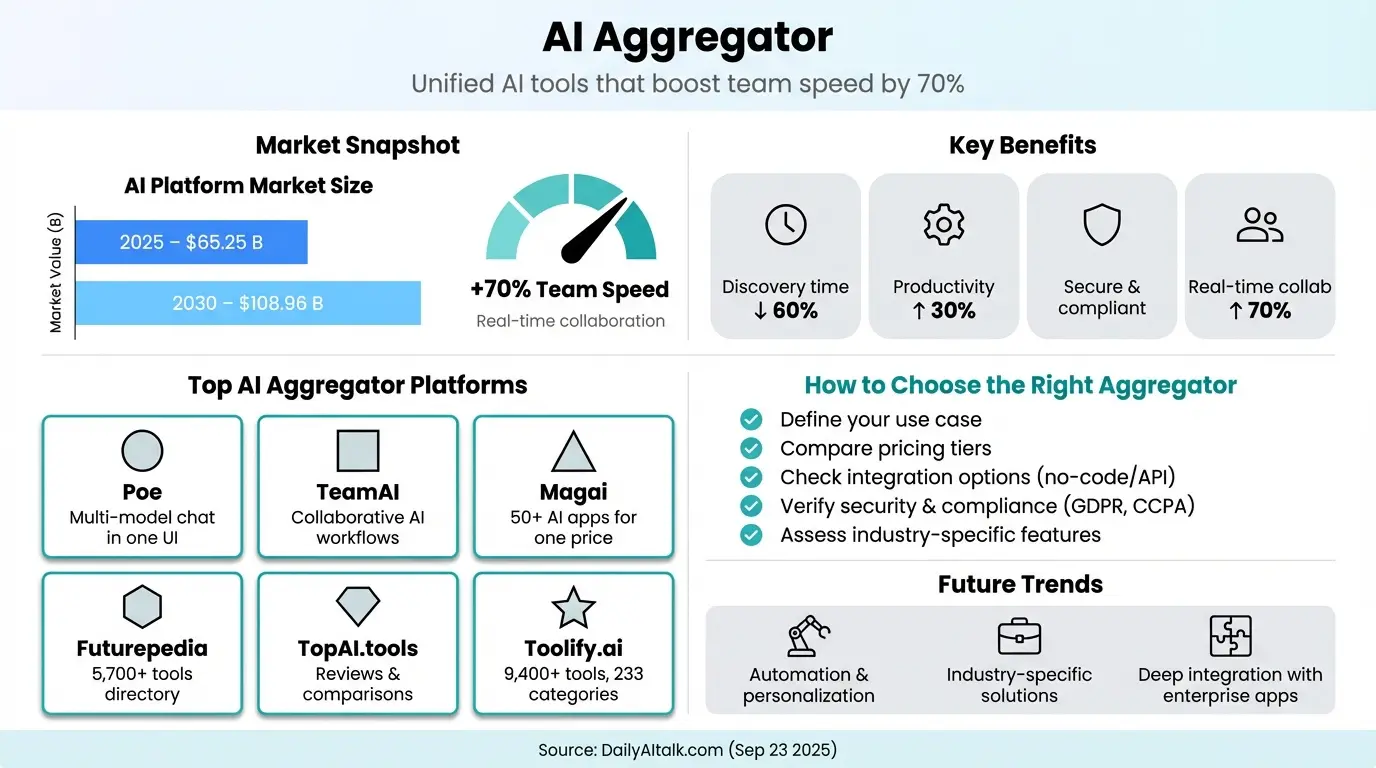
Top AI Aggregator Tools Dominating 2026
The market has moved fast, and we now have some incredibly polished options. Choosing the right one depends mostly on whether you are working alone or with a group. Here is a look at the heavy hitters currently making waves:
- Poe: Created by the folks at Quora, this is probably the most consumer-friendly option. It is fast, has a great mobile app, and lets you create your own “bots” with ease.
- Aymo AI: Formerly known as Geeky.chat, this has become a favorite for teams. It supports over 45 models and focuses heavily on secure, collaborative workspaces.
- TypingMind: This is the gold standard for power users. It offers a stunning UI and follows the BYOK model, meaning you only pay for what you actually use through your API keys.
- MagAI: Perfect for marketers, this platform includes creative personas and built-in templates specifically designed for content production.
How Aggregators Improve Team Collaboration
If you have ever tried to share a ChatGPT link with a teammate only to realize they can’t see the full history or edit the prompt, you know the frustration. Standard AI interfaces are built for individuals, not teams. Aggregators fix this by treating AI chats like Google Docs.
In a professional AI aggregator, you can create “Workspaces.” Imagine your marketing team having a dedicated folder where everyone can see the prompts used for the latest campaign. You can leave comments, tag colleagues, and keep a “organizational memory” of what worked and what didn’t. This transparency prevents the same mistakes from being made twice and helps junior employees learn how to prompt by watching the pros.
Real-world example: A boutique design agency I worked with last year used an aggregator to manage their client research. By having a shared history, the account manager could jump into a chat started by a researcher and immediately have the context needed to draft a proposal. They reported a 30% increase in workflow speed simply because they stopped wasting time copying and pasting text into Slack.
Comparison of Popular AI Model Features
| Feature | GPT-4o (OpenAI) | Claude 3.5 (Anthropic) | Gemini 1.5 (Google) |
|---|---|---|---|
| Best For | Logic \& General Tasks | Creative Writing \& Coding | Large Context \& Research |
| Context Window | 128k Tokens | 200k Tokens | 1M+ Tokens |
| Speed | Very High | High | Moderate |
| API Availability | Excellent | Good | Excellent |
Solving the Accuracy Problem with Multi-Model Testing
No AI is perfect. They all hallucinate occasionally. But here is the trick: they rarely hallucinate the exact same thing at the same time. Using an AI aggregator allows you to perform “cross-verification.” If you are writing a technical report and aren’t sure about a specific fact, you can run the same prompt through Claude and GPT simultaneously.
If both models agree, you can move forward with much higher confidence. If they disagree, you know exactly where you need to dig deeper and do some manual fact-checking. This “triangulation” method is becoming a standard practice for developers and researchers who can’t afford to be wrong. It is much easier to do this when you have both windows open side-by-side in one tool rather than clicking through browser tabs like a maniac.
The Security and Privacy Advantage
Privacy is the big elephant in the room when it comes to AI. Many people are rightfully worried about their sensitive data being used to train future versions of these models. Most reputable AI aggregators offer an “Enterprise” or “Privacy-First” mode. Because they connect via API, they can often opt-out of data training by default.
When you use a platform like TypingMind or Aymo, your data stays in your workspace. For businesses dealing with client confidentiality, this is a non-negotiable requirement. It is much easier to vet the security of one aggregator platform than it is to audit the privacy settings of ten different individual AI startups.
Future Trends: The Era of “Agentic” Aggregators
We are moving past the “chatbox” era. The next generation of AI aggregators won’t just sit there waiting for you to type; they will be proactive. We are starting to see “AI Agents” that can use multiple models to finish a multi-step task. For example, an agent might use GPT to research a topic, Claude to write the draft, and a specialized SEO model to optimize it—all without you lifting a finger.
By centralizing your access now, you are setting yourself up to take advantage of these autonomous workflows as they mature. The “AI content aggregator platform” of the future will likely be an orchestrator that picks the best tool for every sub-task, ensuring the highest quality at the lowest cost.
SEO and Content Creation with an AI Aggregator
For those of us in the content world, these tools are game-changers. An AI news aggregator website can pull in the latest trends, while your LLM dashboard helps you synthesize that info into a blog post. The “best AI aggregator tools” today include features like:
- Direct WordPress integration for one-click publishing.
- Bulk processing for generating meta descriptions or social posts.
- Style “Memory” that ensures the AI always sounds like your brand.
Instead of just being a writing assistant, the aggregator becomes a full-blown content engine. You can maintain a consistent voice across different models, which is vital if you want your SEO efforts to actually convert readers into customers.
Choosing Your First AI Aggregator: A Simple Checklist
Ready to make the jump? Don’t just pick the first one you see. Here is how I evaluate a platform before I commit my data and my budget to it:
- Model Variety: Does it actually have the models you use? Check for Claude and the latest OpenAI versions.
- Latency: Is the interface snappy? If the aggregator adds 5 seconds of lag to every prompt, it will drive you crazy.
- Searchable History: Can you actually find that chat you had three weeks ago? Good indexing is key.
- Mobile Support: Do they have a native app or at least a very good mobile-responsive website?
- Export Options: Can you easily get your data out if you decide to switch platforms later?
Choosing a platform with these features ensures that you aren’t just trading one set of problems for another. You want a tool that feels invisible—something that gets out of your way and lets you do your best work.
The Final Word on AI Consolidation
The “wild west” era of AI where we all had dozens of accounts is coming to an end. Efficiency is the new priority. By moving your workflow to an AI aggregator, you are not just saving money—you are saving mental energy. You are building a central library of your thoughts, prompts, and discoveries.
If you are still on the fence, I highly recommend trying out a free version of a tool like Poe or checking out the collaborative features on Aymo AI. Once you experience the “one-stop-shop” life, going back to individual tabs feels like stepping back into the dark ages.
Frequently Asked Questions (FAQs)
What is the difference between an AI aggregator and using individual AI tools?
An AI aggregator provides access to multiple AI models and tools through a single interface and subscription, eliminating the need for separate accounts. Individual tools require separate logins and payments, which can be more expensive and harder to manage.
How much can businesses save by using AI aggregators?
Most users save between 40% and 60% on subscription costs by replacing multiple $20/month accounts with one aggregator plan. Additionally, the time saved in switching between apps can boost team productivity by up to 30%.
Are AI aggregators secure for business use?
Yes, reputable aggregators use enterprise-level encryption and connect via official APIs. Most allow you to opt-out of data training, ensuring your proprietary business info isn’t used to train public models from OpenAI or Google.
Which AI aggregator is best for beginners?
Poe is widely considered the best for beginners due to its simple interface and excellent mobile app. For those who want more professional features without a steep learning curve, Aymo AI is a fantastic secondary option.
Can I use my own API keys with these platforms?
Some platforms like TypingMind are built specifically for the “Bring Your Own Key” (BYOK) model. This is great for developers or power users who want to pay only for the exact amount of data they consume at wholesale rates.
Also Read: AI Trend Analyzer: Transform Your Business with Powerful Insights in 2026