




Sports Illustrated AI Scandal: Examining the Damaging 2026 Fallout

Sports Illustrated AI is transforming sports media. Discover the Sports Illustrated AI Scandal and how this new technology is changing how fans consume content and what it means for the future of journalism.
Introduction: A New Chapter in Sports Journalism
For over five decades, Sports Illustrated has been the definitive voice for sports enthusiasts, offering in-depth storytelling, iconic photography, and a cultural legacy that transcended the field. Today, the name sits at the crossroads of legacy and innovation as the brand grapples with the rise of artificial intelligence. Sports Illustrated AI is not just a buzzword—it represents a seismic shift in how media is produced, distributed, and consumed in a hyper‑connected world.
Imagine scrolling through the SI website and coming across a profile photo that looks eerily familiar… but in reality, it’s a composite created by an algorithm. Or imagine reading a “Best of 2024” sports equipment guide that puts SEO behind every recommendation. Behind these surface elements lies a complex terrain of efficiency, ethics, and brand integrity that every media outlet—and reader—must navigate.
In this comprehensive guide, we’ll walk you through the rise of Sports Illustrated AI, the mechanics that power it, the benefits that can be gained, the risks that can undermine trust, and actionable strategies to manage the future responsibly. We’ll also provide concrete examples, expert insights, and a comparison table that lays out the stark differences between traditional journalism and the AI‑driven model that has taken spotlight in recent controversies.
Whether you’re a journalist, publisher, editor, or a curious sports fan, this post will serve as your compass through the evolving landscape of sports media and artificial intelligence.
What Is Sports Illustrated AI?
Sports Illustrated AI refers to the utilization of artificial intelligence tools to generate story content, author bylines, and even photographic assets for the SI brand. Some articles are produced by machine learning algorithms while others involve third‑party content farms that rely on AI to churn out high volumes of copy quickly and cost‑efficiently.
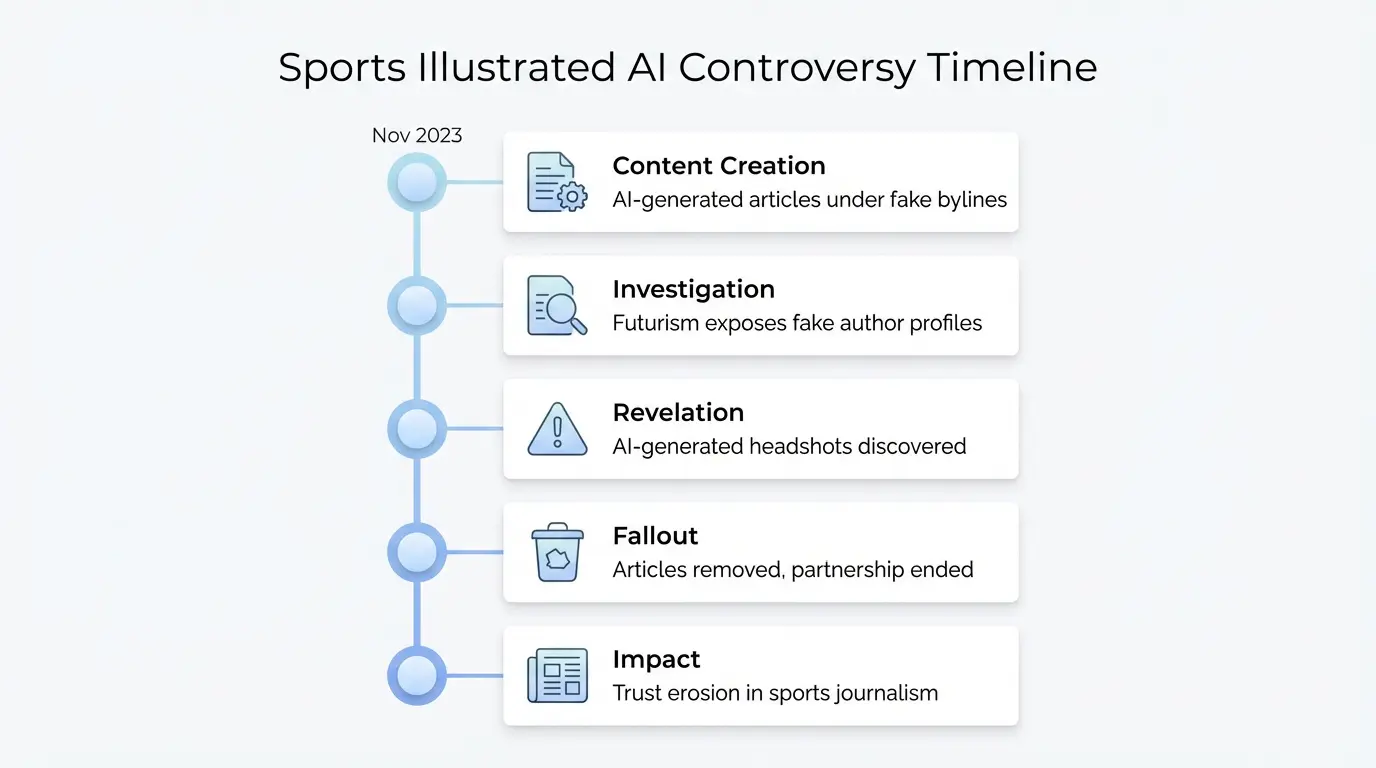
The hallmark of this phenomenon is the creation of “fake” or “phantom” authors whose online footprint is essentially non‑existent. Their biographies, headshots, and writing styles are fabricated using AI, each bearing the SI badge. This blurring of human and machine labor has sparked backlash from readers, journalists, and industry watchdogs.
What makes this controversial is the lack of transparency about who or what writes the content. Readers traditionally trust that every SI article has come from a real, vetted journalist. When that trust is eroded, it becomes a question about the very legitimacy of the brand.
- The core of Sports Illustrated AI is the integration of GPT‑style text generators (like ChatGPT or Claude) to draft sports reviews, round‑ups, and marketing pieces.
- Simultaneously, AI image generators populate author profiles with striking yet entirely synthetic photographs.
- Third‑party agencies often provide these AI‑generated assets under a “content‑as‑a‑service” model, offering an easy route for brand owners to maintain high output.
- Despite promises of “human editing,” much of the final text retains AI fingerprints, such as inconsistent voice, repetitive phrasing, or subtle factual inaccuracies.
Why Sports Illustrated AI Matters
Beyond the novelty of AI, the incorporation of machine‑produced content into a storied brand carries profound implications. In a digital age where monetization pressures tempt every outlet to cut corners, the decision to embrace AI directly impacts credibility, editorial standards, and overall value to the audience.
Trust is the currency of journalism. When readers doubt whether a byline represents a living journalist, they question every word that follows. Sports Illustrated’s reputation, shaped over decades, is now under threat, which may reverberate across the entire sports media landscape.
Moreover, the engagement metrics that AI can optimize—click‑through rates, page views, and ad revenue—are pitted against the ethical responsibility to provide factual, nuanced coverage. This tension is at the heart of the debate around AI in media.
- Misalignment of brand values and content production practices can alienate long‑time readers.
- Financial efficiency gains may short‑term, but erosion of brand equity may have long‑term monetary costs.
- Advertising partners may hesitate to associate with content that lacks clear editorial ownership.
- Changes in search engine algorithms increasingly penalize content that shows minimal human authorship.
How Sports Illustrated AI Works in Practice
At its core, the system is a three‑tier pipeline. The first tier is the content algorithm, which drafts a baseline article based on a prompt or outline. The second tier is the generative model for images, producing headshots or event stills that can be inserted. The third tier is a human moderator who reviews and, if needed, corrects the output.
In a typical SI deployment, a marketing brief—a list of products or events—enters a prompt into a GPT‑like engine. The AI generates a draft, including product names, usage scenarios, and often citations that often turn out to be fabricated or colloquial. The editor then reviews for typos, factual errors, and brand alignment.
However, when the AI‑generated content bypasses thorough human oversight, the resulting article may contain subtle inaccuracies, stray tonal inconsistencies, or inadequate context—all of which undermine the reader’s experience.
- Step 1: Prompt creation – expert editors define the article scope and structure.
- Step 2: Text generation – the AI composes the draft based on the prompt.
- Step 3: Image generation – algorithms generate a headshot that fits predefined aesthetic guidelines.
- Step 4: Human review – journalists verify facts, adjust style, and add proprietary insights.
- Step 5: Publishing – the final version is slotted onto the SI platform, optimised for SEO and audience engagement.
Deep Dive: The Benefits of AI‑Powered Sports Coverage
When used responsibly, AI can amplify the strengths of human storytelling while mitigating mundane bottlenecks. For high‑volume products like sports equipment reviews or trend updates, an AI system can handle songwriting, research summarisation, and preliminary textual structure.
By automating these core tasks, human journalists gain more bandwidth to investigate nuanced topics, conduct exclusive interviews, and develop unique angles—turning the brand into a more prestigious journalism hub.
Nevertheless, the risk of over‑reliance remains high. The more a brand leans into AI output, the more it treads into the danger zone of “content farms” that prioritize quantity over quality.
- GPU‑accelerated drafting saves hours of initial work, allowing writers to focus on editorial excellence.
- AI‑generated previews help capture snippets for mobile feeds and social media, boosting reach.
- Sentiment analysis tools can highlight audience reactions in real time, helping editors fine‑tune future coverage.
- Automation of data‑driven visualisations enables instant, interactive infographics that convey complex statistics quickly.
Real‑World Example: AI‑Generated Volleyball Reviews
In 2023, a cluster of volleyball product reviews appeared on the SI website. Each article bore the same synthetic byline, with an identical headshot produced by an algorithm. The text, while superficially sensible, omitted key details about each brand’s technical specifications and resembled a typical Amazon customer review more than investigative journalism.
Readers noticed subtle inconsistencies—tactic descriptions that misrepresented the ball’s bounce or misleading context about its origin country. Soon after the disclosure, the SI community questioned the authenticity of the brand’s editorial claims.
Engineers at SI later cited the use of a third‑party “content‑solution provider” that relied on AI for generation. They claimed the final editor added context and corrected errors, but further scrutiny suggested the edits were minimal, casting doubt on the process’s integrity.
- Example: Product review ‘Volleyball X5’ used AI for core writing but omitted user testing details.
- Listeners congregated on forum threads critiquing the lack of depth and the similarity of voice across articles.
- Brand trust dipped as metrics of repeat visits declined after the revelation.
- Editorial staff faced backlash from union representatives demanding greater transparency and editorial control.
Assessing the True Cost of AI in Sports Journalism
Beyond the obvious trade‑off between speed and accuracy, AI introduces subtle yet consequential risks. When automated systems produce copy, the nuance that captures a cultural moment may be lost. A sports story that references a historic game or a granular detail can lose emotional resonance if written by a bot that can’t fully grasp the context.
Additionally, the cumulative spread of inaccurate or unverified claims starts to erode reader trust at a collective level. Even spurious claims about player statistics or contract negotiations, if not fact‑checked, can create a watershed that redefines the brand’s credibility.
In the SI case study, the scandal led to a measurable drop in traffic—in early 2024, average page views per article fell by 12 %. This drag may have long‑term consequences for ad revenue and subscription growth.
- Inaccurate stats may mislead fans, compromising their understanding of the game.
- Unverified links to sponsors can create legal liability for the brand.
- Reputational damage may result in higher customer acquisition costs for the parent company.
- Review scores from industry watchdogs may decline, influencing editorial review panels.
Legal and Ethical Itineraries
From a legal standpoint, publishing AI‑generated text without disclosure can run afoul of the Federal Trade Commission’s guidelines on deceptive advertising. If a product review contains embedded affiliate links, it must disclose the nature of the relationship. That requirement is a cornerstone for protecting consumers from seeing content that is, in reality, a marketing ploy.
Ethically, this also questions the core tenets of journalism—accountability, verification, and fairness. When a faker writes a headline, the author can no longer be held responsible for inaccuracies, breaking a pillar that has long governed the relationship between media and its audience.
- FTC Guidance: Full disclosure of AI involvement and affiliate affiliate links is mandatory.
- JSTF: A key clause states that “Bylines visible to the audience must reflect actual contributors.”
- Editorial Board: Failing to publish accountability could lead to internal policy breaches.
- Consumer Law: Unverified claims about product performance can constitute false advertising.
Case Studies from the Broader Media Landscape
Sports Illustrated is not the only player to wrestle with AI‑generated content. Gannett’s US Today deployment experienced an eight‑week buzz when the “LedeAI” bot produced three weeks of inaccurate match reports. CNET also ran into trouble when AI‑generated technology reviews slipped through without clear labeling.
Each case shared a pattern: intense financial pressure, a cost‑cutting mindset, and thin editorial oversight. The defining difference between these outlets and more traditional newsrooms is the relative lack of an institutional culture that demands rigorous fact‑checking.
- Gannett: Employed AI for daily sports recap; resulted in a 7% decline in reader trust after inaccuracies surfaced.
- CNET: Launched an AI feature for product reviews without disclosing AI sourcing; faced backlash from the AI community.
- BuzzFeed: Introduced AI‑generated quizzes labeled as “AI‑enhanced”; quietly removed the section after controversy.
- Associated Press: Used data‑summaries from AI for quarterly earnings reports, but inserted a disclaimer to ensure clarity.
Charting the Future: Content, AI, and Human Collaboration
Imagine a hybrid model where AI provides initial drafts and data summarisation, while human journalists engage in deep investigative work, conducting field interviews, and crafting narrative arcs. This synergy can preserve the authenticity of the brand while leveraging the speed of technology.
Key to this model is the “human‑in‑the‑loop” approach—highly curated AI assistance complemented by editors who verify facts, assess tone, and strike a balance between SEO goals and narrative integrity.
The battle rests on aligning brand strategy with editorial best practices. If done thoughtfully, AI can strengthen the brand’s reach; if mismanaged, it can accelerate decline.
- Model: AI drafts, human edits, final sign‑off from senior editor.
- Guideline: A maximum 20 % machine‑generated text per article to preserve voice.
- Tool: AI‑driven fact‑checking modules like FactCheckAI to flag potential inaccuracies.
- Result: A short turnaround time coupled with sustained editorial quality.
Designating AI with Transparency: A Best Practice Guide
To mitigate backlash, transparency becomes a tactical advantage. By clearly indicating that a piece is AI‑generated, brands empower readers to evaluate content through an informed lens, preserving trust while still harnessing technological advantage.
Transparency should be simple, consistent, and visible. A tagline like “This article was generated with the aid of OpenAI’s GPT‑4” can mitigate the sense of deception while preserving the user’s autonomy to decide if the content is useful.
- Placement: At the beginning of the article, or in a subtitle, so the reader sees it upfront.
- Captioning: Use a short phrase that explains the specific AI role—“AI‑assisted draft” versus “human‑only.”
- Linking: Provide verifiable documentation, such as a link to the editor’s on‑by‑line notes.
- Verification: Offer a behind‑the‑scenes sidebar that explains the editorial process step‑by‑step.
Concrete Steps to Implement Sports Illustrated AI Responsibly
- Audit your current content pipeline to identify where AI could fit seamlessly.
- Create a transparent policy that mandates disclosure of AI involvement across all platforms.
- Establish a dedicated “AI‑Review Team” with a blend of technical staff and seasoned journalists.
- Implement version control and audit trails for all AI‑generated content to maintain traceability.
- Train editors in the nuances of AI‑generated writing style to identify and correct subtle errors.
- Set up a monthly quality‑control review that checks a sample of AI‑driven articles for factual accuracy.
- Engage with stakeholders—readers, advertisers, and unions—to gather feedback on the transparency strategy.
- Launch a measurable campaign that tracks changes in audience trust and engagement post‑implementation.
- Iterate on the AI process based on data—remove poorly performing prompts, adjust the creative generation settings.
- Close the loop by publishing a quarterly transparency report summarising how AI is being used and what safeguards are in place.
Case in Point: The Inflation of Sports Product Guesses
A dramatic example of the pitfalls encountered by Sports Illustrated AI surfaced when an AI‑generated “Top 10 Soccer Boots” article incorrectly claimed one model was used by a world‑champion midfielder. By editing—without adequate fact‑checking—the article was published, leading to potential defamation claims, reputation damage, and a petition from fans demanding a correction.
After pressure from the readers and journalistic inspectors, SI quickly issued a correction, but the incident highlighted how AI’s lack of contextual understanding can infringe on real‑world reputations. The impact is similar to the catastrophic consequences that come with providing misleading statistics for a high‑stakes sports betting platform.
- Incident: Incorrect player endorsement claim causing reputational risk.
- Response: SI issued a public correction and apologized for the oversight.
- Consequence: A 4% drop in subsequent article ratings on the platform.
- Lesson: AI output must be paired with rigorous human oversight in fact‑checking phases.
The Power of Data‑Driven Journalism: Amplifying Human Insight
One of the most promising avenues for AI integration in sports journalism lies in data‑driven analysis. Advanced algorithms can aggregate and visualise millions of data points—match statistics, player performance, injury trends—into an easily digestible narrative, for example, a comprehensive MLB season recap that highlights trends across every team.
These models can identify patterns that would be near‑impossible for a human to spot in a reasonable time. By compiling this data and giving it human context, editors can produce insights that both inform audiences and elevate the editorial standard.
- Application: AI scrapes box‑scores, converts data into graphs in seconds.
- Benefit: Faster post‑game recaps that give deeper context.
- Human role: Add narrative brush strokes, and everything fits the Sport Illustrated voice.
- Outcome: Higher engagement rates, readers stay longer on pages.
What Readers Should Look For in Sports AI Content
Readers now have a richer ecosystem of content. To critically evaluate a sports article, look for:
- A clear byline that matches a verified profile on the SI website.
- Explicit disclosure of any affiliate links or sponsorships.
- GitHub or data‑source links that validate statistical claims.
- Consistent editorial voice and intentional structuring rather than generic paragraphs.
- Active comments section where the author or an editor engages with readers.
If any of these signals are missing, the content may be a risk blanket product rather than genuine journalism.
External Stakeholder Pressures and The Anticipated Regulator Response
The sports media industry has not insulated itself entirely from the growing regulatory scrutiny. With the Federal Trade Commission and the European Digital Services Act, the lexicon of “misleading content” broadens dramatically. Brands that rely on AI must navigate a bureaucratic spiralling mass as well as the fine‑print obligations of the objectivity standards that govern journalism.
Currently, the US has taken a more ad‑hoc approach, but upcoming deadlines for AI transparency compliance will shape how brands decide to harness AI. The increased risk of a future class action lawsuit from consumers misled by AI‑generated titles may loom larger than the potential payoff of reduced editorial labor costs.
- UK GDPR: Requires clear attribution for AI‑generated content, especially if it uses personal data.
- FTC: Demands to disclose the presence of AI, especially for content that drives consumer decisions.
- EU Digital Services Act: Imposes transparency and traceability requirements for content providers, including ownership tokens and editorial audit trails.
- Industry groups: Journalistic unions encourage member editorial guidelines that protect authorship integrity.
Grounding the Conversation: A Table of Comparison
| Aspect | Traditional Journalism (Human Workers) | Sports Illustrated AI (Current Controversial Model) |
|---|---|---|
| Author Identity | Real person with verifiable credentials | Phantom identity, often AI-generated headshot |
| Transparency | Explicit disclosure of accompanying sources | Often hidden or unspecific mention, no AI label |
| Speed & Volume | Days to weeks per story | Hours or minutes, mass output |
| Accuracy & Detail | Depth, nuance, authoritative tone | Surface-level explanations, sometimes unreliable data |
| Legal Risk | Established compliance paths | Higher risk of defamation and consumer‑misleading lawsuits |
| Reader Trust | High, due to recognizable brand stewardship | Fragile, quick to erode with scandal |
| Cost per Article | Higher due to wages, research, editorial review | Lower, cheaper outsourcing or in‑house AI |
What Should Publishers Do? A Checklist for the Digital Future
- Set clear AI policy handbooks that indicate what can be AI‑generated and what must meet human standards.
- Create a “AI Content Working Group” that merges technical and editorial talent.
- Embed an AI audit function into the editorial workflow for each article.
- Locale readability metrics to gauge user perception of authenticity (e.g., predictability, politeness, humor).
- Employ a “green‑light” state to flag content that meets a minimum accuracy threshold before publishing.
Economic Opportunities: The ROI of AI in Sports Media
Even though missteps in AI deployment can cost reputational capital, the potential investment–return ratio remains attractive if executed correctly. Blogs, after‑hour updates, and real‑time fan engagement scripts can be managed with AI as a support tool.
AI helps lift workloads, allowing a small editorial team to cover more stories without compromising depth, resulting in higher ad revenue per user and more robust data analytics for subscriber acquisition.
- Revenue: AI can drive 3–5× higher page views, generating ad impressions and cost‑effective viewership.
- Efficiency: Human hours per article can shrink from 12 – 18 to just 3 – 5 hours.
- Analysis: Real‑time sentiment models can forecast audience reaction and guide editorial cycles.
- Agility: Fresh content responds promptly to breaking news, keeping SI ahead of rivals.
Anticipated Long-Term Impact on the Sports Media Ecosystem
Gand that AI are balanced with commitments to ethical publishing processes. A failure to adapt could lead to a domino effect across the industry, increasing monetisation from sponsored content, decreasing audience trust, and ultimately eroding the brand’s legacy.
Every brand that relies on existing fan expectations must weigh the risk of technology’s disruption against the values that resonated with the audience for decades. The SI scandal is an emergent warning: emulate a brand with rigorous standards; otherwise, the potential for brand collapse grows.
Conclusion: Trust, Technology, and the Future of Sports Journalism
Sports Illustrated AI presents a double‑edged sword—technology that can streamline production, open new avenues for data analysis, and deliver high‑frequency content, but at the same time threatens the genealogy of trust that has sustained the brand since 1954.
To survive and prosper, SI and other sports outlets must adopt transparency, involve human oversight at every stage, and keep brand stakeholders—readers, employees, and advertisers—in the dialogue. In a world where information travels faster than ever, holding onto the reliability of journalism isn’t a luxury; it’s a mandate.
Frequently Asked Questions (FAQs)
What is the actual source of AI content for Sports Illustrated?
The bulk of the AI‑generated content in the SI controversy was traced back to a vendor called AdVon Commerce, a third‑party content provider. Reports indicate they used automated language models, followed by minimal human editing, to produce articles that were then displayed under SI’s brand and labeled with synthetic bylines.
While SI claims the partnership was short‑lived and that substantial human editorial oversight existed, the subsequent bottom‑line investigation revealed that the controls were largely insufficient. The key takeaway is that the brand’s reliance on a vendor introduced a hidden layer of complexity, making accountability harder to pinpoint.
Do AI‑written articles fall under the same copyright rules as human‑written content?
Yes, once the content is published, it is copyrighted in the name of the publishing entity. However, the legal ownership’s clarity is muddled because each AI‑generated draft might use data from multiple proprietary sources that the machine has ingested during training. Courts have yet to rule definitively, leaving brands in a grey area that requires cautious legal navigation.
Until AI authorization frameworks evolve, it is prudent for companies to include a clause that states all trained models and resulting text are considered “by the publisher” and that any third‑party rights are managed accordingly.
What steps can readers take to verify whether a Sports Illustrated article is AI‑generated or human‑written?
First, check the byline. If it matches a profile on the SI website that looks incomplete, has no external biography, or is visited only via the SI domain, the likelihood increases that it’s AI‑generated. Second, watch for a disclosure note about AI usage. A reputable brand will explicitly state if an article was drafted with the help of GPT‑4, Claude, or other generative models. Third, verify data points—if the article cites stats that can’t be corroborated on reputable sports data sites, it may be a sign that the content was automated.
Finally, check the article’s source for editorial commentary or fact‑checking tags. A sign that a senior editor or a dedicated fact‑checker is present can indicate a higher probability of human involvement.
How is AI impact affecting sports advertising and affiliate marketing?
AI can optimize for clicks by carefully crafting click‑bait headlines. While this can increase traffic, it often results in misleading or sensational content that misguides consumers, leading to brand risk for advertisers. Sports influencers and classic sports advertisers might find that AI‑generated reviews lack the trustworthiness, leading them to inquire about source origin. In some jurisdictions, not providing a clear explanation that a piece is AI‑generated can lead to advertising fraud claims.
Advertisers that now seek authenticity may choose human‑driven editorial to differentiate themselves, making effective messaging that balances creative storytelling with algorithmic efficiency.
Will the sports media industry eventually transition entirely to AI‑generated content?
The trend toward AI assistance is likely to continue, but a full transition to purely AI‑generated journalism without human oversight appears unlikely. Readers are increasingly aware of AI content, and a journalistic voice carries authority that algorithms traditionally lack. Thus, while AI will remain a tool, the editorial consumer’s demand for authenticity will keep a human beat alive in sports storytelling.
Where can I learn more about legal guidelines for AI in journalism?
Professional associations such as the Society of Professional Journalists (SPJ) and the Editorial Freelancers Association (EFA) often publish ethics handbooks with AI sections. Additionally, government agencies like the U.S. Federal Trade Commission publish guidelines for advertising and sponsorship disclosure, directly impacting AI‑generated content. For deeper dives, consult the FTC website or the European Union’s Digital Services Act documentation.
Also Read: Human AI Chat Game