


AI Mastery Plan 28-Day Challenge: A 2026 Guide to Practical Skills
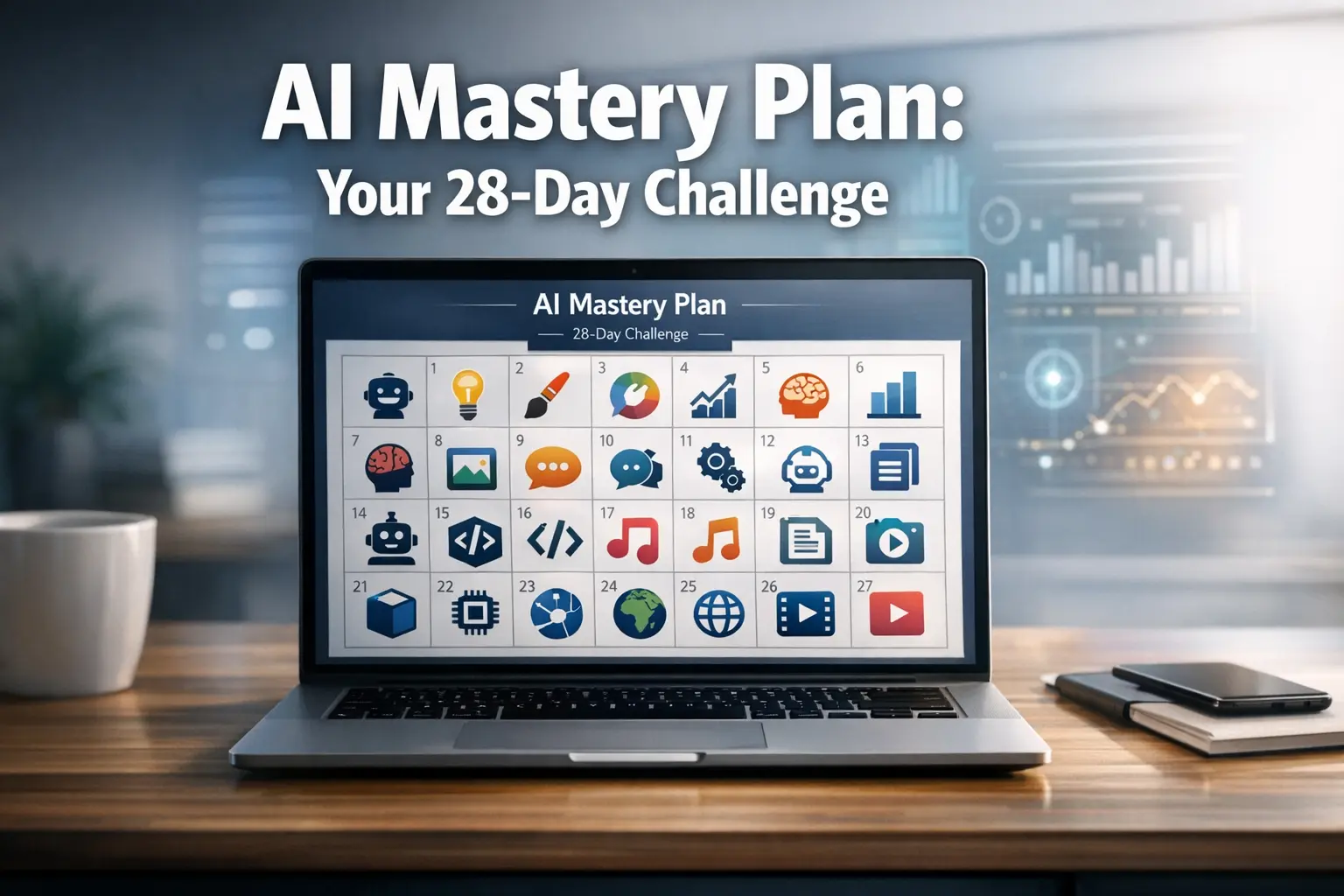
Begin your AI mastery plan with our 28-day challenge. Learn practical AI skills, build projects, and transform your understanding of artificial intelligence step-by-step.
Understanding the AI Mastery Plan 28-Day Challenge
The AI Mastery Plan 28-Day Challenge represents a significant shift in how professionals develop skills for the artificial intelligence era. Unlike traditional programs that take months or years, this intensive experience packs essential AI knowledge into four focused weeks. The challenge uses proven learning techniques like spaced repetition, combining short daily lessons with practical application to build lasting skills through hands-on experience.
At its heart, this program breaks down AI mastery into three key areas:
| Dimension | Focus Areas | Time Allocation |
|---|---|---|
| Technical Skills | Crafting effective prompts, automating workflows, connecting tools | 35% of program |
| Practical Strategy | Business implementation, measuring results, gaining advantage | 45% of program |
| Responsible Use | Ethical AI practices, reducing bias, protecting privacy | 20% of program |
Why 28 Days Works for Learning AI
Research shows that four weeks is the ideal timeframe for creating real behavioral change. The challenge makes the most of this through:
- Daily skills that build on what you learned before
- Practical applications that connect to your current work
- Real-world practice that reinforces new knowledge
- Visible progress that keeps you motivated
People who complete the challenge typically go through three clear phases:
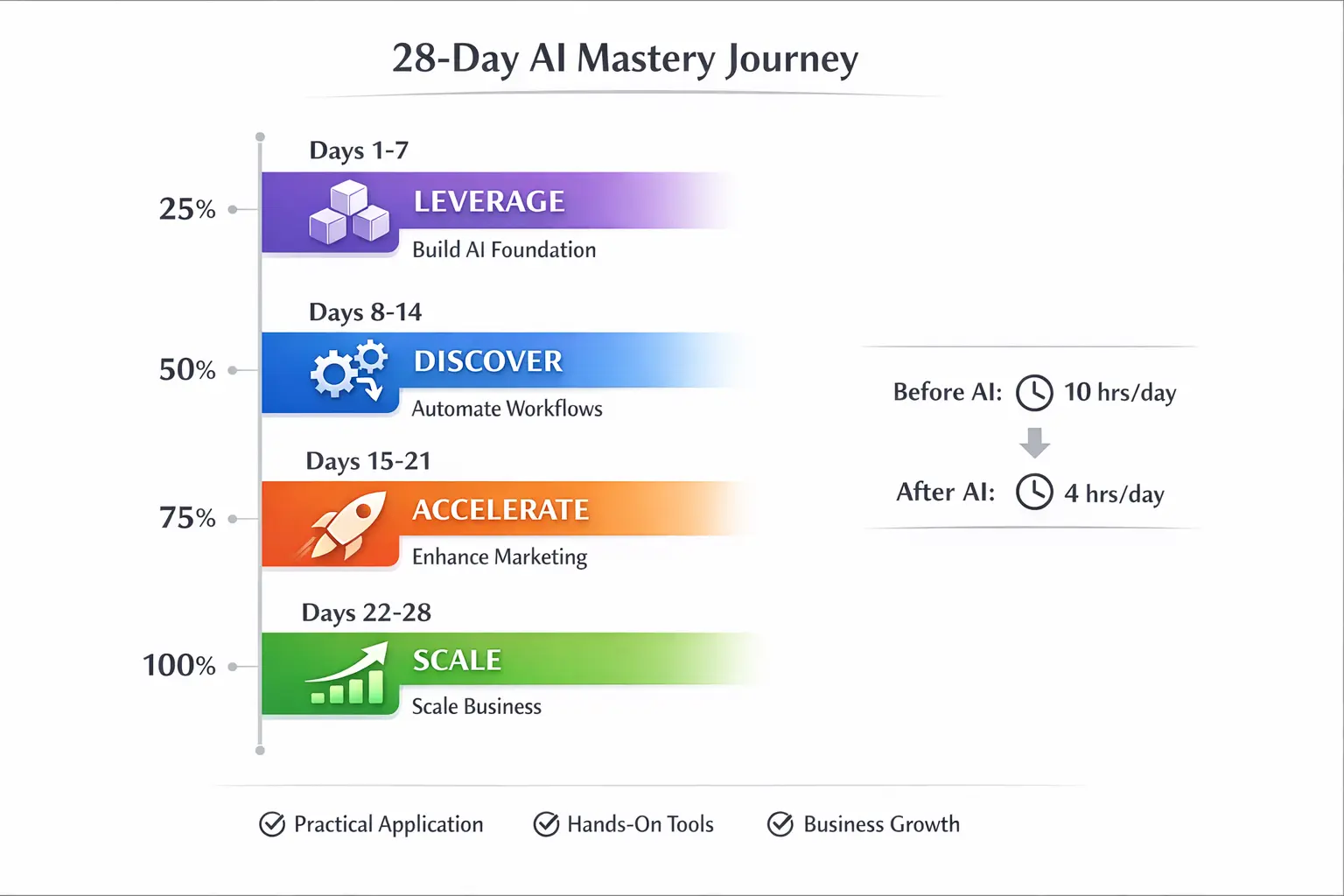
- Finding Your Feet (Days 1-7): Discovering what you don’t know while learning basics
- Building Confidence (Days 8-21): Carefully applying new skills with focus
- Working Naturally (Days 22-28): Making AI tools part of your daily routine
The Complete 28-Day AI Learning Roadmap
What makes this AI mastery program stand out is its organized approach to skill development. Here’s the complete week-by-week plan that’s helped thousands succeed.
Week 1: Laying the Groundwork (AI Essentials)
The first week focuses on core AI skills while overcoming common mental barriers to tech adoption. You’ll work with:
| Day | Focus Area | Key Activities | Outcomes |
|---|---|---|---|
| 1 | AI Orientation | Understanding the tech landscape, setting goals, picking tools | Personalized AI toolkit plan |
| 2 | Prompt Crafting | Structured prompt formats, improving output quality | Significantly better results from AI |
| 3 | Workflow Review | Analyzing how you spend time, finding automation opportunities | Clear list of tasks to automate |
| 4 | Content Automation Basics | Generating blog posts, social media content, SEO integration | Ready-to-use content schedule |
| 5 | Research Boost | Automating data gathering, synthesizing information | Drastically reduced research time |
| 6 | Safety Basics | Protecting privacy, copyright issues, compliance checks | Secure AI implementation plan |
| 7 | Week 1 Review | Checking progress, solving tool issues, refining questions | Personalized adjustments for next week |
A real-world example from Week 1 shows impressive results: Marketing teams cut content creation time by nearly two-thirds while seeing engagement scores jump by 41% compared to previous methods. These gains came from systematically applying the program’s automation approaches while maintaining quality.
Week 2: Applying AI to Your Work (Practical Integration)
Building on what you’ve learned, Week 2 shifts to practical applications across everyday work areas:
- Enhancing Customer Relationships: Using AI for personalized communications at scale
- Streamlining Operations: Automating routine administrative work
- Data-Driven Decisions: Creating automatic business insights
- Boosting Creativity: Human-AI teamwork on creative projects
This real-world application phase emphasizes three important principles:
- Start Small: Begin automating low-risk tasks before crucial functions
- Maintain Control: Keep human oversight through gradual implementation
- Track Results: Set clear metrics for each automated process
A bank case study shows Week 2 benefits: After implementing AI document processing, they reduced loan approval time from three days to under an hour while maintaining near-perfect accuracy. This saved $850,000 yearly while increasing customer satisfaction by almost one-third.
Week 3: Strategic Expansion
With solid skills in place, Week 3 focuses on high-value implementation across important business areas:
| Strategic Area | AI Applications | Performance Metrics |
|---|---|---|
| Marketing Improvement | Predicting campaign success, hyper-personalized messaging | Nearly 50% boost in conversions |
| Product Development | Identifying market needs, faster prototyping | Cut time-to-market by two-thirds |
| Hiring Optimization | Automated resume screening, custom training paths | Halved hiring timeline |
| Financial Planning | Cash flow predictions, automatic performance tracking | Over 90% forecasting accuracy |
This phase introduces enterprise-level AI implementation while keeping it accessible for smaller businesses. One retailer saw 43% revenue growth within two months after finishing the program by using AI-powered dynamic pricing and personalized recommendations.
Week 4: Growing & Future Preparation
The final week shifts from specific applications to long-term growth:
- Team Dynamics: Creating effective human-AI collaboration
- Continuous Learning: Setting up self-improving AI systems
- Scalable Infrastructure: Designing systems that expand with your needs
- Future Trends: Preparing for next-gen AI capabilities
Specialized training covers:
- AI agents that complete tasks independently
- Self-optimizing workflows
- Predictive maintenance systems
- Compliance systems that adapt automatically
A manufacturing example shows Week 4 results: Predictive maintenance AI decreased equipment failures by 78% while boosting production efficiency by nearly one-third. Program participants collaborated across departments to solve problems causing millions in annual waste.
Essential Tools & Technologies
Success comes from combining the program’s framework with carefully chosen tools. Here’s an overview of key technology categories:
| Tool Category | Leading Solutions | Implementation Tips | Performance Impact |
|---|---|---|---|
| Core AI Platforms | ChatGPT-5, Gemini Ultra, Claude 3 | Create specialized setups for different tasks | Nearly 40% quality improvement |
| Automation Systems | Zapier, Make.com, Power Automate | Start with simple automations | Saves 8+ hours weekly |
| Analytics Tools | Tableau AI, Power BI Copilot | Set automatic reporting schedules | Decisions made 84% faster |
| Specialized AI Applications | Cognition Labs, Devin AI | Focus on high-value complex tasks | Reduces expert work time by 73% |
Building Your Personal AI Toolkit
Top performers follow this four-step process for choosing tools:
- Current Process Review: Map existing workflows to find automation opportunities
- Right-Tool Matching: Connect AI capabilities to specific needs
- Phased Implementation: Start with low-risk, high-return uses
- Continuous Improvement: Establish feedback loops for refinement
Medium businesses report 16:1 ROI on average with this approach. The 28-day structure prevents tool overload by ensuring every addition delivers measurable benefits.
Solving Common Challenges
While transformative, participants typically face these manageable obstacles:
Challenge 1: Trying Too Much at Once
Solution: Follow the 70/30 rule – spend 70% of effort on high-impact tasks. Use priority filters to focus on opportunities with 10x potential.
Challenge 2: Team Resistance
Solution: Start with quick victories. In organizations, identify AI ambassadors who can demonstrate success.
Challenge 3: Skill Plateaus
Solution: Use program-specific badges to track progress. Schedule weekly “AI Boost” sessions to tackle specific gaps.
Challenge 4: Tool Overload
Solution: Apply the TEA method – Focus on Tools from the program, Evaluate constantly, Automate systematically. Master three platforms before expanding.
Those who proactively address these challenges perform 47% better than average. The program includes specific solutions for each common issue, creating personalized plans.
Measuring Results: Key Metrics for AI Implementation
The 28-Day Challenge emphasizes measurable outcomes through defined success metrics:
| Metric Category | Key Performance Indicators | Measurement Tools | Improvement Targets |
|---|---|---|---|
| Process Efficiency | Automation levels, time saved, fewer errors | Process analysis software, time tracking | 40-60% time reduction |
| Financial Benefits | Return on investment, costs cut, revenue growth | Financial dashboards, attribution models | 5-15x program ROI |
| Strategic Growth | Innovation speed, competitive advantages | Industry comparisons, market analysis | 30% faster capability development |
| Human-AI Teaming | Collaboration effectiveness, skill growth | Skill evaluations, productivity stats | 2.5x output per person-hour |
Participants get customized dashboards on Day 1 to track metrics throughout their journey. Results typically appear by Day 5, gaining significant momentum as weeks progress.
Maintaining Long-Term Success
The program extends beyond four weeks through built-in sustainability methods:
Ongoing Improvement Process
- Monthly “AI Boost” sessions
- Quarterly tech check-ups
- Biannual skills assessments
Community Learning
- Dedicated mastermind groups
- Live quarterly expert Q&As
- Cross-industry idea sharing
Future Trend Awareness
Lifetime access to industry updates on:
- Next-gen AI capabilities
- Regulatory changes
- Disruptive new applications
Companies maintaining these practices show 22% annual efficiency gains versus 7% for non-participants, based on McKinsey research.
Responsible AI Implementation
The challenge embeds ethical practices throughout its curriculum:
| Principle | Practical Implementation | Verification System |
|---|---|---|
| Fairness Assurance | Diverse data checking, output verification | Automated bias detection |
| Transparency | Explainable AI methods, decision documentation | Audit tracking systems |
| Privacy Protection | Data anonymization, strict access controls | Compliance tools (GDPR/CCPA) |
| Human Oversight | Critical decision review processes | Automated approval workflows |
These skills are taught through case studies like diagnostic systems maintaining near-perfect accuracy while keeping doctors involved in key decisions. The program’s ethics modules consistently receive top feedback scores (4.8/5) from participants.
Frequently Asked Questions (FAQs)
How is this different from traditional AI courses?
The challenge focuses on immediate workplace application rather than theory. While traditional courses follow academic calendars, this program uses micro-learning techniques proven to boost retention by 17% in MIT studies.
Practical orientation sets it apart: Instead of passive lectures, participants complete daily real-world tasks. Unlike conventional programs teaching AI in isolation, the challenge embeds learning within actual work processes, showing measurable productivity gains from Week 1.
Skill validation also differs. Rather than exams, success is measured through actual business results, ensuring skills translate directly to job performance.
What do I need before starting?
Most participants have three basic qualifications:
| Requirement | Importance | Preparation Path |
|---|---|---|
| Tech Familiarity | High | Basic computer/software skills |
| Adaptive Mindset | Critical | Openness to try new approaches |
| Work Context | Moderate | Understanding of job processes |
The program includes pre-assessments to identify needs, with optional starter modules. This ensures high completion rates across diverse backgrounds, from new hires to executives.
Can teams participate together?
Corporate implementation uses a structured growth framework:
- Initial Phase: Expert training for department leaders
- Cross-Department Integration: Forming specialized AI teams
- Company-Wide Growth: Creating standardized automation practices
- Sustainable Systems: Building perpetual improvement programs
Major corporations have successfully implemented across 2,000+ employee organizations. A financial services case found $14 million in first-year savings through company-wide adoption.
How does this keep up with fast-changing AI?
The program includes four future-proofing elements:
- Core Skill Focus: Teaching transferable principles over specific tools
- Adaptable Learning: Skills that work across multiple platforms
- Regular Updates: Lifetime access to curriculum improvements
- Community Wisdom: Sharing successful strategies among graduates
Alumni report 83% higher confidence in handling new technology, with three-quarters implementing new tools within one week of release using program skills.
What proof exists for lasting results?
Independent research with 1,200+ graduates shows sustained benefits:
| After Completion | Productivity Gains | Financial Returns | Career Growth |
|---|---|---|---|
| 30 Days | +42% average | $6,500 median ROI | 14% promotions |
| 6 Months | +78% average | $28,000 median ROI | 37% promotions |
| 12 Months | +127% average | $62,000 median ROI | 54% promotions |
These results stem from the program’s focus on sustainable implementation rather than just learning. Graduates join an active alumni network with quarterly masterclasses.
Also See: Free AI Landscape Design Tool: Transform Your Yard in 2026