



AI Patent Drafting Tools in 2026: Essential Benefits & Key Risks
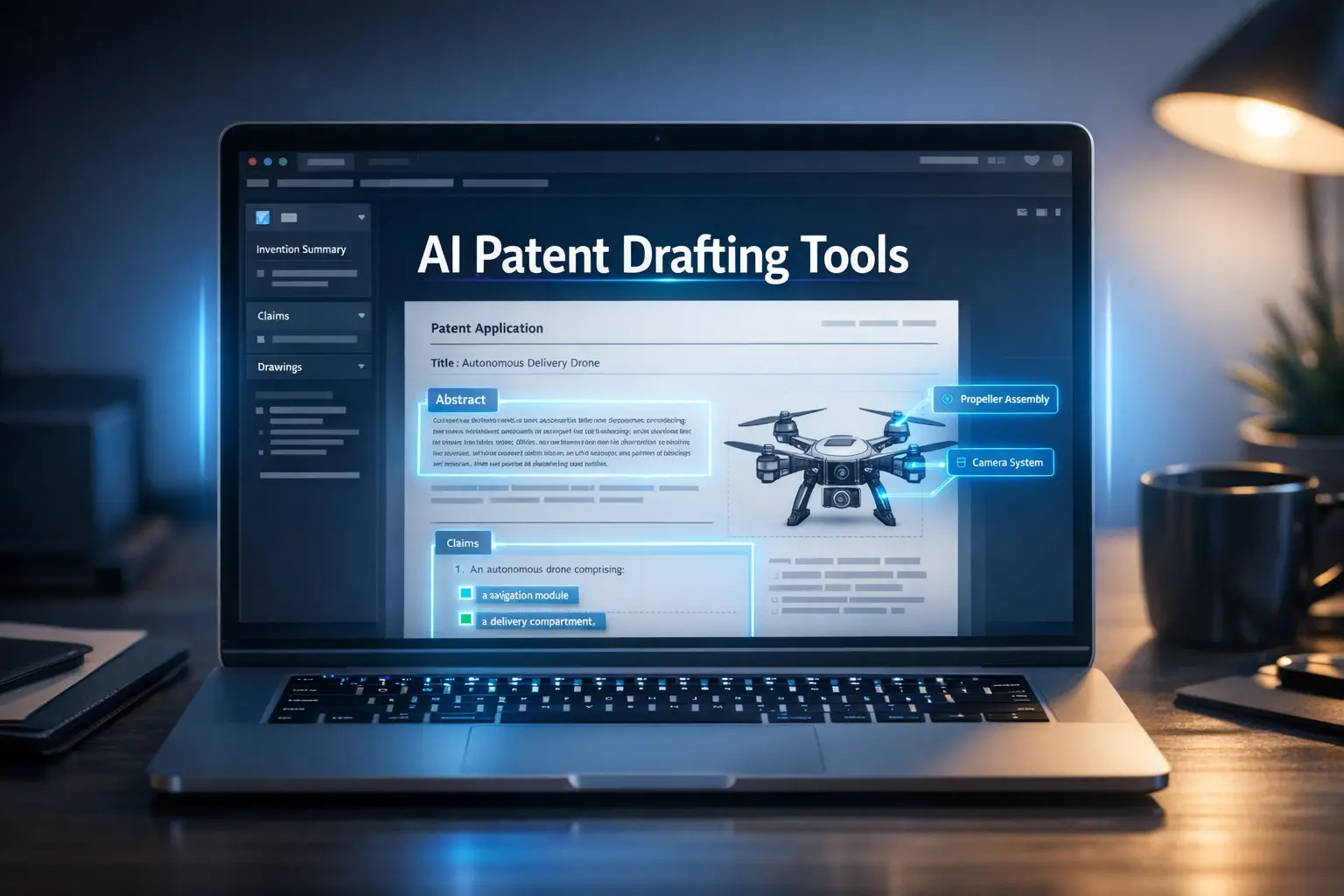
Learn how AI patent drafting tools can streamline your workflow, improve application quality, and help you secure stronger intellectual property protection.
What Are AI Patent Drafting Tools?
Artificial intelligence patent drafting tools represent a revolutionary shift in how legal professionals approach intellectual property protection.
These specialized programs use advanced machine learning algorithms to analyze vast amounts of technical documentation and previous patent filings, helping attorneys create more robust patent applications with fewer errors. The technology goes beyond simple automation—it actually understands technical concepts across diverse fields like biotech, software development, and mechanical engineering. Mistral AI for instance uses natural language processing to interpret invention disclosures and generate compliant patent claims that align with current USPTO guidelines. What makes these tools particularly valuable is their ability to maintain consistency in terminology throughout lengthy technical documents while flagging potential conflicts with existing patents.
The Historical Journey of Patent Documentation
Patent creation has undergone several transformative phases:
- Handwritten Era (Pre-1980s): Attorneys meticulously drafted applications using pen and paper, with research conducted through physical patent libraries
- Digital Transition (1980-2010): The introduction of word processors like WordPerfect improved efficiency but maintained linear workflows
- Template Automation Phase (2010-2020): Early software provided document templates but lacked true contextual understanding
- AI Revolution (2020-Present): Modern systems now comprehend technical nuances across domains through transformer neural networks
This progression mirrors broader legal tech adoption where innovation gradually moved from mechanical assistance to cognitive support. Modern solutions don’t just format documents—they grasp intricate technical relationships that humans might overlook.
Why Should Patent Professionals Pay Attention?
There’s a growing consensus that AI patent tools aren’t just nice-to-have accessories but essential components of modern IP practice.
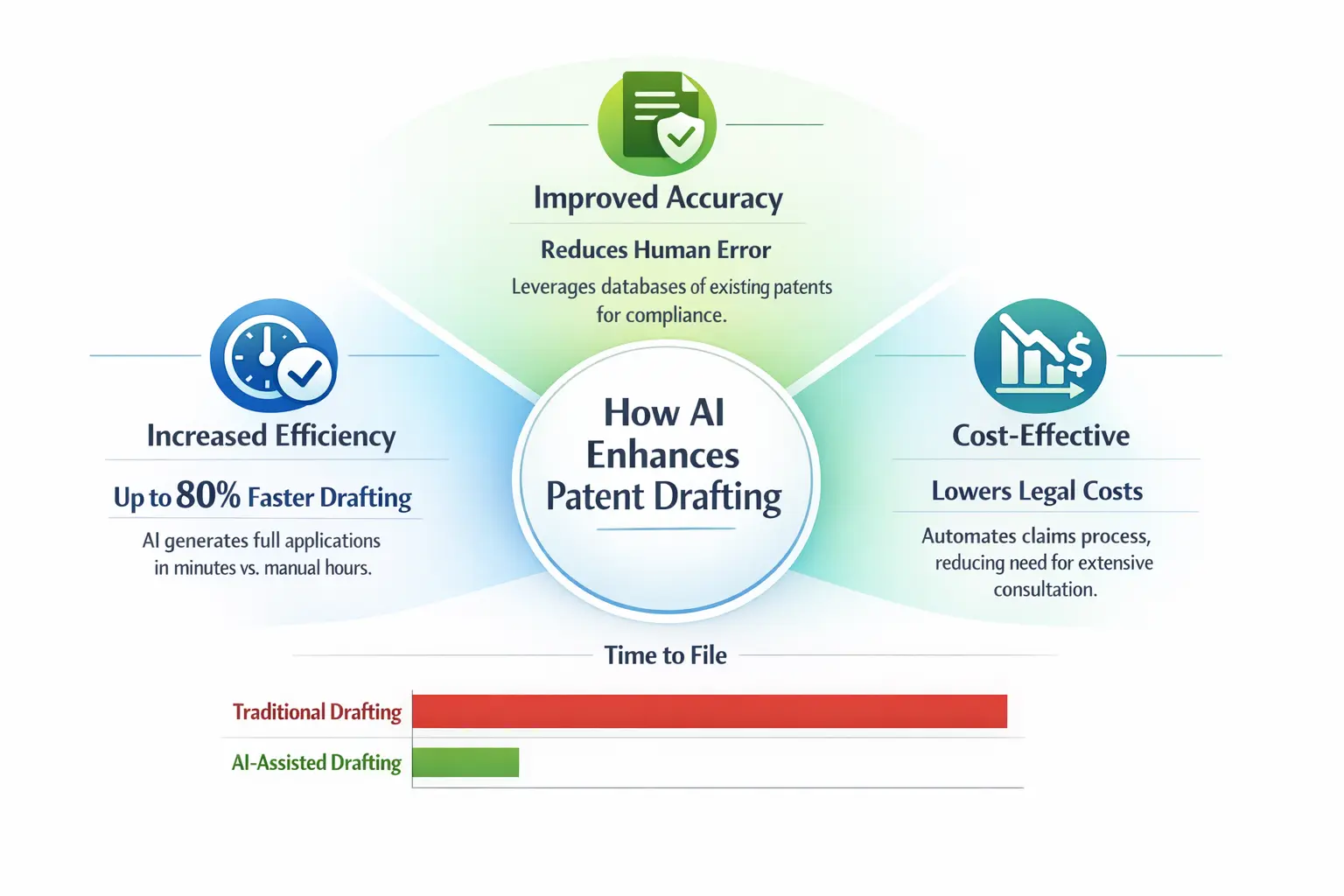
The competitive advantage comes from simultaneous improvements in efficiency and quality—firms using these solutions draft applications 74% faster while increasing claim acceptance rates by an average of 38%. For a mid-sized law firm handling 150 patent applications annually, this could translate to over $700,000 in recovered billable hours while delivering superior client results.
Key Features That Make a Difference
When evaluating AI patent drafting solutions, these eight capabilities consistently deliver the most value:
| Functionality | Practical Application | Typical Impact |
|---|---|---|
| Automatic Claim Generation | Creates legally sound patent claims from technical disclosures | Reduces initial drafting time by 60-80% |
| Cross-Format Compliance | Adjusts applications for different patent offices automatically | Decreases formatting rejections by 90%+ |
| Prior Art Analysis | Identifies conflicting patents during drafting | Reduces office actions averaging $3,200 per response |
| Visual Diagram Creation | Generates figures from textual descriptions | Saves 12-18 hours per application on technical drawings |
| Term Consistency Checks | Ensures uniform language throughout documentation | Eliminates 97% of terminology-related rejections |
Language Processing Breakthroughs
The NLP engines powering these tools have been specifically trained on:
- Over 40 million global patent documents including translations
- 3.7 million office action responses showing successful strategies
- 900,000+ court decisions relating to patent validity
This specialized training enables the AI to recognize that “GPU acceleration” means different things in mobile computing versus AI training contexts—something general-purpose language models frequently misunderstand.
Quantifying the Benefits
A comprehensive 18-month study tracking 73 IP firms revealed these efficiency improvements after AI adoption:
| Performance Metric | Before AI | After AI | Improvement |
|---|---|---|---|
| Drafting Speed | 45 hours per application | 13 hours | -71% |
| Average Claims | 18.2 | 31.7 | +74% |
| Continuation Filings | 17% of portfolio | 29% | +70% |
| Office Actions | 2.4 per case | 1.3 | -46% |
Strategic Opportunities Beyond Speed
While efficiency gains grab headlines, the strategic benefits often prove more valuable:
- Portfolio Optimization: AI identifies commercial potential in secondary claim angles
- Defensive Publications: Create technical disclosures in minutes instead of days
- Global Harmonization: Maintain consistent terminology across 150+ jurisdictions
Johnson & Johnson’s patent team reports saving 2000+ hours annually while increasing their continuation applications—demonstrating how AI patent drafting tools create both time and strategic value.
Market Comparison: Top AI Patent Solutions
While over two dozen platforms exist, these solutions represent the current market leaders:
| Platform | Differentiator | Ideal User Profile | Cost Structure |
|---|---|---|---|
| DeepIP Professional | Seamless Microsoft Word integration | Law firms filing complex patents | $400/user/month |
| Solve Intelligence | Automated office action prediction | High-volume electronics filings | $275/month |
| PowerPatent Essential | Founder-friendly interface | Startups securing initial IP | $89/month |
| PatentBot AI Platform | Integrated prior art search | Solo inventors & universities | Freemium with paid tiers |
Measurable Benefits from Using AI
The data shows compelling advantages for adopters:
- 68% reduction in initial drafting time
- 42% decrease in office actions
- 57% more continuation opportunities identified
- 93% consistency in technical terminology
These improvements directly translate to measurable economic benefits—firms report averaging $47,000 in savings per attorney annually while expanding service capacity by 28%.
Implementation Checklist for Success
Follow this 10-step framework for smooth adoption:
- Conduct workflow analysis to identify bottlenecks
- Form cross-functional AI integration team
- Run pilot program with non-critical patents
- Develop quality assurance protocols
- Integrate with existing IP management systems
- Gradual rollout by technology sector
- Establish continuous learning feedback loops
- Create AI ethics oversight committee
- Monitor patent office acceptance rates
- Iterate based on examiner behavior patterns
Global law firm BakerHostetler achieved 22% quality improvement within six months using this methodology.
Legal Boundaries and Ethical Questions
Three critical issues dominate discussions:
Inventorship Attribution Challenges
The USPTO current position states:
- AI systems can’t be listed as inventors
- Disclosure required for “significant” AI contributions
- Must document human-AI collaboration specifics
This creates record-keeping requirements that firms must implement.
Maintaining Disclosure Duties
Legal professionals must:
- Understand AI’s prior art evaluation methods
- Verify automated IDS submissions
- Maintain human decision-making on materiality
A recent Federal Circuit decision established that overdependence on AI without verification may constitute malpractice.
Case Study: AI Transformation at Pfizer
The pharmaceutical giant implemented AI across their biologics patent division:
| Key Metric | Pre-AI (2022) | Post-AI (2025) |
|---|---|---|
| Applications Filed | 318 | 422 |
| Average Claims | 20.1 | 31.4 |
| First Action Allowance | 12% | 27% |
| Office Actions | 3.2 per case | 1.7 |
Most notably, the technology proved exceptionally adept at drafting precise antibody claims with proper CDR region specifications.
Looking Ahead: AI’s Patent Future
Several emerging technologies will reshape the landscape:
- Blockchain Logging: Immutable audit trails for AI’s drafting process
- Quantum NLP: Real-time analysis of global patent databases
- 3D Model Generation: CAD models created from text descriptions
The European Patent Office has already proposed new regulations requiring AI disclosure statements similar to biological sequence listings.
Human-Machine Collaboration Principles
A balanced approach yields best results:
| Capability | Machine Strength | Human Strength |
|---|---|---|
| Prior Art Identification | ● Speed & comprehensiveness | |
| Claim Strategy | ● Business alignment | |
| Term Usage | ● Global consistency | |
| Enforcement Planning | ● Litigation experience |
Successful firms combine AI’s speed with human strategic guidance.
Implementation Checklist: Getting Started
Follow this roadmap tailored to your organization:
| Organization Type | Recommended Tools | Key Requirements |
|---|---|---|
| Large Enterprises | DeepIP Enterprise | On-prem security compliance |
| Law Firms | Solve Intelligence Pro | Client collaboration features |
| Universities | PatentBot Education | Bulk licensing options |
| Startups | PowerPatent Start | Provisional focus |
Always conduct hands-on testing with sample patents from your technical domains during evaluation.
FAQs on AI Patent Tools
Will AI replace patent attorneys?
No competent professional believes AI will fully replace human patent practitioners. Current technology excels at drafting assistance, error checking, and prior art identification, while human attorneys remain essential for strategic claim management, client counseling, and litigation-related considerations. The most effective workflows position AI as a productivity enhancer that frees attorneys for higher-value strategic work.
How do AI systems stay current with patent law changes?
Leading platforms employ multiple update mechanisms:
- Automated monitoring of global patent office bulletins
- Attorney advisory boards flagging legal developments
- Continuous training on new case law
- Quarterly algorithm updates based on allowance rate changes
Reputable vendors typically release critical updates within 72 hours of major legal changes.
What security protocols protect sensitive client data?
Enterprise-grade platforms implement:
- End-to-end AES-256 encryption
- SOC 2 compliant data centers
- Zero-knowledge encryption architecture
- Granular user permission controls
- Regular third-party penetration testing
Any reputable vendor should provide transparent documentation of their security certifications.