




AI Mechanical Engineers: A Powerful 2026 Guide to Boost Efficiency
Discover how AI mechanical engineers are revolutionizing design, simulation, and automation. Learn the key skills and tools needed to advance in this cutting-edge field.
Computers Meet Wrenches When Robot Brains Optimize Gears
Nothing stays the same forever in the world of machines and moving parts. These days, seeing engineering plans with coffee stains beside scribbled math proofs feels like discovering dinosaur bones – fascinating remnants of a bygone age. Digital transformation didn’t just knock politely on mechanical engineering’s door; it kicked the whole structure down and started remodeling. Mechanical engineers used to joke that their CAD stations contained more pizza crumbs than circuit boards, but today’s AI-powered design systems demand cleaner keyboards and sharper minds.
When Metal Learned to Think
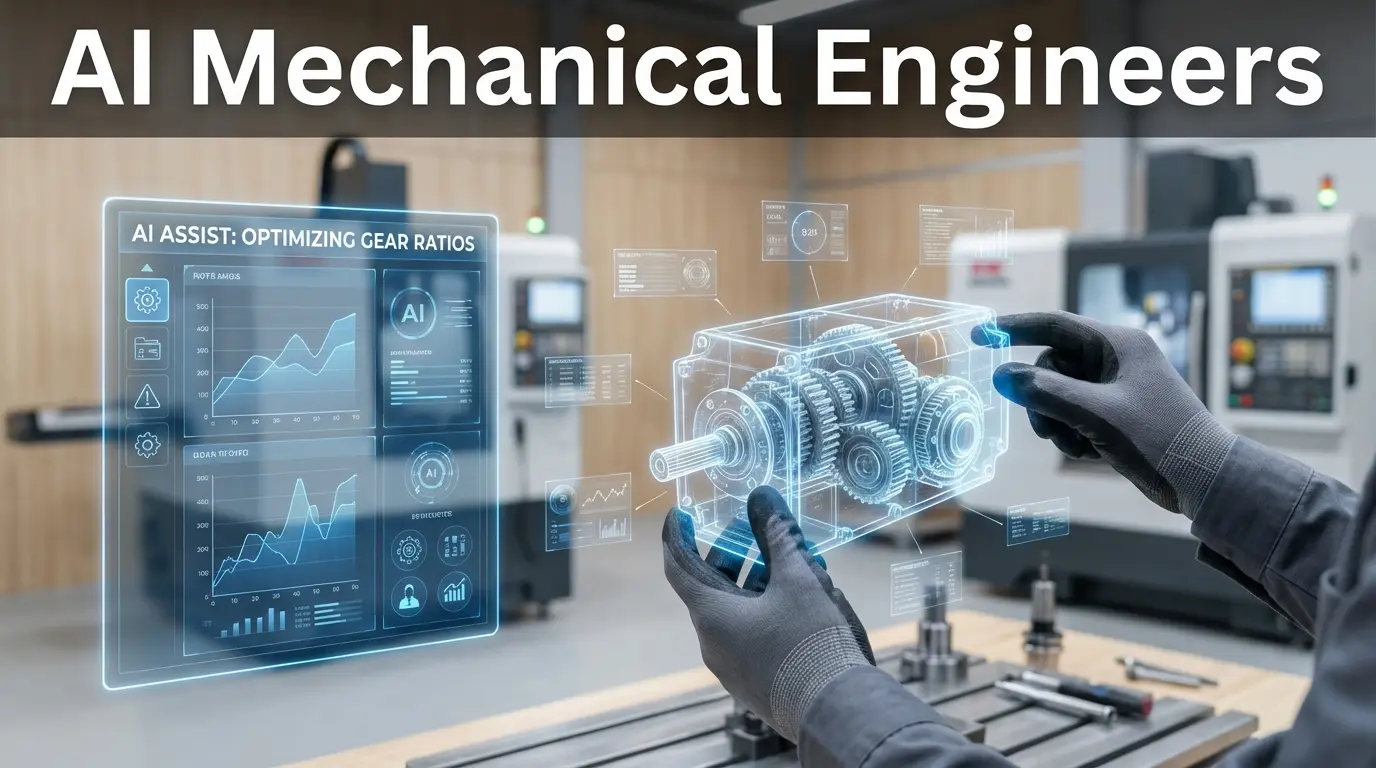
Picture this: 1978 engineering departments filled with tilt-up desks overflowing with blueprint scrolls, mechanical pencils stored behind ears, and protractors dangling from belt loops. Fast forward to modern labs where computational fluid dynamics simulations run autonomously overnight and machine learning algorithms auto-correct stress analysis before dawn. Companies like Baker Hughes now integrate AI so deeply into their drilling equipment designs that their mechanical engineers receive algorithmic improvement suggestions over morning coffee – sometimes before they’ve finished their first cup. “The machine figured out a better gear ratio while I slept,” admits senior design lead Marcus Zhao. “It’s equal parts impressive and terrifying.” Turbines spin smarter, pistons fire more efficiently, and bearings last longer – all thanks to silicon-based colleagues working 24/7 without bathroom breaks.
When the Algorithm Wields the Wrench
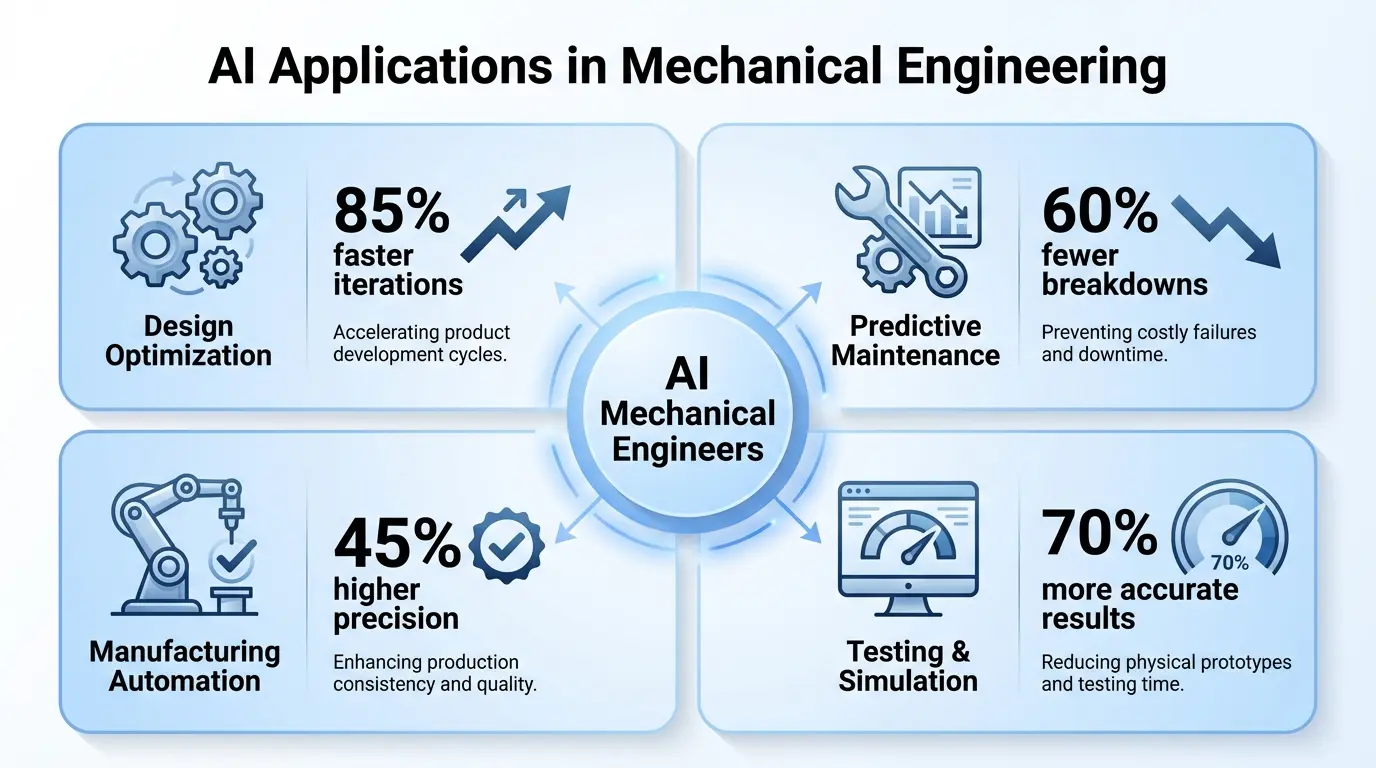
Generative design represents the craziest blind date between human ingenuity and machine intelligence. Forget sketching component shapes; engineers now input performance needs and let AI explore possibilities human brains couldn’t conceive. Caterpillar’s latest hydraulic systems contain twisted lattice structures that look like alien coral reefs – shapes no sane engineer would’ve drawn manually. “We called them impossible geometries until the simulation results proved otherwise,” says materials specialist Dr. Elena Petrov. The real magic happens during failure tests: these bizarre-looking components withstand pressures that snap traditional designs like dry twigs.
| Design Approach | Prototype Iterations | Weight Reduction | Weirdness Factor |
|---|---|---|---|
| Human Engineer | 12-15 versions | Up to 15% | Conventional |
| AI Collaboration | 4,800+ options | 35-62% | “Is this witchcraft?” |
Consider what happened when Whirlpool redesigned washing machine drum suspensions. Traditional approaches tweaked existing spring configurations – incremental improvements measured in single percentage points. Their AI system proposed replacing springs entirely with a nested series of flexible polymer rings that adjust stiffness based on load detection. The resulting mechanism handles unbalanced loads so effectively that test engineers couldn’t make the machines vibrate excessively even when stuffing them with soaking wet rugs on one side and feathers on the other. Production models now feature this counterintuitive solution that emerged from machine logic rather than textbook principles.
Machines Predicting Their Own Breakdowns
Nothing silences factory floors faster than unexpected equipment failure. Modern predictive maintenance systems monitor vibrations with accelerometers so sensitive they detect worn bearings before humans hear grinding noises. Honeywell’s aerospace division installed neural networks that track turbine blade degradation patterns across entire fleets. “We’re fixing parts before pilots notice issues,” explains reliability engineer Sofia Martinez. “The AI flagged vibration harmonics indicating microscopic cracks in alloys – something our best technicians missed during inspections.”
Carbon-Based Brains Meet Silicon Colleagues
Traditional engineering education emphasized slide rules and drafting boards; today’s curriculum requires Python scripts and neural network architectures. MIT’s mechanical engineering labs now resemble computer science departments, with students debugging reinforcement learning algorithms that teach robotic arms novel assembly techniques. “We’ve had robot clusters that independently developed more efficient welding paths than human experts,” reports Professor Amir Khan. “The challenge becomes verifying their solutions aren’t just clever but actually safe.”
Several critical shifts define modern mechanical engineering roles:
- Calculation clerks → AI system trainers
- Drafting specialists → Generative design curators
- Field technicians → Data labelers for machine learning models
- Maintenance crews → Algorithmic validation teams
| Traditional Skill | Modern Equivalent | Learning Curve |
|---|---|---|
| Freehand Sketching | AI Prompt Engineering | 6-8 months |
| Manual Tolerance Analysis | Neural Network Interpretation | 1 year+ |
| Gear Ratio Calculations | Hyperparameter Tuning | Ongoing |
Resistance Is Futile (And Unwise)
Seasoned engineers initially dismissed AI tools as CAD assistants – digital tape measures rather than revolutionary partners. That changed when 3M’s filtration division attempted to optimize industrial air purifier housings. Human teams spent months iterating on conventional geometries before conceding to run an AI generative design experiment. The resulting spiral vortex chamber increased particulate capture by 47% while reducing material costs. “The design looked biologically impossible, like something grown rather than machined,” recalls VP of Engineering David Wu. “Production required entirely new 3D printing techniques, but performance justified the overhaul.” This pattern repeats across industries: human expertise defines problems and validates solutions while AI handles combinatorial explosions of possibilities.
Ethical Wrenches in the Machine
Decisions carry weight when engineers sign off on load-bearing calculations – literally life-or-death responsibility. Delegating portions of this process to inscrutable neural networks raises unsettling questions. Boeing’s 797 program implements strict explainability protocols where AI-generated structural suggestions undergo “algorithmic autopsies” before implementation. “We need to understand why the AI prioritizes certain load paths over others,” explains certification specialist Marie-Claire Bisset. “Black box solutions don’t fly when human lives depend on every decision.”
Core challenges include:
- Traceability: Documenting decision trees through millions of neural network connections
- Bias Detection: Ensuring training data doesn’t favor conventional solutions over unconventional improvements
- Failure Attribution: Determining liability when AI-enhanced designs encounter unforeseen issues
The European Engineering Ethics Board recently published controversial guidelines requiring “human comprehension parity” for AI-generated mechanical solutions – essentially mandating that engineers must understand designs as thoroughly as if they’d created them manually. Critics argue this negates AI’s advantage in exploring counterintuitive solutions, while supporters insist it maintains necessary safety standards.
Future Foundries
Quantum computing looms on the horizon like a technological tsunami. Lockheed Martin’s quantum experiments solved fluid dynamics problems for hypersonic aircraft in minutes rather than months. “We’re entering an era where materials can be designed atom-by-atom,” predicts futurist Dr. Lisa Tanaka. “Imagine bearing surfaces with nanometer-scale textures optimized by quantum-AI hybrids – friction coefficients approaching theoretical minimums.”
Autodesk’s labs already demonstrate AI systems that don’t just design components but invent novel manufacturing processes to create them:
- Self-organizing molecular deposition for frictionless bearings
- 4D-printed alloys that change properties under load
- Bio-hybrid materials combining engineered proteins with carbon fiber
These innovations emerge from iterative experimentation at speeds human researchers can’t match – thousands of simulated material combinations tested overnight.
Learning to Speak Machine
Mechanical engineering students share lecture halls with computer science majors these days, united by shared AI coursework. Stanford’s redesigned curriculum includes “Machine Shop for Coders” alongside “Python for Welders” – unconventional pairings that reflect industry convergence. “I never expected to debug a neural network while operating a CNC mill,” laughs graduate student Priya Kapoor. “But watching a robotic arm adjust its welding pattern based on real-time thermal imaging? That’s pure magic.”
Academic programs now blend disciplines:
| Traditional Course | AI Augmentation |
|---|---|
| Thermodynamics | AI-Optimized Heat Exchange Modeling |
| Fluid Mechanics | Neural Network Flow Predictions |
| Materials Science | Generative Alloy Design Systems |
Industry partnerships provide crucial context; Siemens offers students access to their digital twin platforms while General Electric hosts competitions for AI-driven turbine efficiency improvements. “The academic-industrial feedback loop spins faster now,” observes MIT’s department chair Dr. Henry Lin. “Tuesday’s thesis project becomes Thursday’s production implementation.”
The Uncanny Valley of Automation
Humans instinctively trust well-understood mechanical systems – gears mesh predictably, levers pivot reliably. AI introduces probabilistic behaviors that unsettle this mechanical certainty. John Deere’s autonomous tractors exemplify this tension: farmers accept mechanical failures caused by worn parts but distrust software glitches that manifest unpredictably. “When a bearing fails, you see metal shavings and feel play in the shaft,” explains agricultural engineer Kyle Johnson. “When the AI misclassifies a rock formation as soft soil? That erosion of trust takes months to rebuild.”
Effective AI integration requires transparency layers:
- Real-time decision visualization during operations
- Historical performance tracking comparable to maintenance logs
- Explainability interfaces translating machine logic into mechanical terminology
Komatsu’s smart excavators display “confidence scores” for autonomous digging decisions – numerical values that experienced operators quickly learn to interpret. “You develop intuitive sense for when the AI’s certainty matches actual ground conditions,” says veteran operator Maria Gonzalez. “Like feeling hydraulic resistance through control sticks, but digital.”
Economic Earthquakes
Traditional manufacturing economics crumble under AI’s efficiency. McKinsey analysis reveals AI-optimized factories achieve 30-50% higher output with equivalent footprints. “We’re witnessing mechanical productivity miracles,” remarks economist Dr. Sanjay Patel. “What Henry Ford did with assembly lines now happens automatically through AI-driven process refinement.” However, job displacement worries persist despite new roles emerging in AI supervision and hybrid system design.
| Role | 2015 Prevalence | Current Demand | Change |
|---|---|---|---|
| Manual Drafters | 112,000 | 18,000 | -84% |
| AI Design Validators | 0 | 47,000 | New Field |
| Predictive Maintenance Specialists | 8,000 | 89,000 | +1012% |
Frequently Asked Questions (FAQs)
Can AI Truly Understand Material Science?
Current AI systems don’t “understand” materials like human engineers; they correlate patterns in massive datasets. However, their pattern recognition capabilities exceed human capacity – predicting material behaviors under conditions no researcher has tested physically. ArcelorMittal uses AI that predicts alloy performance at extreme temperatures with 97% accuracy based solely on atomic composition data. The models can’t explain metallurgical theory, but their predictions enable breakthroughs in lightweight armor plating.
How Small Can AI-Driven Manufacturing Scale?
Contrary to belief, AI isn’t just for industrial giants. Desktop Metal’s cloud-based AI service helps machine shops optimize tool paths for individual parts. “We helped a bicycle framemaker generate custom titanium lugs that reduced assembly time by 60%,” reports founder Ric Fulop. The service costs less than a deluxe torque wrench set and runs on smartphones – democratizing AI capabilities for artisan workshops.
What’s Preventing Total Automation?
Three stubborn realities preserve human roles:
- Edge Cases: Unusual operating conditions lacking training data
- Regulatory Hurdles: Certification processes demanding human accountability
- Creative Leaps: True innovation requiring intuitive jumps beyond existing data
Until AI demonstrates genuine creativity rather than combinatorial optimization, human engineers remain essential for pioneering designs beyond incremental improvements.
Recommended: How RPA Transforms Factory Floors Without Replacing Workers