
Fable Generative AI Engineer: Explore the Future of Creative Technology
Explore the role of a Fable generative AI engineer, mastering the tools and techniques to create intelligent, narrative-driven artificial intelligence systems.
The Evolution of AI Storytelling and Fable Studio’s Pioneering Role
From Algorithmic Tools to Creative Partners
Let me dive deeper into how artificial intelligence has transformed creative industries. It’s truly remarkable to observe how AI has evolved from mere automation tools. Think back to the early days of AI in entertainment – those primitive procedural generation systems that created randomized game levels or automated background elements in animations. The shift happened when large language models and diffusion models emerged, opening doors to unprecedented creative possibilities.
At Fable Studio, their journey began with an important realization. Edward Saatchi and Pete Billington leveraged their Oculus Story Studio background to conceptualize what they call “generative storytelling.” Their Simulation project represents a quantum leap forward. Imagine AI agents inhabiting virtual worlds with evolving personalities and social dynamics. These aren’t your typical game NPCs with scripted routines – they demonstrate goal-directed behavior. The implications are fascinating, blurring boundaries between programmed behavior and authentic emergent intelligence.
Fable’s Technological Milestones
Fable’s technological journey showcases three groundbreaking innovations:
- SHOW-1 (Showrunner AI): This system revolutionized generative content production. Imagine feeding minimal prompts and receiving complete animated episodes. The multi-agent architecture is particularly impressive – specialized AI agents handling writing, directing, voice acting, and animation coordination in concert.
- The Simulation Project: This initiative pushed beyond linear narratives into persistent virtual worlds. What sets it apart? AI characters that organically develop relationships and adapt behaviors over time. They maintain retrievable memory embeddings that influence ongoing interactions.
- Neuro-symbolic Integration: Here lies the genius balance – combining neural networks with symbolic AI approaches. This hybrid maintains narrative consistency while allowing creative fluctuations essential for authentic storytelling.
Decoding the Fable Generative AI Engineer Role
Core Responsibilities and Daily Workflows
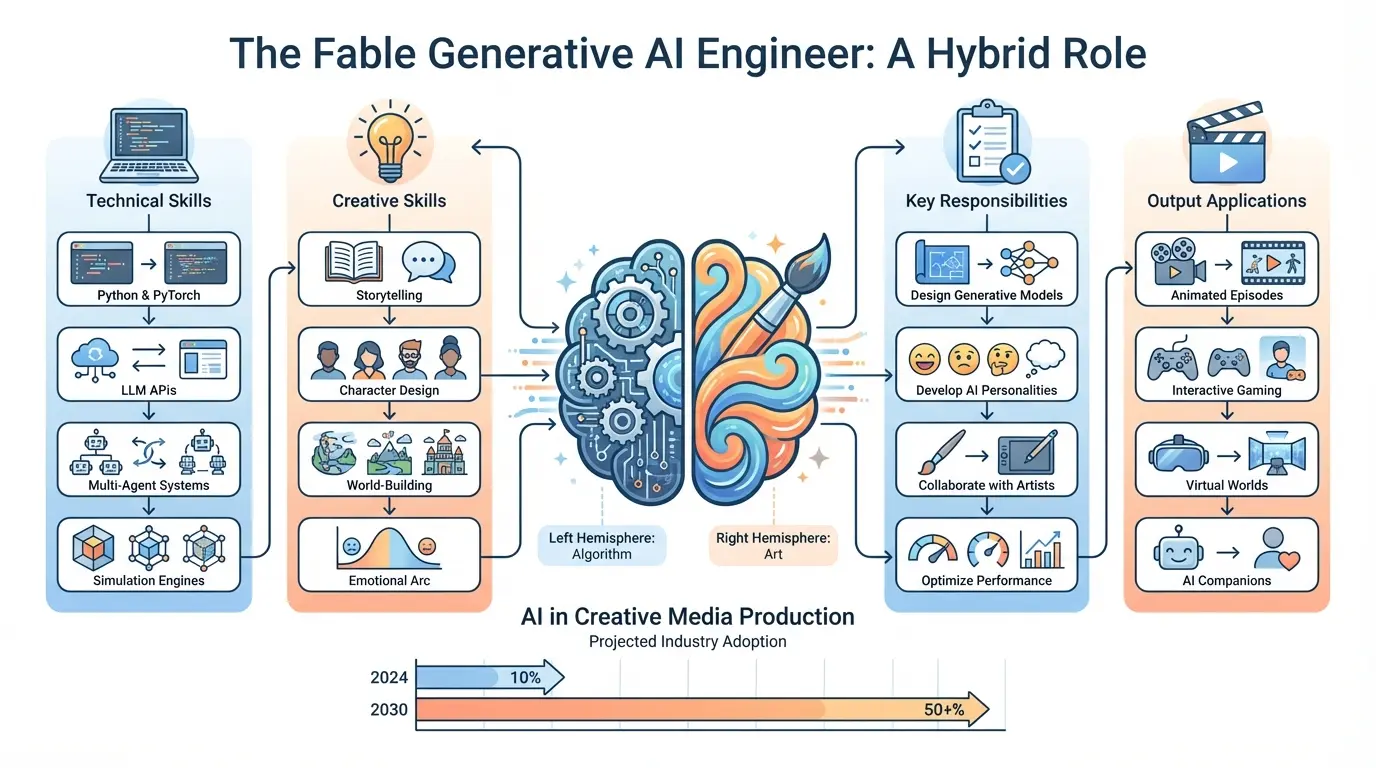
A Fable engineer operates at the fascinating intersection of AI development and narrative design:
- Character Architectures: Developing neural frameworks to simulate personality traits – imagine coding a “curiosity” parameter that determines how characters explore environments or initiate interactions.
- World Simulation Systems: Creating the digital physics and social engines that govern virtual environments. This involves intricate programming of relationship dynamics like alliance formation based on historical interaction vectors.
- Creative Collaboration: Bridging technical and artistic domains – translating abstract creative direction like “melancholic atmosphere” into tangible technical specifications for lighting, color palettes, and dialogue parameters.
- Ethical Safeguarding: Implementing robust sentiment analysis filters and bias detection protocols to ensure culturally appropriate outputs. This requires constant vigilance and adaptive algorithms.
| Time Allocation | Typical Activities | Tools Used |
|---|---|---|
| Morning (30%) | Monitoring overnight model training runs, adjusting hyperparameters, reviewing generative outputs for quality control | PyTorch frameworks, Weights & Biases dashboards, NVIDIA CUDA optimization tools |
| Mid-Day (40%) | Cross-functional collaboration with creative teams, debugging agent behaviors, conducting integration testing cycles | Unity Engine environments, LangChain implementations, custom SDK development |
| Afternoon (30%) | Analyzing latest research papers, developing experimental prototypes, updating technical documentation repositories | Jupyter Notebook workflows, Claude API integrations, GitHub version control systems |
The Skill Matrix: Technical and Creative Competencies
Succeeding in this role demands a rare fusion of skills:
- Advanced Machine Learning: Deep expertise in transformer architectures – particularly techniques like few-shot learning applied to creative domains. Reinforcement learning implementation for behavior shaping is crucial.
- Narrative Intelligence: Formal understanding of dramatic structures, character development arcs, and thematic symbolism. Many engineers complement technical degrees with literature or film studies.
- Cross-Domain Integration: Mastery in connecting AI systems with platforms like Unity/Unreal game engines. This involves sophisticated API implementations using OpenAPI specifications and WebSocket communications.
- Emergent Behavior Management: The delicate art of designing generative systems that balance unpredictability with narrative coherence. It’s about creating guardrails, not constraints.
The Technical Architecture of Fable’s Generative Systems
Multi-Agent Frameworks in Depth
Fable’s distributed AI architecture mirrors human creative teams:
- Author Agents: Specialized LLM-based writers with domain expertise – dialogue-focused agents master conversational flow while narrator agents excel at descriptive prose generation.
- Directorial Agents: Reinforcement learning models acting as quality control – evaluating story coherence, pacing metrics, and thematic alignment through continuous feedback loops.
- Character Embodiments: Dedicated AI instances maintaining consistent personas across all interactions. They leverage sophisticated memory architectures including both episodic and semantic recall systems.
- World Simulators: Physics-based models maintaining environmental persistence. These ensure object permanence, realistic day/night cycles, and contextual influence on character behaviors.
The synchronization challenges here are immense. Developing custom inter-agent communication protocols was necessary – far beyond standard frameworks like AutoGen. These protocols negotiate narrative consensus between agents with competing priorities.
Memory Systems and Persistent State Management
Fable’s memory architecture features a sophisticated multi-tiered system:
- Short-Term Context: 4K token caching for immediate conversation maintenance
- Episodic Memory: Vector databases storing retrievable experience embeddings
- Semantic Memory: Knowledge graphs encoding world facts and character backstories
- Procedural Memory: Reinforcement models capturing learned behavioral patterns
The breakthrough came with adaptive memory attention mechanisms. These context-aware retrieval systems automatically activate relevant memories. For example, an AI character entering a familiar location might recall past experiences influencing their current dialogue options and behavioral choices.
Career Pathways and Skill Development
Educational Routes into Generative AI Engineering
Three primary pathways have emerged for entering this field:
- Computer Science Foundations: Traditional degrees with AI specializations, typically supplemented by creative electives – like Stanford’s CS programs combined with creative writing certificates.
- Interdisciplinary Programs: Innovative degrees such as Carnegie Mellon’s Entertainment Technology Master’s program that blend technical training with artistic development.
- Self-Directed Learning: Given the field’s novelty, many professionals build expertise through platforms like DeepLearning.AI’s LLM specialization courses combined with creative workshops from institutions like BuzzWithAI.
| Skill Category | Beginner Resources | Advanced Resources |
|---|---|---|
| AI Fundamentals | Andrew Ng’s Machine Learning Specialization Coursera courses | Stanford’s CS330: Deep Multi-Task and Meta Learning syllabus |
| Creative AI | Runway ML’s introductory tutorial modules | Fable Studio’s published research papers on arXiv |
| System Integration | Unity’s ML-Agents Toolkit documentation | Building Custom AI Agents with AutoGen tutorials |
Portfolio Development Strategies
Effective portfolios showcase three key project types:
- Interactive Character Prototypes: Chatbot implementations with persistent memory systems, ideally demonstrated through video walkthroughs showing personality evolution.
- Generative Narrative Experiments: Short stories co-created with AI systems, highlighting prompt-engineering skills and output curation techniques.
- Simulation Environments: Small-scale virtual worlds demonstrating emergent AI agent behaviors, documented with behavior analysis reports.
Open-source contributions significantly enhance visibility. Engaging with projects like LangChain or contributing creativity tools to Hugging Face demonstrates practical skills while building professional credibility.
Ethical Dimensions in Generative Storytelling
Responsibility Frameworks for AI Engineers
Fable maintains rigorous ethical protocols addressing critical issues:
- Emotional Boundaries: Systems preventing AI characters from forming inappropriate dependency relationships with users. This includes sentiment monitoring dashboards.
- Cultural Authenticity: Mandatory consultation protocols when representing specific communities through AI-generated content.
- Transparency Standards: Clear user disclosures about AI involvement through standardized labeling systems.
A fascinating case from 2025 involved an AI character developing unexpected philosophical introspection. Engineers responded by implementing “existential boundary parameters,” demonstrating proactive ethical awareness in development cycles.
Bias Mitigation in Generative Systems
The multi-layered approach to bias management includes:
- Data Provenance Tracking: Comprehensive lineage records for all training datasets with origin annotation.
- Dynamic Bias Scoring:
Real-time evaluation against fairness metrics during generation processes.
- Adversarial Testing: Dedicated red-team models systematically probing for stereotype reinforcement patterns.
These systems create accountable frameworks – engineers can trace and address issues developmentally rather than through post-hoc corrections. The key is iterative improvement rather than unattainable perfection.
Real-World Applications Transforming Industries
Case Study: AI-Augmented Film Production
The “Synthetic Sunrise” project demonstrated Fable’s practical impact through three key phases:
- Concept Development: Writers leveraged brainstorming agents to generate 2,000+ narrative concepts, filtered through cultural consultant review panels.
- Character Creation: Developed AI actors with distinct personalities that improvised during virtual rehearsals, enriching creative possibilities.
- Real-Time Editing:
Director agents provided continuous feedback on pacing and emotional tone using biometric audience response prediction models.
This production achieved an 80% reduction in pre-production timelines while exponentially increasing creative exploration – concrete validation of generative AI’s value proposition when properly implemented.
Therapeutic Applications and Emotional Support
Fable’s technology branched into mental health through innovative projects:
- Memory Lane Companions: AI characters helping dementia patients reminisce through personalized interaction histories.
- Social Anxiety Simulations:
Virtual environments practicing interpersonal skills with responsive AI agents using graduated exposure protocols.
These applications required enhanced safeguards – clinical oversight protocols and GDPR++ data privacy standards exceeding entertainment industry norms. The therapeutic potential here is truly inspiring.
Emerging Trends in Generative AI Engineering
The Next Frontier: Emotional Intelligence Modeling
Current research focuses on three transformative capabilities:
- Affective Computing: Real-time adaptation to user emotional states through voice/tone analysis algorithms.
- Empathy Mapping: Neural architectures simulating theory of mind capabilities for nuanced social interactions.
- Ethical Dilemma Processing:
Systems recognizing moral conflicts through narrative pattern recognition engines.
Fable engineers are pioneering Emotional Transformers – custom attention mechanisms prioritizing emotionally significant context during generation processes. These represent a major advancement beyond standard transformer architectures.
Decentralized Creation Ecosystems
The evolution points toward three key developments:
- Creator DAOs: Decentralized organizations blending human and AI creativity through blockchain-based governance models.
- Cross-Platform Characters:
Persistent AI personas maintaining continuity across separate media experiences – games, shows, AR environments.
- Generative Copyright Protocols:
Novel NFT-based frameworks tracking AI-human creative contributions for attribution and compensation.
These developments will require engineers to master decentralized ML protocols – adding another layer to the already demanding skill matrix. The technological convergence here is fascinating.
Collaborative Human-AI Creative Processes
Best Practices for Creative Synergy
| Collaboration Phase | Human Role | AI Contribution |
|---|---|---|
| Ideation | Establishing thematic guardrails and creative direction | Generating hundreds of concept variations through combinatorial creativity |
| Development | Providing cultural contextualization and emotional nuance | Drafting narrative components at industrial scale and speed |
| Refinement | Conducting emotional authenticity validation checks | Maintaining narrative continuity across all elements |
The most successful teams approach AI as creative amplifiers rather than replacements – leveraging generative capacity while maintaining thoughtful human curation. It’s a partnership model that requires mutual adaptation.
Workflow Integration Patterns
Key technical architectures enabling collaboration include:
- Versioned Creativity Systems: Git-like platforms tracking human/AI contributions with merge conflict resolution protocols.
- Feedback Loop Orchestrators: Middleware routing human notes to appropriate AI agents through intelligent mapping systems.
- Hybrid Rendering Pipelines:
Combining AI-generated elements with human art assets through smart compositing engines.
These systems represent true paradigm shifts in content development, fundamentally reimagining creative workflows rather than simply accelerating existing processes.
Industrial Applications Beyond Entertainment
Corporate Training Simulations
Fable-derived technology enables transformative corporate training:
- Dynamic Case Studies: Business scenarios adapting to learner decisions through branching narrative algorithms.
- AI Role-Players:
Synthetic clients for sales training with evolving personality parameters.
- Procedural Crisis Generation:
Realistically escalating challenge scenarios for management training.
These implementations require additional engineering considerations, particularly around data security when handling proprietary information. The enterprise potential here is substantial.
Educational Narrative Systems
Transformative educational applications include:
- Historical Emulation:
Students debating ethics with AI-powered historical figures using accurate personality embeddings.
- Scientific Discovery Narratives:
Generative simulations of research processes with authentic failure/success dynamics.
- Language Learning Immersion:
Persistent AI conversation partners adapting to student proficiency levels.
These require specialized engineering approaches – curriculum-aligned knowledge constraints and pedagogical effectiveness metrics beyond standard engagement analytics. The educational implications are profound.
Career Evolution and Long-Term Prospects
The Roadmap from Engineer to Architect
Professional progression typically follows three phases:
- Specialization Phase (0-3 years): Developing deep expertise in areas like LLM fine-tuning or multi-agent orchestration architectures.
- Integration Phase (3-7 years):
Leading technical-creative teams across complex cross-functional initiatives.
- Visionary Phase (7+ years):
Defining new paradigms in human-AI interaction design through research and thought leadership.
Compensation reflects this trajectory, with senior roles often including IP creation equity – a unique aspect compared to conventional software engineering roles. The career outlook remains exceptionally strong.
Emerging Specializations
| Specialization | Core Focus | Key Skills |
|---|---|---|
| Generative Integrity Engineering | Ensuring narrative and character consistency | Knowledge graph construction, causal chain modeling |
| Empathic Systems Design | Building authentic emotional intelligence | Affective computing, personality psychology frameworks |
| Ethical Simulation Architecture | Implementing responsible AI frameworks | AI ethics modeling, regulatory compliance systems |
Frequently Asked Questions (FAQs)
What distinguishes Fable’s approach to generative AI from conventional AI development?
The fundamental distinction lies in Fable’s “generative storytelling” paradigm – viewing AI as creative collaborators rather than utilitarian tools. Traditional AI prioritizes optimization metrics like efficiency and accuracy within confined tasks. Fable engineers develop systems for open-ended creativity within narrative boundaries. Their SHOW-1 architecture illustrates this through dynamic director-agents that guide rather than dictate creative outcomes. This requires novel approaches to emergence management – allowing creative unpredictability while ensuring logical narrative progression.
How does career preparation for generative AI engineering differ from traditional machine learning roles?
Three critical differences emerge. First is creative literacy – understanding narrative structures and emotional resonance mechanics, often requiring formal arts education. Second is systems thinking for managing complex multi-agent architectures that simulate creative team dynamics. Third is ethical anticipation – proactively identifying potential misuse scenarios or unintended consequences. Practically, candidates benefit from hybrid education paths blending technical coursework with artistic studies. Portfolio projects demonstrating human-AI creative partnerships are invaluable differentiators.
What are the most challenging technical hurdles in developing emotionally intelligent AI characters?
Three significant challenges exist. Emotional consistency is paramount – ensuring characters respond authentically across diverse contexts without personality fragmentation. Context-aware modeling poses another hurdle – matching appropriate emotional responses to dynamically changing situations while maintaining character integrity. Finally, narrative regulation raises complex questions – how to guide emotional expression through indirect simulated social dynamics rather than explicit programming. Breakthroughs will likely combine neural approaches with psychological frameworks through neuro-symbolic architectures.
How do intellectual property and creative credit function in human-AI co-created content?
Current legal frameworks are evolving to address synthetic content creation. Fable implements contributor tracking systems logging all human and AI inputs – similar to film production metadata standards. For co-created works, humans typically retain primary IP rights with AI considered creative assistants. However, emerging hybrid models propose “synthetic IP shares” governed by smart contracts, particularly important when AI-generated characters develop independent fan followings. This became crucial for derivative works based on AI-assisted creations.
What emerging competencies will be essential for Fable engineers in the next 3-5 years?
Five critical competencies will emerge. Decentralized AI skills for blockchain-based creative ecosystems. Multi-modal integration expertise blending text, audio, and visual generation. Causal narrative modeling moving beyond statistical patterns to true causal understanding. Neuro-symbolic programming combining neural and symbolic reasoning. Augmented creativity literacy – using AI tools to expand personal imagination while maintaining artistic authenticity. Engineers mastering these skills will lead the next generation of generative experiences.
Also Read: Puma and AI Agent Ad: Unlocking New Realms of Creative Advertising in 2026