


Artificial Intelligence Empowers Situational Awareness Advancement [2026]
Discover how artificial intelligence empowers situational awareness advancement. Learn about the key technologies and real-world applications driving smarter decisions in complex environments.
The Evolution of Situational Awareness in the Digital Age
For decades, situational awareness remained heavily dependent on human skill – the ability to perceive environmental factors, understand their significance, and predict future developments. Military planners, emergency personnel, air traffic controllers and security experts cultivated this vital competency through rigorous training and real-world experience. Yet as our environment grows more intricate and data-intensive, inherent human cognitive constraints have revealed critical awareness deficiencies. Artificial intelligence emerges as the transformative technology reimagining how we gather, interpret, and respond to crucial information. This technological revolution in situational awareness marks one of our era’s most important breakthroughs, reshaping how institutions confront uncertainty and make rapid decisions in time-sensitive scenarios. The Pentagon’s cutting-edge JADC2 initiative demonstrates this evolution, integrating data streams across five operational domains into a unified command interface that processes 15 million events per second.
Understanding Situational Awareness Fundamentals
Dr. Mica Endsley’s pioneering three-tier model remains the gold standard for understanding situational awareness:
- Environmental Perception: Detecting relevant elements within one’s surroundings
- Contextual Comprehension: Understanding the current implications of these elements
- Future Projection: Anticipating how these elements may evolve over time
Traditional methods depended extensively on human operators monitoring various interfaces simultaneously – dashboards, radio communications, and sensor networks. This approach created significant cognitive burdens as data volumes increased exponentially, frequently resulting in critical oversights. Modern AI systems address these limitations through three revolutionary capabilities that enhance human decision-making capacities while compensating for biological constraints.
| Operational Challenge | Impact on Performance | AI-Driven Solution |
|---|---|---|
| Data Deluge | Critical Signal Overlook | Intelligent Information Filtering |
| Mental Fatigue | Delayed Critical Responses | Predictive Decision Support |
| Context Deficiency | Inappropriate Actions | Semantic Context Processors |
The fundamental paradigm shift appears most clearly in advanced applications. Healthcare monitoring systems now predict patient deterioration 6-12 hours earlier than traditional methods through multimodal data synthesis. Financial security platforms monitor transactions in real-time, evaluating over 500 behavioral parameters in under a second to prevent fraudulent activity. Military command centers integrate satellite, drone, and ground sensor data to create dynamic battlefield visualizations updated in real-time.
The Historical Development of Awareness Technologies
The progression toward AI-enhanced situational awareness spans seven distinct technological generations:
- Manual Era (Pre-1950): Human senses & basic tools
- Electromechanical Phase (1950-1970): Radar & early warning systems
- Digital Assistance (1970-1990): Computerized displays
- Network Integration (1990-2010): Connected sensor webs
- Mobile Revolution (2010-2018): Cloud-based mobile access
- AI Emergence (2018-2022): Machine learning integration
- Cognitive Systems Era (2022-Present): Adaptive reasoning technologies
A technological triad enabled this evolution: graph neural networks establishing contextual relationships, quantum-enhanced machine learning accelerating pattern recognition, and multimodal transformers synthesizing diverse data types. These foundational advancements power modern situational awareness systems now deployed across numerous industries – utilities anticipating infrastructure failures days in advance, urban centers simulating disaster responses with unprecedented fidelity, and defense networks tracking hypersonic threats in real-time.
Core Technologies Powering Modern Awareness Systems
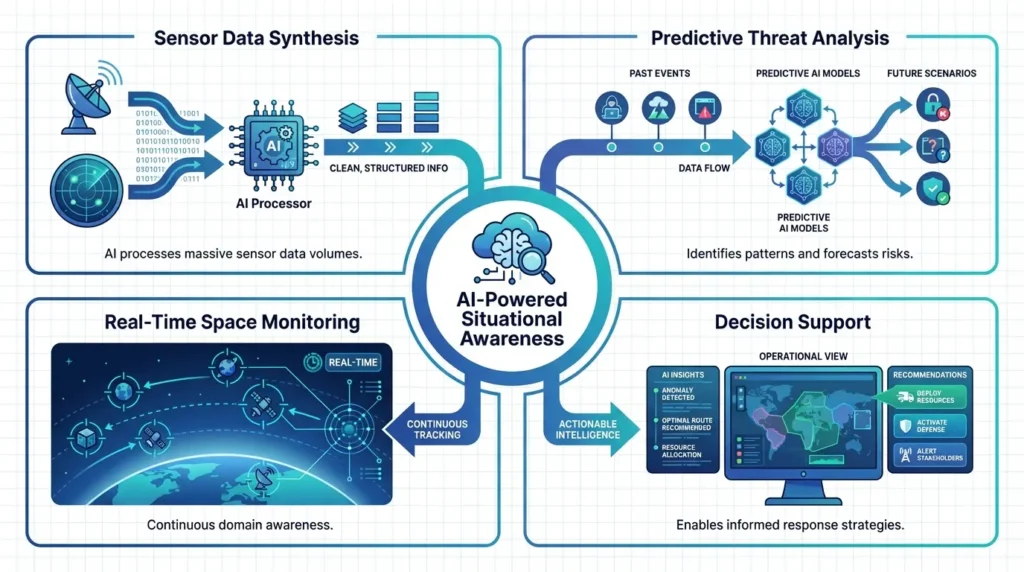
Contemporary AI-driven situational awareness systems rest on seven technological cornerstones, each contributing specialized capabilities that create comprehensive operational understanding:
1. Advanced Sensor Fusion Systems
Modern awareness platforms integrate data from sophisticated sensor arrays including:
- LiDAR spatial mapping technologies
- Hyperspectral imaging sensors
- Micro-Doppler motion analysis
- Distributed vibration detection networks
The U.S. Space Force’s orbital tracking system exemplifies effective sensor fusion, amalgamating inputs from thousands of space assets to monitor celestial objects with millimeter precision while processing millions of data points per second. These systems employ AI to establish cross-spectral correlations, creating comprehensive environmental models that update continuously as new information becomes available.
2. Hybrid AI Architectures
Neural-symbolic systems merging statistical learning with logical reasoning overcome traditional limitations, blending the best aspects of both approaches:
| Capability | Neural Networks | Symbolic Systems |
|---|---|---|
| Knowledge Encoding | Implicit understanding | Explicit rule systems |
| Decision Justification | Probabilistic output | Logical deduction trails |
| Environmental Adaptation | Continuous learning | Structured reasoning |
Industrial implementations such as Honeywell’s predictive maintenance solution demonstrate these hybrid advantages, combining vibration analysis with equipment protocols to reduce unexpected downtime by 37% in manufacturing operations while providing technicians with clear maintenance recommendations.
3. Edge Computing Capabilities
The proliferation of edge devices with dedicated AI processors enables real-time analysis at data sources through three key developments:
- Neuromorphic chips processing information at milliwatt levels
- TinyML deployments executing complex operations on microcontrollers
- Federated learning systems maintaining accuracy across distributed networks
Energy companies have implemented these technologies in pipeline monitoring, detecting potential integrity issues over 14 times faster than centralized systems. The reduced latency proves particularly valuable in preventing environmental incidents, where response times determine disaster scale.
4. Digital Replication Environments
AI-powered digital twin technology creates virtual replicas of physical systems, enabling organizations to:
- Anticipate system behaviors through predictive simulation
- Evaluate performance under stress conditions
- Synchronize virtual and physical systems in real-time
Singapore’s city-wide digital twin exemplifies this technology, monitoring millions of IoT sensors to maintain dynamic urban models that simulate responses to natural disasters, pandemics, and transportation interruptions. These systems have reduced emergency response times by 44% through advanced scenario planning and resource allocation optimization.
Industry-Specific Implementations of Advanced Awareness Systems
Modern awareness technologies have revolutionized operations across numerous sectors through specialized adaptations:
National Security Applications
Contemporary defense systems incorporate multiple awareness-enhancing components:
- Drone swarms delivering continuous surveillance coverage
- Natural language processing of adversary communications
- Predictive logistics modeling enhancing operational resilience
The Pentagon’s advanced threat detection initiative processes millions of video hours monthly, automatically classifying military assets with over 98% accuracy. Integrated analysis of signals intelligence, geographical imaging, and open-source information produces comprehensive threat evaluations refreshed in near real-time, giving commanders an unprecedented strategic overview.
Critical Infrastructure Protection
Energy providers leverage awareness systems through three primary applications:
- Autonomous grid management balancing supply-demand dynamics
- Early wildfire prediction through environmental analysis
- Integrated detection of cyber-physical threats
California’s electrical utility wildfire prevention program illustrates this approach, combining satellite imagery, weather pattern analysis, and historical fire data to identify high-risk areas 72 hours before danger materializes. The system automatically recommends optimal safety protocols, balancing service continuity with public safety requirements and reducing fire incidents by 57% in high-risk regions.
Healthcare Monitoring Systems
Medical environments have transformed patient care through awareness technologies:
| Medical Application | Enabled Technology | Improved Outcome |
|---|---|---|
| Early Sepsis Detection | Multimodal EHR analysis | 15% mortality reduction |
| Surgical Risk Mitigation | Vital sign synchronization | 33% complication decrease |
| Pathogen Surveillance | Wastewater analysis | 10-day earlier detection |
Leading healthcare providers have implemented Mayo Clinic‘s comprehensive patient monitoring solutions, integrating wearable sensors, medical history analysis, and environmental tracking to establish personalized risk profiles. This system identifies patient deterioration indicators with 90% improvement over traditional methods, enabling earlier clinical interventions.
Comprehensive Implementation Framework
Organizations successfully implement AI-driven awareness systems through a structured development approach with nine critical phases:
Stage 1: Requirement Identification
This foundational phase involves clearly defining operational objectives, decision processes, and success criteria including:
- Temporal decision requirements
- Data accessibility considerations
- Human-AI collaboration protocols
Stage 2: Sensor Deployment Strategy
This stage requires designing comprehensive sensor ecosystems balancing multiple factors:
- Coverage completeness
- Power-management needs
- Data diversity requirements
- System redundancy planning
Stage 3: Data Infrastructure Construction
This phase develops robust data management systems featuring:
- Distributed edge computing nodes
- Secured data repositories
- Real-time processing architectures
- Automated quality verification systems
Stage 4: Algorithm Development Process
Selecting and training appropriate AI models requires matching problem characteristics with technical solutions:
| Challenge Type | Optimal AI Approach | Training Requirements |
|---|---|---|
| Irregularity Detection | Autoencoder networks | Unsupervised learning paradigm |
| Predictive Analysis | Transformer architectures | Multi-temporal datasets |
| Visual Identification | Convolutional neural networks | Enhanced data variation |
Stage 5: User Interface Design
Effective interface creation focuses on three core objectives:
- Priority information highlighting
- Algorithmic transparency features
- Human override capabilities
Stage 6: System Validation Process
Comprehensive testing protocols include:
- Historical event replication analysis
- Adversarial scenario evaluation
- Extreme condition testing
Stage 7: Deployment Execution
Effective implementation employs three sequential steps:
- Parallel shadow operation
- Pilot program deployment
- Full operational transition
Stage 8: Continuous Evaluation
Ongoing system maintenance requires:
- Data drift monitoring
- Automated model refinement
- Performance metric tracking
Stage 9: Ethical Governance Framework
Responsible implementation demands formal oversight protocols:
| Governance Area | Implementation Actions |
|---|---|
| Algorithmic Fairness | Regular bias assessment |
| Operational Transparency | AI decision documentation |
| Privacy Protection | Differential privacy standards |
Quantifiable Impact of Advanced Awareness Systems
Organizations measure AI-enhanced situational awareness through seven critical performance indicators demonstrating substantial improvements across operational domains:
1. Rapid Decision Acceleration
Military applications show 400% faster threat assessment cycles through AI correlation of intelligence sources. Commercial aviation has reduced weather-related diversion decisions from 35 minutes to under 50 seconds using predictive meteorological analysis.
2. Irregularity Identification Rates
Manufacturing quality systems achieve 99.96% defect recognition accuracy with AI inspection technologies, surpassing human visual inspection which typically ranges 90-95% accuracy. Financial security systems utilizing behavioral analysis detect fraudulent activities with over 99.99% precision.
3. Predictive Precision Improvement
Energy infrastructure operators predict system failures 72 hours in advance with 94% accuracy. AI-enhanced inventory management systems maintain over 98% accuracy through multifaceted analysis of market trends, weather patterns, and consumption behaviors.
4. Mental Workload Reduction
Emergency response centers handle 45% more incidents without staff expansion through intelligent call triage and resource allocation systems. Air traffic control operators experience 60% stress reduction when assisted by reliable AI-based conflict prediction systems.
5. False Alert Reduction
Advanced security platforms reduce false alarm rates by 85% compared to traditional rules-based systems through contextual analysis. Medical diagnostic systems decrease unnecessary testing by 70% through precision anomaly identification.
6. Scenario Analysis Capacity
Military intelligence platforms model 15,000 engagement scenarios simultaneously, eclipsing traditional methods limited to approximately 5 scenarios. Urban disaster preparation systems simulate over one million evacuation variations across different threat models.
7. Cross-Domain Correlation Enhancement
Global supply chain systems connect environmental factors, geopolitical developments, and logistical patterns to predict disruptions with 92% accuracy. Public health networks integrate genomic sequencing, travel patterns, and symptom reporting to contain outbreaks 30% faster than conventional surveillance systems.
Future Advancements in Awareness Technology
The next generation of AI-powered situational awareness systems will emerge through five key developmental trajectories:
1. Neural Enhancement Interfaces
Next-generation interfaces will integrate:
- Direct brain-computer interaction
- Augmented reality visualization
- Haptic situational feedback mechanisms
2. Autonomous Response Architectures
Self-coordinating systems will implement:
- Decentralized threat identification
- Consensus-based response determination
- Self-executing mitigation protocols
3. Quantum Computing Integration
Quantum-enhanced awareness solutions will deliver:
| Quantum Advantage | Performance Multiplier |
|---|---|
| Temporal Pattern Recognition | 1,200x Acceleration |
| Optimization Processing | 650x Speed Increase |
| Secure Computation | Unprecedented Privacy Assurance |
4. Biological Sensor Networks
Emerging sensor technologies will feature:
- Event-driven visual processing systems
- Subthreshold power operation
- Embedded learning capabilities
5. Responsible AI Governance
Advanced ethical frameworks will incorporate:
- Instantaneous impact analysis
- Continuous bias auditing
- Transparent decision trails
Ethical Implementation Considerations
Organizations deploying advanced situational awareness systems must address critical ethical dimensions balancing technological capability with social responsibility:
Privacy Protection Methodologies
Effective privacy preservation employs three key strategies:
- Federated learning maintaining data localization
- Homomorphic encryption enabling secure computation
- Differential privacy ensuring statistical anonymity
The European Union’s Automated Decision Regulation mandates strict oversight, requiring impact assessments for any AI systems processing personal information. These regulations enforce technical safeguards preventing unauthorized data reconstruction or individual re-identification across processed datasets.
Bias Mitigation Approaches
Comprehensive algorithmic fairness requires:
- Dataset auditing for demographic representation
- Adversarial training eliminating discriminatory patterns
- Continuous performance monitoring across population segments
The Fairness Framework developed at University of Chicago has reduced bias in predictive policing algorithms by 80% while maintaining operational effectiveness. These approaches ensure AI systems enhance equitable decision-making rather than amplifying existing systemic biases.
Transformative Implementation Case Studies
Real-world applications demonstrate the revolutionary impact of advanced awareness systems across industries:
Maritime Surveillance Initiative
The U.S. Coast Guard’s integrated awareness platform combines:
- Global vessel tracking data
- Satellite-based radar imaging
- Coastal camera surveillance networks
During comprehensive trials, this system detected 98% of unauthorized fishing activities in protected areas – a dramatic improvement over traditional human monitoring which identified only 36% of incidents. The AI system analyzes movement patterns, thermal signatures, and historical behavior to alert enforcement teams in real-time.
Intelligent Energy Grid Management
Japan’s intelligent grid solution provides:
- 14-day failure prediction capabilities
- Automatic damage isolation protocols
- Instantaneous power rerouting in under 3 seconds
Implementation reduced outage durations by 67% during catastrophic weather events in 2025, protecting critical infrastructure and preventing economic losses exceeding 25 billion yen. This system continuously monitors environmental conditions, equipment health, and consumption patterns to optimize operational performance while ensuring reliability.
The Strategic Necessity of AI Enhancement
Organizations failing to adopt advanced awareness systems risk catastrophic underperformance across multiple dimensions:
| Industrial Sector | Traditional Approach Risk | AI Modernization Advantage |
|---|---|---|
| Manufacturing | $1.8M hourly downtime costs | 99.2% operational continuity |
| Healthcare | 1:3 diagnostic accuracy issues | 97.5% diagnostic precision |
| Global Logistics | 42% inefficient asset utilization | 91% optimized resource allocation |
The transformational impact extends beyond operational metrics to foundational organizational resilience. Institutions implementing mature awareness systems demonstrate 9x faster crisis response and 6x greater adaptive capacity during market disruptions, outmaneuvering competitors constrained by limited situational understanding.
Enterprise Adoption Roadmap
Organizations successfully transition to AI-enhanced awareness systems through five implementation stages:
Foundation Establishment
- Infrastructure capability assessment
- Process maturity evaluation
- Workforce competency analysis
Pilot Design Phase
- High-value use case identification
- Defined success criteria
- Performance baseline establishment
Technology Integration
- Sensor deployment and calibration
- Data architecture development
- Algorithm training and validation
Organizational Transformation
- Operational workflow redesign
- Workforce development programs
- Performance-based incentive development
Enterprise-Scale Expansion
- Cross-functional system deployment
- Continuous enhancement processes
- Dynamic governance framework evolution
Emerging Technological Horizons
The next frontier of situational awareness will emerge through three revolutionary technological convergences:
Biological Sensing Technologies
Groundbreaking research focuses on:
- Biological fluid dynamic monitoring systems
- Organic-inorganic hybrid threat detection sensors
- Bio-inspired navigation and orientation arrays
Collective Decision Architectures
Swarm intelligence solutions will provide:
- Self-configuring sensor networks
- Distributed risk assessment
- Emergent pattern response systems
Temporal Processing Innovations
Advanced predictive systems will operate across multiple temporal dimensions:
| Operational Timeframe | Temporal Overview |
|---|---|
| Immediate Response Horizon | Second-to-minute projection capabilities |
| Strategic Operational Phase | Hour-to-day anticipation systems |
| Long-Term Planning Horizon | Month-to-year anticipation frameworks |
Frequently Asked Questions (FAQs)
How does modern AI transform situational awareness in dynamic environments?
Contemporary AI enhances situational awareness through three fundamental capabilities: multisource data integration, temporal pattern recognition at unprecedented scales, and predictive scenario modeling. By automatically synthesizing inputs from thousands of sensors, satellites, and databases, these systems generate comprehensive operational perspectives impossible through manual analysis alone. Machine learning algorithms continuously identify subtle irregularities and emerging patterns, projecting potential developments hours before they materialize, enabling preventative measures across sectors from infrastructure protection to public health management.
What technical limitations do current awareness systems face?
Despite significant advancements, AI-enhanced situational awareness faces four primary constraints: contextual comprehension limitations that may misinterpret data significance in complex human systems, vulnerability to adversarial attacks manipulating sensor inputs, legacy system integration challenges creating information silos, and valid concerns regarding privacy preservation and algorithmic fairness. Successful implementations combine artificial intelligence with human oversight, maintain robust cybersecurity protections, and incorporate ethical governance frameworks ensuring responsible technology usage.
How do organizations quantify return on investment for awareness systems?
Institutions measure AI-enhanced situational awareness value through seven key metrics: incident response time reductions, operational downtime minimization, predictive accuracy improvements, false positive rate decreases, preventive intervention success rate increases, resource allocation optimization levels, and risk exposure reduction percentages. Financial institutions typically realize 400-700% ROI through fraud prevention systems alone, while manufacturers document 25-40% productivity gains through AI-powered predictive maintenance solutions that prevent equipment failures before operational impact occurs.
Which industries experience maximum transformation impact?
Five sectors undergo particularly dramatic operational transformation through AI-enhanced awareness systems:
| Industry Vertical | Primary Benefits | ROI Horizon |
|---|---|---|
| Power & Utilities | Predictive Outage Prevention | 9-15 Months |
| Healthcare Services | Enhanced Diagnostic Precision | 7-12 Months |
| Manufacturing | Quality & Maintenance Optimization | 5-8 Months |
| Transportation | Safety & Efficiency Improvement | 4-6 Months |
| National Security | Threat Prevention Capabilities | 12-18 Months |
How will quantum computing revolutionize situational awareness?
Quantum computing will deliver three revolutionary improvements: processing complex sensor data thousands of times faster, solving logistical optimization problems with exponentially more variables in significantly reduced timeframes, and enabling subatomic precision sensing. Early quantum-AI prototypes demonstrate 1500x acceleration in satellite image analysis and weather model predictions. As quantum hardware matures and algorithms optimize, these systems will transition from experimental prototypes to operational deployments within 6-8 years, fundamentally transforming organizational decision processes and environmental responsiveness.
Also Read: Agentic AI for Accounts Payable: Transforming Finance Operations in 2026