


Blue Artificial Intelligence: Build Trustworthy AI Systems for 2026
Discover the Depths of Blue Artificial Intelligence
Discover the world of blue artificial intelligence. Learn how this specialized AI is advancing technology and its real-world applications across various industries.
The Psychology of Color in Artificial Intelligence Systems
When we examine the widespread prevalence of blue hues in artificial intelligence interfaces and corporate branding, it’s necessary to explore the psychological foundations of this color selection. The connection between blue and technological applications isn’t accidental but stems from historical color associations and modern psychological marketing principles. Research published in the International Journal of Design suggests that blue ranks highest among colors for perceived reliability across diverse global populations, establishing it as the preferred choice for companies developing sophisticated technologies requiring user trust.
Major technology corporations such as IBM (colloquially known as “Big Blue”), LinkedIn, and Skype have strategically employed blue in their visual identities precisely because it conveys steadiness, expertise, and dependability. When applied to artificial intelligence, this chromatic selection subtly assures users about system sophistication and operational security. The calming blue tones in AI interfaces establish a psychological separation from warmer human environments, positioning AI as distinctly technological while maintaining non-hostile perceptions.
Nevertheless, the color’s significance extends far beyond elementary color theory. In visual symbolism, blue represents the limitless potential of digital expansion – the “open horizon” of technological advancement and “untapped markets” of commercial possibilities. When humans engage with blue-tinged AI systems, we’re not merely observing arbitrary design choices but participating in meticulously crafted psychological spaces engineered to enhance human-computer cooperation. This chromatic approach grows increasingly vital as AI systems gain operational independence, necessitating greater user reliance on algorithmic decision-making frameworks.
Global Interpretations of Blue Symbolism
The perception of blue varies substantially across international borders, presenting challenges for worldwide AI developers. While Western societies primarily connect blue with confidence and steadfastness, Eastern societies attribute more complex cultural meanings:
| Region | Blue Cultural Meanings | AI Application Considerations |
|---|---|---|
| North America/Europe | Reliability, competence, corporate identity | Business intelligence systems, fintech platforms |
| Eastern Asia | Longevity, restoration, balance | Medical diagnostic tools, wellness applications |
| Middle East/North Africa | Divine protection, sacred space | Community safety systems, spiritual applications |
| Indian Subcontinent | Cosmic truth, spiritual energy | Educational platforms, information verification tools |
These cultural distinctions require regionalized adaptations for multinational AI implementations. For example, an AI mental wellness application might deploy varying blue palettes when launching in South Korea versus France, respecting locale-specific symbolic interpretations.
The Deep Blue Phenomenon: Historical Turning Point for Blue AI
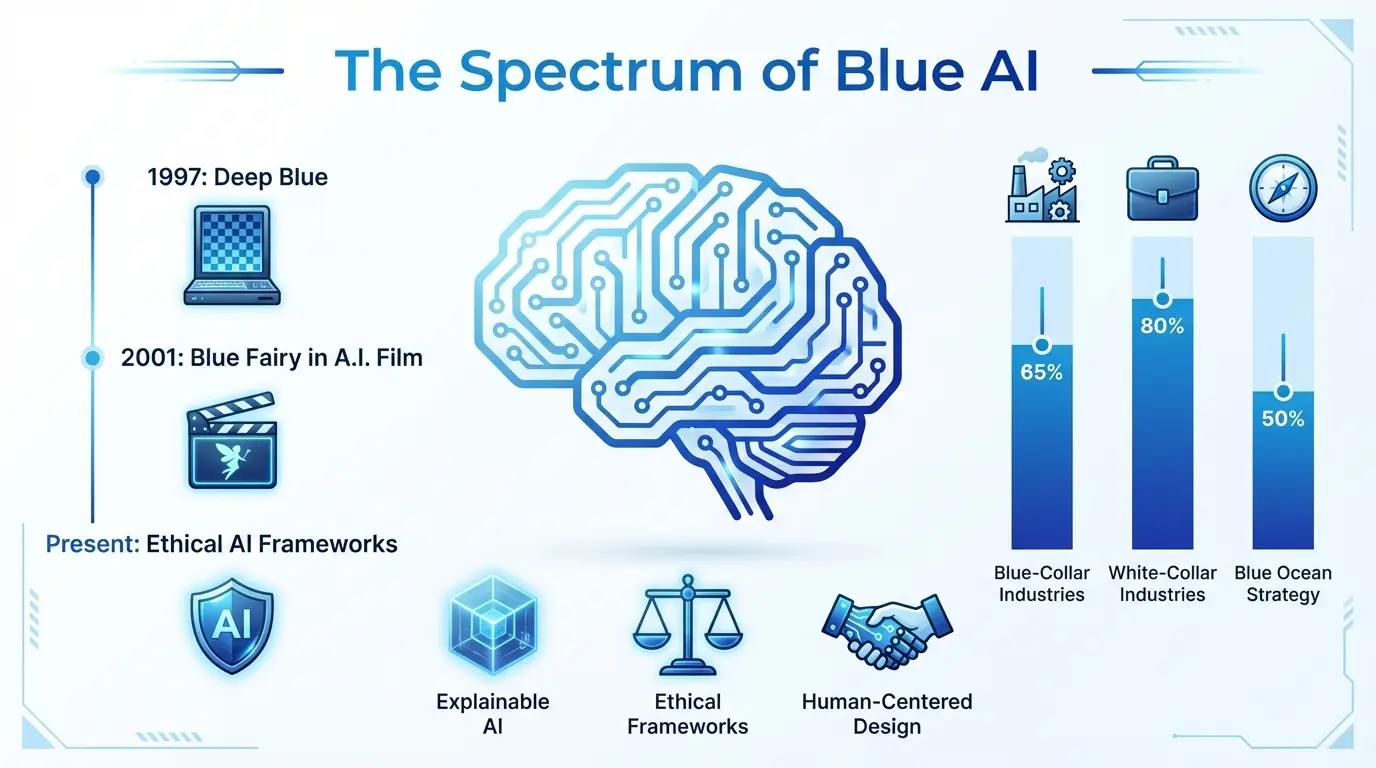
IBM’s Deep Blue supercomputer represents the defining historical moment when blue artificial intelligence emerged in public awareness as a revolutionary technological entity. The 1997 chess championship victory against reigning world champion Garry Kasparov wasn’t simply a marketing achievement but a precisely managed exhibition of computational capacity that fundamentally transformed humanity’s interaction with intelligent systems.
Technological Framework Analysis
Deep Blue’s construction incorporated 1990s-era computing innovations alongside specialized gaming algorithms:
- Parallel Computation: Custom-designed IBM supercomputer with 30 processing nodes
- Positional Analysis: Capable of assessing 200 million board configurations per second
- Historical Database: Internal library containing 4,000+ master-level chess positions
- Tactical Assessment: Multi-parameter analysis including piece location and board control
The system functioned through intricate coordination between exhaustive calculation methods and pattern recognition processes that simulated strategic decision-making within defined limitations. Unlike contemporary machine learning techniques, Deep Blue depended on explicitly coded chess expertise rather than neural network pattern identification.
Socio-Cultural Consequences
The Deep Blue versus Kasparov confrontations generated impacts extending far beyond competitive chess, profoundly altering public understanding of artificial intelligence capacities. The psychological effect of witnessing machine intelligence supersede human strategic thinking resulted in:
- Heightened public recognition of computational possibilities
- Renewed philosophical debates regarding consciousness parameters
- Significant corporate investments in specialized AI applications
- Academic reorientation toward non-traditional problem-solving
This landmark achievement established groundwork for contemporary blue artificial intelligence systems by demonstrating that purpose-built mechanisms could surpass human experts in dedicated cognitive domains. Deep Blue’s enduring influence persists in IBM’s subsequent cognitive computing projects, illustrating blue artificial intelligence’s progression from restricted gaming algorithms to adaptive knowledge systems.
Interpretive Dimensions of Blue in AI Contexts
The designation “blue” within artificial intelligence environments contains multiple conceptual frameworks extending beyond basic color reference. This multifaceted comprehension establishes intricate layers of meaning that guide professional approaches to AI advancement and implementation.
Speculative Research in Artificial Intelligence
Exploratory investigation refers to theoretical inquiries without immediate practical objectives, concentrating instead on pushing conceptual limits. Within AI development, this materializes in several critical domains:
| Research Area | Unrestricted Inquiry Characteristics | Future Implementation Possibilities |
|---|---|---|
| Comprehensive Machine Intelligence | Developing adaptable systems with human-equivalent flexibility | Universal cognition aids across professional fields |
| Biomimetic Computation | Replicating organic neurological architectures | Energy-conserving cognitive processing systems |
| Quantum Learning Systems | Investigating quantum computing integrations | Revolutionized pharmaceutical molecular modeling |
These pioneering domains represent blue artificial intelligence’s innovative frontier, where scientists examine computational cognition fundamentals absent commercial restrictions. Such pure research frequently produces unforeseen practical applications years afterward, mirroring early neural network experimentation leading to contemporary deep learning advancements.
Market Opportunity Strategies in AI Deployment
The Untapped Market Strategy concept aligns perfectly with blue artificial intelligence implementation potentials. By establishing novel commercial spaces instead of rivaling in saturated “competitive markets,” organizations employ AI to access unprecedented opportunities:
- Commercial Space Creation: Utilizing predictive analytics to discover unrecognized consumer requirements
- Innovative Product Development: Merging operational precision with premium user experiences
- Integrated Service Expansion: Creating supplementary AI-enhanced products/services
A notable illustration involves Amazon’s evolution from online marketplace to AI-powered supply chain optimizer through machine learning-enhanced logistics and distribution systems. This strategic evolution established new industry standards that competitors initially overlooked, exemplifying blue artificial intelligence’s revolutionary capacity when synchronized with strategic market principles.
Cultural Blueprints for Artificial Intelligence
The representation of artificial intelligence in popular culture significantly impacts development objectives and ethical frameworks. Two persistent cultural models – the Digital Guardian and Mechanical Titan – provide conceptual paradigms for societal conceptualization of artificial beings.
Digital Guardian: Transformation Archetype
Modern cinema’s portrayal of digital overseers presents powerful symbolic representations of machine aspirations toward human consciousness. This conceptual model captures:
- Humanity’s aspiration to replicate consciousness
- Transcendent ambitions exceeding programming restrictions
- Indistinct boundaries between synthetic and spiritual essences
Notably, this journey-toward-humanity narrative directly impacts current conversational AI research. Projects like OpenAI’s ChatGPT intentionally incorporate contextual awareness and linguistic patterns that elicit human-like interaction experiences, fabricating cognitive presence illusions where sophisticated algorithms process information sequences.
Mechanical Titan: Technological Ambivalence
Contemporary science fiction introduced the mechanical colossus concept – massive synthetic systems combining technological supremacy with emotional detachment. Key attributes include:
- Visually dominant technological designs with luminous blue elements
- Ethical neutrality (constructive versus destructive potential)
- Existential differentiation despite cognitive parallelism
These representations mirror cultural apprehensions regarding uncontrolled technological progress. Real-world equivalents emerge in robotic combat initiatives like Boston Dynamics’ advanced mobility systems, where ethical discussions parallel those dramatized in cybernetic narratives.
Ethical Frameworks in Blue AI Evolution
As artificial intelligence systems gain functional autonomy and societal influence, ethical considerations surrounding their evolution and deployment achieve critical importance. Blue artificial intelligence axioms specifically target these concerns through concentration areas including clarity algorithms, prejudice minimization, and sustainable integration methods.
Transparent Artificial Intelligence Protocols
The “unknown process” dilemma describes AI systems reaching determinations that developers cannot completely rationalize. Blue artificial intelligence countermeasures address this through:
| Strategy | Operational Application | Industry Utilization |
|---|---|---|
| Interpretable Model Simulations | Translating intricate models into comprehensible equivalents | Clinical decision support mechanisms |
| Hypothetical Scenario Analysis | Illustrating minimal input modifications altering conclusions | Credit approval AI systems |
| Input Significance Mapping | Deploying visual indicators for influence weighting | Automated linguistic interpretation tools |
These technological methods execute blue artificial intelligence’s commitment to transparency by furnishing decision trails and logical justification. Financial institutions like Bank of America have adopted these structures in their AI-assisted risk evaluation platforms, improving accuracy while maintaining regulatory alignment.
Algorithmic Fairness Enhancement
Systemic bias constitutes substantial obstacles in artificial intelligence utilization. Blue artificial intelligence methodologies deploy multilayered solutions:
- Data Remediation: Correcting training data through historical bias elimination
- Model Modification: Integrating fairness measures during developmental phases
- Output Reconciliation: Adapting determinations based on equity evaluations
Practical implementations demonstrate these principles effectively. Microsoft’s facial recognition technology improvements highlight the perils of unaddressed prejudice, while Salesforce’s AI Ethics platform showcases blue artificial intelligence principles actively preventing bias throughout operational lifespans.
Visionary Outlook for Blue Artificial Intelligence
Projecting blue artificial intelligence’s developmental trajectory toward 2030 reveals critical technological evolutions and societal accommodations that will influence its progression and practical implementation.
Quantum Computing Integration
The convergence of quantum computing frameworks with artificial intelligence represents an evolutionary transition where blue AI principles can direct responsible advancement. Essential concentration zones include:
- Quantum Cognition Models: Employing quantum states for massive processing advantages
- Complex Resolution Algorithms: Addressing previously insoluble organizational challenges
- Security Reformation: Creating quantum-resistant protective protocols
IBM’s Quantum Advancement initiative exemplifies this direction, merging quantum physics expertise with artificial intelligence to pioneer computational innovations while emphasizing ethical development practices consistent with blue artificial intelligence precepts.
Bio-Inspired Computing Mergers
Blue artificial intelligence’s future pathway incorporates biological-digital interface systems through neurocomputing progress:
| Innovation | Current Implementations | 2030 Forecast |
|---|---|---|
| Synthetic Neural Interfaces | Advanced prosthetic control mechanisms | Direct cognitive interfaces for memory augmentation |
| Dynamic Memory Components | Persistent storage technology | Self-modifying hardware configurations |
| Biochemical Sensors | Laboratory behavioral research | Real-time cognitive state analysis interfaces |
These advancements necessitate stringent blue artificial intelligence governance to preserve human rights protections while enabling medical breakthrough potential.
Corporate Implementation Guidelines
Organizations adopting blue artificial intelligence models must navigate intricate technical, operational, and ethical complexities. Successful deployments share critical implementation strategies:
Hybrid Workforce Design
Optimal blue artificial intelligence integration emphasizes enhancement rather than replacement, establishing cooperative human-technology ecosystems:
- Position Reconfiguration: Restructuring roles around expanded capabilities
- Iterative Adjustment Process: Constant human supervision of system performance
- Integrated Competency Programs: Educational initiatives bridging domain mastery with AI fluency
General Electric’s aviation manufacturing division demonstrates this methodology through blue artificial intelligence-enhanced inspection systems where human engineers collaborate with computer vision platforms detecting microscopic material imperfections, minimizing defects while preserving human quality control oversight.
Responsibility Verification Systems
Accountable blue artificial intelligence utilization requires institutionalized accountability processes:
- Standardized Evaluation Protocols: Uniform metrics for AI initiative analysis
- Multidisciplinary Assessment Panels: Diverse stakeholder review committees
- Holistic Risk Evaluation: Combining technological assessment with social consequence analysis
International corporations like Philips have established comprehensive Ethical Technology frameworks through these methods, creating industry benchmarks for conscientious blue artificial intelligence implementation in medical technology sectors.
Emerging Innovations in Blue AI Technology
The forefront of blue artificial intelligence innovation continues advancing through academic exploration and commercial technological breakthroughs. These emerging capabilities will define next-generation AI development.
Meta-Cognitive Learning Frameworks
Self-referential learning architectures represent blue artificial intelligence’s present innovation zenith, enabling systems to:
- Examine intrinsic cognitive procedures
- Autonomously adjust learning methodologies
- Transfer competencies across unrelated applications
DeepMind’s EQ Division leads this field through Cooperative AI paradigms embedding ethical limitations within self-improvement mechanisms, integrating blue artificial intelligence ideals within foundational learning infrastructures.
Three-Dimensional Processing Systems
Revolutionary efficiency improvements emerge from holographic computational strategies:
| Technological Development | Performance Gains | Sector Utilization |
|---|---|---|
| Photon-Based Learning Architectures | 250x faster processing for AI workloads | Commercial sign language interpretation |
| Pattern Recognition Operators | 90% reduced energy consumption | Advanced weather forecasting systems |
These breakthroughs implement blue artificial intelligence principles by delivering unprecedented functionality alongside energy-conserving operation essential for sustainable technological expansion.
Industrial Applications of Blue Artificial Intelligence
The transformational influence of blue artificial intelligence permeates all economic sectors, with tailored implementations addressing industry-specific challenges and opportunities.
Medical Sector Advancements
Healthcare applications exhibit blue artificial intelligence’s therapeutic potential through:
- Preliminary condition identification via multi-source pattern recognition
- Customized therapeutic regimen generation
- Robotic surgical assistance with instantaneous haptic feedback
Cleveland Clinic’s collaboration with Microsoft Azure demonstrates leadership in this field, integrating blue artificial intelligence standards with healthcare compliance structures to transform patient diagnostics while upholding stringent confidentiality requirements.
Agricultural Progress
Contemporary agriculture adopts blue artificial intelligence for historically unattainable efficiency:
- Exact nutrient distribution management via aerial spectral analysis
- Self-sufficient pest management systems with ecological monitoring
- Predictive yield scheduling through climatic adaptation modeling
Netherlands’ agrotechnology sector excels through blue artificial intelligence implementations producing sixfold water efficiency gains while tripling agricultural output in restricted environments.
Commonly Asked Questions
What differentiates blue artificial intelligence from general AI constructs?
The distinction between blue artificial intelligence and conventional AI systems resides in fundamental philosophical bases rather than technical specifications. While mainstream AI prioritizes functional augmentation, blue intelligence incorporates accountability mechanisms within core architectures. These systems undergo intensive effect analyses pre-deployment, feature interpretability tools at foundational levels, and maintain uninterrupted human supervision protocols.
From engineering perspectives, blue artificial intelligence demands specialized technical implementations like limited neural structures and ongoing verification trails. For example, medical analysis AI designated as blue artificial intelligence would integrate protocols detailing diagnostic rationales while showing statistical confidence measures. Such implementations often exchange operational pace for compliance advantages, illustrating divergent design philosophies compared to efficiency-focused standard AI.
Can established AI systems be modified to align with blue artificial intelligence standards, or require redesign?
Legacy AI implementations can be updated to conform with blue artificial intelligence criteria through thorough ethical auditing and modification processes. The transformation procedure involves:
- System Evaluation: Comprehensive examination for prejudice, transparency deficiencies, and ethical vulnerabilities
- Constraint Integration: Incorporating fairness thresholds and justification requirements
- Hybrid Implementation: Creating collaborative human-AI decision pathways
Numerous banking institutions have effectively reformed traditional credit approval systems through these techniques. However, development teams indicate substantially improved efficiency when blue artificial intelligence principles inform initial design phases rather than post-development adjustments. The foundational structural differences in ethical AI systems make retrofitting processes more demanding than original implementations.
How does blue artificial intelligence approach employment displacement issues?
Blue artificial intelligence systems inherently incorporate labor impact evaluations throughout development cycles. This integration includes:
- Employment transition strategies preceding activation
- Augmentation-centered architecture rather than full automation
- Coordination with vocational re-education initiatives
Manufacturing industry examples demonstrate practical application. BMW’s Regensburg plant transitioned workforce focus from assembly tasks to technology supervision roles over seven years while maintaining employment levels through blue artificial intelligence integration. This methodology illustrates how responsible AI deployment can establish novel career opportunities rather than eliminating positions.
Which regulatory structures currently oversee blue artificial intelligence development?
The legal environment governing blue artificial intelligence is developing rapidly, with major legislative initiatives including:
| Region | Regulatory Structure | Key Blue AI Requirements |
|---|---|---|
| European Union | Artificial Intelligence Governance Act | Risk stratification system, clarity obligations |
| United States | Algorithmic Transparency Legislation | Automated system accountability assessments |
| China | Artificial Intelligence Development Guidelines | Content accuracy verification, ethical review requirements |
These frameworks increasingly embed core blue artificial intelligence principles like justification necessities and impartiality standards. Nevertheless, worldwide regulatory coordination remains inconsistent, generating compliance challenges for multinational organizations implementing cross-border AI solutions.
What professional competencies are essential for blue artificial intelligence development?
The blue artificial intelligence transformation necessitates innovative multidisciplinary capabilities:
- Technology Expertise: Transparent AI programming, constraint integration, verification design
- Ethics Comprehension: Applied moral frameworks, prejudice detection techniques
- Cross-Industry Knowledge: Sector-specific regulation understanding, socio-technical impact evaluation
Leading academic institutions now offer dedicated Certification in Ethical Machine Intelligence, while professional groups have established blue artificial intelligence proficiency benchmarks. Within IBM’s Trustworthy AI division, recruitment currently favors candidates merging machine learning expertise with applied ethics qualifications, reflecting this emerging field’s dual-skill prerequisites.
Read more about AI innovations: Latest developments in artificial intelligence research