

AI SaaS Product Classification: Essential Guide for 2026
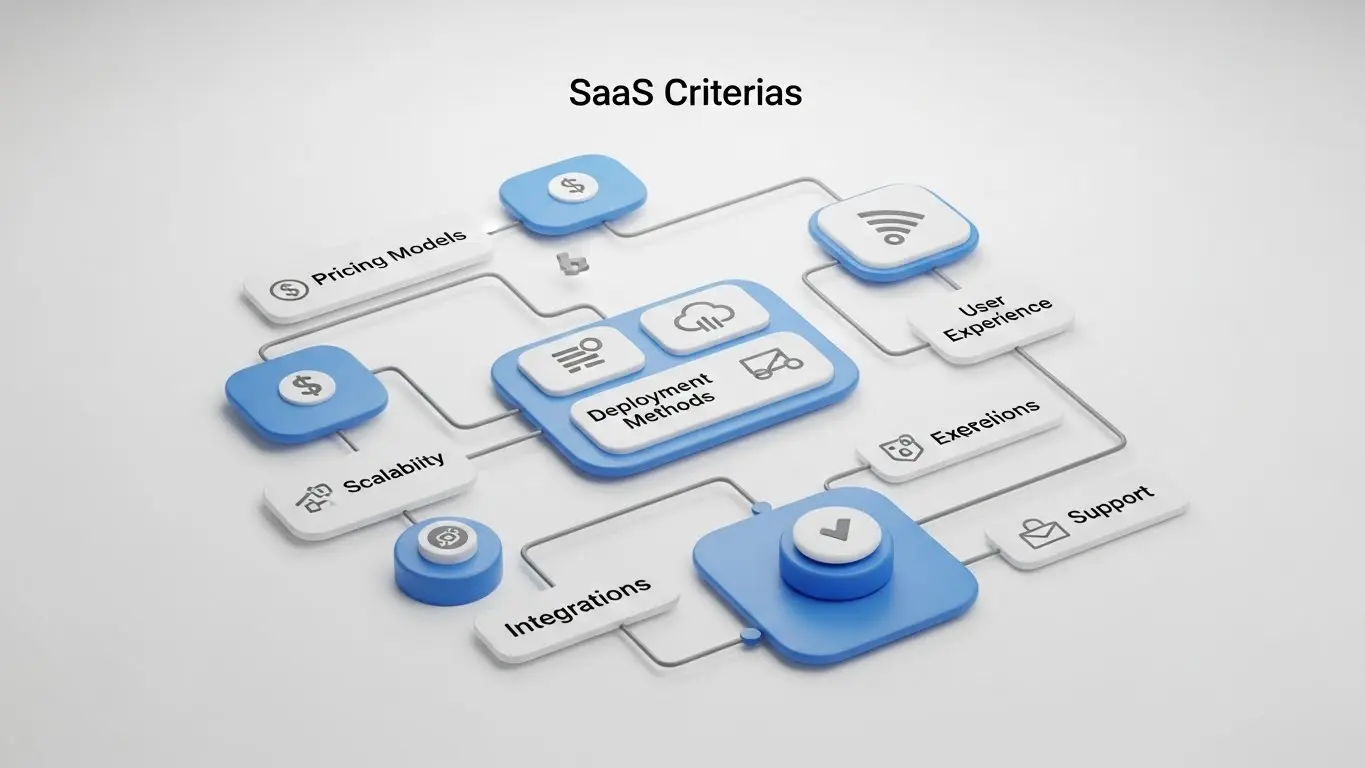
Explore key AI SaaS product classification criteria to understand market positioning, feature sets, and pricing models for better technology evaluation and selection.
The Evolution of AI in SaaS: A Historical Context
The integration of artificial intelligence into Software-as-a-Service solutions represents one of the most significant technological convergences of the digital age. To fully comprehend modern AI SaaS product classification criteria, we must examine the evolutionary path that brought us here.
The journey began in the early 2000s with the emergence of basic web applications delivered through browser interfaces. These pioneer SaaS solutions focused primarily on making business software more accessible and affordable through subscription models. The real transformation started around 2010 when machine learning algorithms became sophisticated enough for commercial applications.
The Three Waves of AI SaaS Development
First Wave (2010-2015): Basic Automation – Early adopters implemented simple rule-based systems for tasks like email filtering and basic data analysis. These were narrow AI applications with limited learning capabilities.
Second Wave (2016-2020): Machine Learning Integration – With advancements in neural networks and cloud computing power, SaaS platforms began incorporating predictive analytics and natural language processing. Products like Salesforce Einstein and Zoho AI marked this transitional phase.
Third Wave (2021-Present): Cognitive SaaS – Modern AI SaaS solutions demonstrate human-like reasoning capabilities through transformer architectures and generative models. These systems continually learn from user interactions while maintaining ethical AI frameworks.
The historical progression explains why classification systems must account for both technical implementation and business functionality. An AI SaaS product from 2015 fundamentally differs from its 2025 counterpart in architecture, capability, and compliance requirements.
Defining AI SaaS: Core Characteristics and Components
Before examining classification criteria, we must establish what constitutes an AI SaaS product in today’s technology landscape.
The Quintessential AI SaaS Framework
A genuine AI SaaS solution combines five essential components:
- Cloud-first architecture with API-driven microservices
- Machine learning models continuously trained on aggregated user data
- Predictive capabilities that improve with usage
- Autonomous decision-making within defined parameters
- Ethical AI guardrails ensuring compliance and fairness
This framework differentiates AI-enhanced SaaS from traditional SaaS with basic automation. The presence of self-improving algorithms capable of making predictive recommendations forms the cornerstone of proper AI SaaS classification.
AI Maturity Levels in SaaS Products
| Maturity Level | Technical Capability | Business Impact | Example Products |
|---|---|---|---|
| Basic Automation | Rule-based workflows | 10-20% efficiency gains | Zapier, IFTTT |
| Machine Learning | Predictive analytics | 30-50% process optimization | HubSpot AI, Zendesk Insights |
| Cognitive AI | Generative systems | 60-80% task automation | Gong.io, Notion AI |
Comprehensive Classification Framework: 12 Key Criteria
Modern AI SaaS classification requires a multidimensional approach that considers technical, functional, and commercial dimensions. This framework comprises twelve essential criteria for accurate categorization.
1. Business Function Specialization
The most fundamental classification criterion identifies the primary business function addressed. This determines the solution’s position in organizational workflows and its competitive landscape.
- Operational Efficiency: Solutions automating core business processes (e.g., accounts payable automation)
- Customer Experience: Platforms enhancing customer interactions (e.g., chatbots, sentiment analysis)
- Strategic Decision Support: Tools providing executive-level insights (e.g., predictive market analytics)
- Creative Augmentation: Systems enhancing human creativity (e.g., AI design assistants)
2. AI Technology Stack Implementation
The underlying artificial intelligence architecture significantly impacts product capabilities, implementation requirements, and compliance considerations.
| Technology Type | Strengths | Limitations | Implementation Complexity |
|---|---|---|---|
| Machine Learning (ML) | Pattern recognition, predictive modeling | Requires large datasets | Moderate-High |
| Natural Language Processing (NLP) | Text analysis, conversational AI | Contextual understanding challenges | High |
| Computer Vision | Image/video recognition | Computationally intensive | Very High |
3. Deployment Architecture Models
Implementation architecture affects security, scalability, and customization potential – critical factors for enterprise adoption.
- Public Cloud SaaS: Multi-tenant environments with standardized features
- Private Cloud Solutions: Dedicated instances for regulated industries
- Hybrid AI Systems: Combination of cloud and edge computing
- On-Premise AI SaaS: Locally hosted solutions with API connectivity
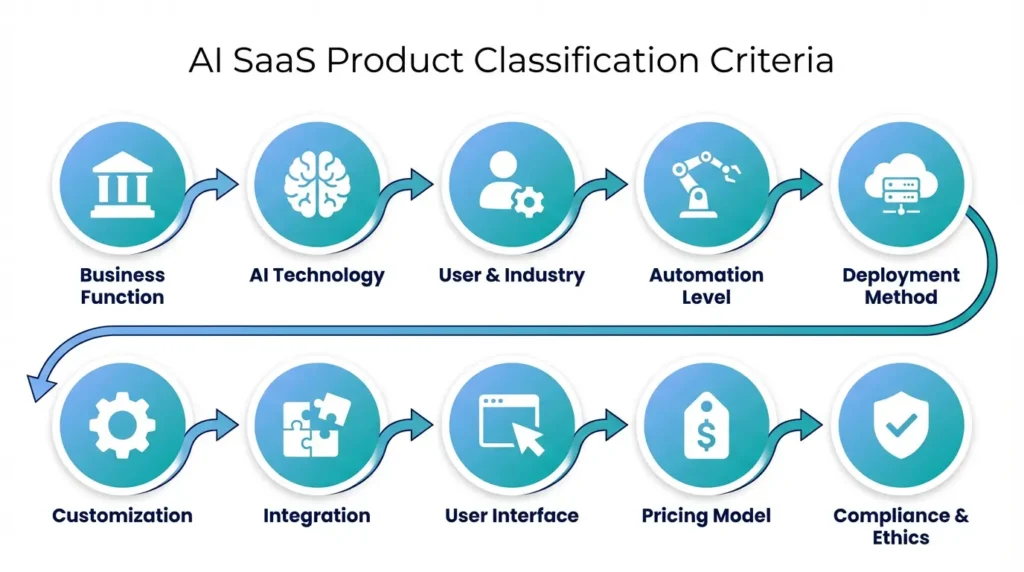
4. Industry Vertical Specialization
AI SaaS products increasingly specialize in industry-specific workflows to address unique regulatory and operational requirements.
- Healthcare AI: HIPAA-compliant solutions for patient data analysis
- Legal Tech AI: Contract analysis and compliance monitoring systems
- Fintech AI: Fraud detection and algorithmic trading platforms
- Industrial AI: Predictive maintenance for manufacturing
5. Intelligence Autonomy Spectrum
The degree of human oversight required determines implementation complexity and risk profiles.
| Autonomy Level | Human Involvement | Use Case Examples | Risk Profile |
|---|---|---|---|
| Assistive AI | Human-driven decisions | Analytics dashboards | Low |
| Collaborative AI | Human-AI partnership | Content creation tools | Medium |
| Autonomous AI | AI-driven decisions | Algorithmic trading | High |
Advanced Classification Methodologies
Moving beyond basic categorization, enterprise buyers require sophisticated frameworks for evaluating AI SaaS products in complex technology ecosystems.
Technical Capability Matrix
This evaluation framework assesses products across four technical dimensions:
- Algorithm Sophistication: From basic regression to deep learning architectures
- Data Processing Capabilities: Real-time streaming vs. batch processing
- Integration Depth: API availability and pre-built connectors
- Learning Mechanisms: Supervised, unsupervised, and reinforcement learning
Business Impact Assessment
Complementing technical evaluation, this framework measures potential organizational value:
| Impact Dimension | Measurement Metrics | Evaluation Methods |
|---|---|---|
| Operational Efficiency | Process cycle time reduction | Time-motion studies |
| Decision Quality | Forecasting accuracy rates | A/B testing |
| Customer Experience | NPS, CSAT improvements | Survey analysis |
Implementation Considerations for Enterprises
Classifying AI SaaS products effectively requires understanding practical implementation challenges and success factors.
Integration Complexity Factors
- Legacy System Compatibility: Mainframe and ERP integration requirements
- Data Governance Requirements: GDPR, CCPA, and industry-specific compliance
- Change Management Needs: User adoption and workflow redesign
- Performance Scalability: Handling seasonal peaks and data volumes
Total Cost of Ownership Analysis
Beyond subscription fees, enterprises must consider:
| Cost Component | Percentage of TCO | Optimization Strategies |
|---|---|---|
| Subscription Fees | 40-60% | Volume discounts, long-term commitments |
| Implementation Services | 15-25% | Phased rollout, internal resourcing |
| Data Migration | 10-20% | Incremental migration, validation tools |
Regulatory Compliance and Ethical AI Considerations
Modern classification systems must account for increasingly complex regulatory landscapes governing AI applications.
Global Compliance Framework Mapping
- EU AI Act Compliance: Risk-based classification requirements
- HIPAA Technical Safeguards: Healthcare data protection standards
- SEC AI Governance Rules: Financial services algorithm auditing
- California Privacy Laws: Consumer data rights implications
Ethical AI Implementation Framework
Responsible classification includes evaluating ethical implementation:
- Bias Mitigation: Techniques for reducing algorithmic discrimination
- Explainability Standards: Interpretability of AI decisions
- Human Oversight Protocols: Escalation paths for disputed outputs
- Environmental Impact: Carbon footprint of model training
The Future of AI SaaS Classification: Emerging Trends
As AI capabilities evolve, classification frameworks must adapt to new technological paradigms.
Next-Generation Classification Criteria
Emerging factors that will shape future evaluation frameworks:
- Quantum AI Readiness: Compatibility with quantum computing infrastructure
- Neuromorphic Computing: Brain-inspired computing architectures
- Federated Learning Capabilities: Privacy-preserving collaborative AI
- Self-Improving Algorithms: Automated model retraining mechanisms
Industry-Specific AI Evolution Paths
| Industry | 2023-2025 Focus | 2026-2030 Projection |
|---|---|---|
| Healthcare | Diagnostic support systems | Preventive health prediction engines |
| Manufacturing | Predictive maintenance | Autonomous production systems |
| Financial Services | Fraud detection | Autonomous wealth management |
Practical Implementation Guide: Classifying Your AI SaaS Product
For product teams developing AI SaaS solutions, proper self-classification is essential for market positioning, pricing, and go-to-market strategy.
Seven-Step Classification Process
- Technical Audit: Document AI architecture, data sources, and algorithms
- Functional Mapping: Identify core business processes supported
- Competitive Analysis: Position relative to alternative solutions
- Regulatory Assessment: Identify compliance requirements
- Pricing Benchmarking: Analyze comparable solutions’ pricing models
- User Persona Development: Define primary and secondary users
- Roadmap Alignment: Ensure classification supports future development
Common Classification Pitfalls to Avoid
- Feature-Based Classification: Focusing on capabilities rather than outcomes
- Overly Broad Positioning: Claiming too many functional areas
- Technical Jargon Overload: Confusing buyers with AI terminology
- Static Classification: Failing to update as product evolves
Enterprise Procurement Strategies: Applying Classification Frameworks
Large organizations require systematic approaches to evaluating and selecting AI SaaS products based on classification criteria.
Vendor Evaluation Scorecard
| Evaluation Category | Weighting | Evaluation Metrics |
|---|---|---|
| Technical Capability | 30% | Accuracy, scalability, integration depth |
| Business Alignment | 25% | Process fit, ROI potential |
| Compliance & Security | 20% | Certifications, audit trails |
| Commercial Terms | 15% | TCO, flexibility, exit clauses |
Negotiation Framework Based on Classification
- Commodity AI SaaS: Leverage pricing competition
- Specialized Solutions: Focus on value demonstration
- Enterprise Platforms: Negotiate custom development
- Regulated Industry Solutions: Emphasize compliance requirements
FAQs: AI SaaS Product Classification Criteria
How does AI SaaS differ from traditional SaaS in classification?
Traditional SaaS classification primarily considers business function and deployment models, while AI SaaS classification requires additional dimensions: algorithm types, learning methods, autonomy levels, and ethical considerations. The dynamic nature of AI systems necessitates ongoing classification validation as models evolve through usage.
What are the compliance implications for different AI SaaS categories?
Highly regulated industries like healthcare and finance impose stringent requirements on AI SaaS products. Solutions handling protected health information (PHI) must comply with HIPAA security rules including audit controls and access management. Financial AI systems fall under SEC regulations requiring model explainability and decision audit trails. Cross-border data flows introduce GDPR obligations regardless of vendor location.
How can enterprises evaluate the maturity of AI capabilities in SaaS products?
Evaluation should combine technical assessment and business impact analysis. Technically, examine model training methodologies, data pipeline architecture, and integration capabilities. Operationally, conduct proof-of-concepts measuring accuracy improvements and process efficiencies. Third-party audits from organizations like NIST’s AI Risk Management Framework provide objective assessments of AI system robustness.
What classification criteria matter most for startup vs enterprise AI SaaS?
Startups should prioritize product-market fit indicators: user persona alignment, problem specificity, and competitive differentiation. Enterprises require comprehensive evaluations including regulatory compliance, integration capabilities, and vendor stability. Scalability thresholds differ significantly – startups may prioritize flexibility while enterprises need proven performance at scale.
How will quantum computing impact future AI SaaS classification?
Quantum computing introduces new classification dimensions including quantum algorithm support and hybrid quantum-classical architecture compatibility. We’ll see new categories emerge for optimization problems currently intractable for classical computers. Classification frameworks will need to account for quantum advantage thresholds and specialized hardware requirements.
Also Read: AI Semantic Interoperability Health IT Trends: Revolutionizing HealthTech in 2025