

AI Trend Analyzer: Transform Your Business with Powerful Insights in 2026
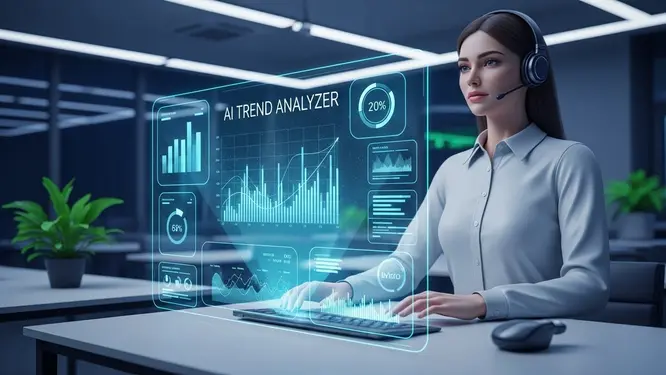
Discover how to harness the power of an AI trend analyzer to uncover insights, forecast changes, and stay ahead in the fast-paced digital landscape.
The Transformative Power of AI Trend Analyzers
In the current fiercely competitive business environment, the companies which can spot and take advantage of the emerging trends are the ones that stay ahead of the market. In a way, AI trend analyzers are a huge step forward as compared to the conventional analytics methods which are still used by the majority. This means that organizations have the ability to work on very large datasets, find very subtle patterns and make predictions about the future with a level of accuracy which has never been experienced before thanks to AI trend analyzers. This all-inclusive handbook unravels every aspect of AI-powered trend analysis starting from its scientific bases to the real-world application in different sectors.
Defining AI Trend Analysis
An AI trend analyzer is a sophisticated computational system that integrates machine learning algorithms, natural language processing, and predictive analytics to recognize, understand, and forecast trends in various datasets.
The Evolution of Trend Analysis Technology
Unlike static reporting tools, such systems keep on learning from new data, changing their models to be in line with updated market conditions at the very time. The transition of human data interpretation work to AI-powered analysis is probably the biggest technological change of business intelligence.
The Pre-Digital Era (1950s-1980s)
Market analysts used to depend on manual surveys, focus groups, and rudimentary statistical models only. Gathering data took a lot of time, the number of samples was always small, and the insights were so late that they couldn’t be used for strategy implementation. Research teams were engaged in a long process of compiling quarterly reports which gave them only a backward look at the market situation.
The Digital Revolution (1990s-2010s)
The arrival of business intelligence software made data analysis automated. These tools, such as SAP BusinessObjects and IBM Cognos, allowed for quicker processing of structured data, but they were still limited by:
- Limited real-time capabilities
- Inability to process unstructured data
- Dependence on pre-defined queries and metrics
- High technical barriers to advanced analysis
The AI Transformation (2020s-Present)
| Feature | Traditional BI | AI Trend Analyzer |
|---|---|---|
| Data Processing Speed | Hours/Days | Milliseconds |
| Data Types | Structured Only | Structured & Unstructured |
| Adaptability | Fixed Models | Continuous Learning |
| Insight Depth | Surface-Level Trends | Causal Relationships |
Core Functionalities of AI Trend Analyzers
The advanced AI trend analysis platform has various dependent technologies that together drastically increase the level of business insights:
Natural Language Processing (NLP) Engines
The cutting-edge NLP technologies like BERT and GPT-4 understand the context of the human language and thus can perform analysis on:
- Customer reviews in different languages
- Social media conversations on a large scale
- Industry reports and news sentiment
- Transcripts from earnings calls and interviews
Brandwatch’s AI-driven social listening platform analyses more than 100 million online conversations every day and is able to spot the changes in the general opinion long time before they appear in the traditional market surveys.
Deep Learning Networks
Complex neural networks that help in identifying the non-linear relationships in the datasets which are unnoticeable by the human analysts and the traditional algorithms are used. Amazon’s demand forecasting system halved the error rates by using deep learning for trend prediction of products based on:
- Search query patterns
- Social media mentions
- Economic indicators
- Historical sales data
Industry-Specific Applications
The use of AI trend analyzers is very different from one industry to another, with each having distinct necessities and possibilities:
Consumer Packaged Goods (CPG)
Top CPG companies such as Unilever take advantage of AI trend analysis for:
- New product development guided by emerging ingredient trends
- Demand forecasting tailored for regional preferences
- Competitor innovation tracking across global markets
Procter & Gamble’s AI-powered system scans half a million product reviews every week to identify emerging consumer expectations about environmentally friendly packaging.
Financial Services
JPMorgan Chase’s LOXM program is one of the examples where AI trend analysis is done by the bank for:
- Market sentiment analysis-based algorithmic trading
- Credit risk assessment with involvement of alternative data
- Fraud detection systems that evolve with new patterns
The bank’s Contract Intelligence (COiN) platform that goes through 12,000 commercial credit agreements annually – is a task that required 360,000 human hours previously.

The AI Trends in Brand Storytelling for 2025
Looking to 2025, the use of AI for brand storytelling is further matured through several important breakthroughs:
Hyper-Personalized Narrative Generation
Advanced NLG systems generate numerous story versions practically:
- Highly personalized customer profiles
- Up-to-date context factors
- Real-time engagement metrics
Coca-Cola’s “Create Real Magic” initiative leverages generative AI along with brand assets to quickly produce personalized digital content in large volumes, thereby increasing engagement by 42%.
Multi-Sensory Experience Design
Top-tier companies are employing AI trend analyzers to build interconnected brand stories over:
- Scent preference revealed by social data analysis
- Audio branding optimized by emotional response algorithms
- Tactile experience based on material trend forecast
Implementing AI Trend Analysis: A Step-by-Step Guide
Successful implementation demands strategic planning across several areas:
Phase 1: Foundation Building
- Perform a data infrastructure audit
- Discover the currently available structured and unstructured data sources within an organization
- Evaluate data quality and governance frameworks
- Define business objectives
- Match AI potentials with the company’s strategic priorities
- Create measurable success metrics
Phase 2: Technology Selection
Main things to consider when you are looking at an AI trend analysis platform include:
- Real-time processing capabilities
- Compatibility with the current data ecosystems
- The ability to explain AI output
- Scalability across various departments
- Conformity to the standards set for the industry
Ethical Considerations in AI Trend Analysis
As their potency increases, firms would have to tackle serious issues of ethics:
Algorithmic Bias Mitigation
Some of the recommended practices are:
- Different training dataset gathering
- Continuous bias evaluation procedures
- Transparent model documentation
IBM’s AI Fairness 360 toolkit features a set of open-source algorithms that help locate and alleviate different kinds of biases in datasets and models.
Privacy-Preserving Analytics
The newly-emerging methods that prohibit privacy breach while inferences are made include:
- Federated learning strategies
- Differential privacy implementations
- Synthetic data creation
Apple’s Private Compute Cloud is designed to handle user data in such a way that no personally-identifiable information is stored. In doing so, it ensures that users get personalized services while at the same time their privacy is respected.
The Future of AI Trend Analysis
Several new technologies will significantly change the way trend analysis is done:
Quantum Computing Integration
- Quantum algorithms will enable:
- Exponentially fast processing
- Opening up the analysis of problem sets that have never been solved before
- Simulation of extremely complex market scenarios
One of the first capabilities demonstrated by Google’s Quantum AI team is the 47-qubit processors which can carry out financial modeling tasks in a few hours where classical computers would need thousands of years.
Frequently Asked Questions (FAQs)
How does an AI trend analyzer differ from traditional business intelligence tools?
Traditional BI tools are limited to mainly processing structured historical data and generating standardized reports. On the other hand, AI trend analyzers have the following transformational capabilities:
- Simultaneous processing of structured and unstructured data streams even from remote locations
- Predictive forecasting through the deployment of machine learning models
- Uninterrupted adjustment to new informational patterns
- Automated creation of reports in the form of natural language
BI tools work on the basis of answering already known questions whereas AI analyzers search for unknown unknowns – discovering new patterns and relationships that an analyst may not have thought of. Just as an example, Credit Suisse’s AI system found the hidden correlations between the movement of shipping containers and the changes in the prices of commodities which eventually led to the conclusion that these fluctuations have something to do with each other whereas the conventional methods could not find such correlations.
What are the primary challenges in implementing AI trend analysis systems?
Pretty often, organizations face the following problems when they want to put their ideas into practice:
- Data Quality Issues: Datasets that are incomplete, inconsistent, or biased may result in wrong insights. According to a MIT study in 2025, almost half (47%) of AI projects fail because of poor data preparation.
- Integration Complexity: It is quite challenging to link the AI the system with old infrastructures while requiring a detailed architectural plan. The German automaker BMW had to wait a year and a half to complete the integration of AI analytics throughout its worldwide supply chain systems.
- Talent Shortages: According to World Economic Forum, the shortage of AI specialists worldwide is more than 1 million positions.
- Regulatory Compliance: Being in compliance with GDPR, CCPA, and other industry-specific requirements makes the implementation process more complicated.
How can small businesses implement AI trend analysis cost-effectively?
Small and medium-sized businesses (SMBs) have the opportunity to implement various strategies, such as:
- Beginning with narrowly focused use cases (social media sentiment tracking, website visitor analysis)
- Employing cloud-based AI services (AWS SageMaker, Google AutoML)
- Industry-specific SaaS solutions adoption that has AI built-in
- Collaborating with university AI research programs
- Executing phased rollout plans that focus on areas with the greatest impact first
Innovative offerings such as the Revuze Express package deliver features typical of a large enterprise but at a price point that is affordable for SMBs, with implementations starting at less than $1,000/month.
Also Read: AI Tech Solutions: Transforming Business Operations for 2025 Success