

Contract Management in the AI Era: Boost Efficiency and Compliance in 2026

Explore how contract management in the AI era is transforming businesses, enhancing efficiency, and streamlining processes for better outcomes.
The Evolution of Contract Management: From Paper to AI
Delve into the changes brought about by AI-era contract management in business, the resulting efficiency improvement, and the simplified processes that yield better outcomes. Contract management has changed its face completely since the era of physical filing cabinets and the manual review processes. It all started with paper-based systems in which legal teams were working for a whole day to draft, file, and retrieve documents. The digital revolution led to spreadsheet tracking and simple document management systems, which accessibility-wise were a step forward but still required a lot of work from people.
The true paradigm shift has been the integration of artificial intelligence technologies. An AI-driven contract lifecycle management (CLM) system can automate 60-80% of the routine contracting tasks as per the Gartner research. Therefore, it frees the legal departments to do more high-value strategic work. The entire digital transformation has been fast in the 2020s as natural language processing (NLP) and machine learning (ML) technologies have become mature enough to deal with complex legal documentation.
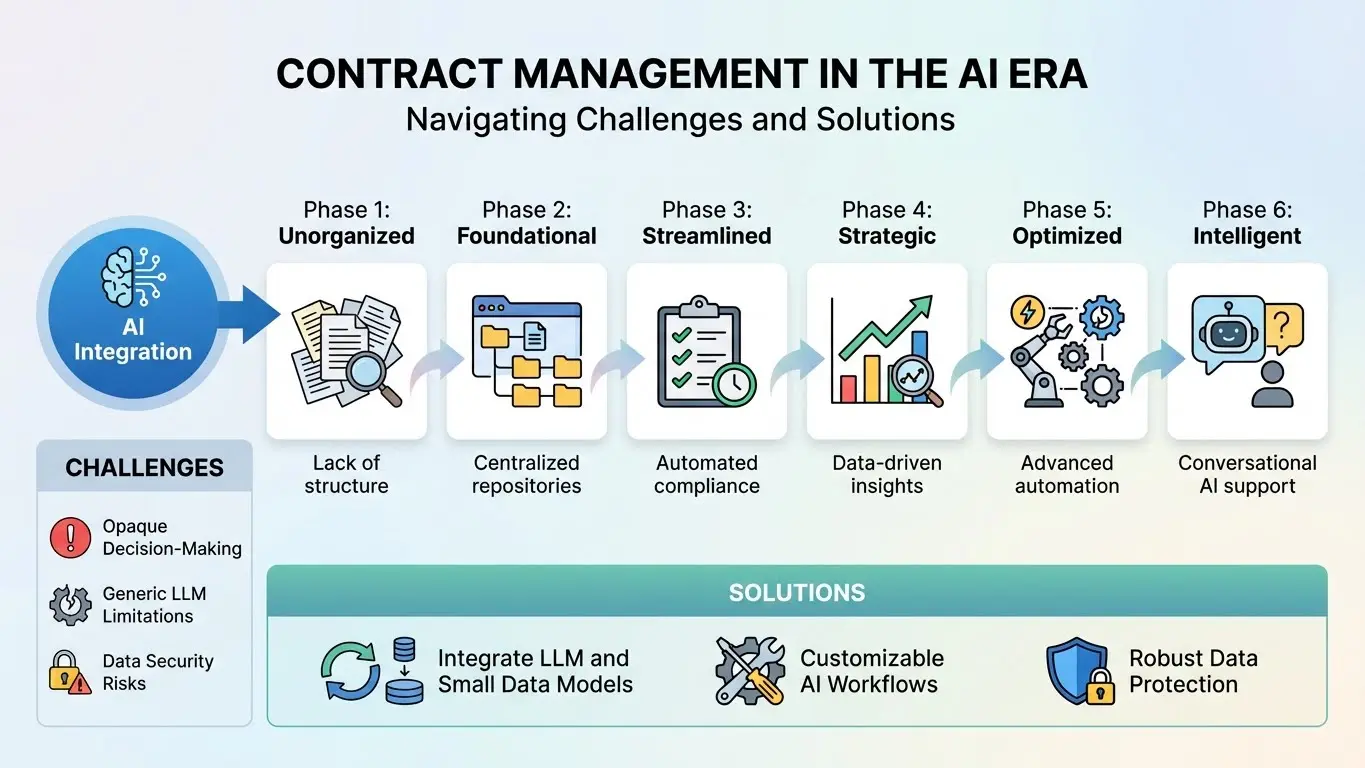
The Six Stages of AI Adoption in Contract Management
Most companies go through six different stages while implementing AI-related solutions for managing contracts:
- Unstructured Phase: Contracts exist in different departments and there is no central system
- Digitization Stage: PDF repositories with rudimentary search functionality
- Workflow Automation: use of electronic signatures and approval routing
- AI-Assisted Analysis: simple clause extraction and risk identification
- Predictive Contracting: risk assessment driven by ML and term optimization
- Autonomous Management: automatically updated contracts through blockchain integration
| Phase | Key Features | Time Savings |
|---|---|---|
| Manual | Paper contracts, physical storage | 0% |
| Digital | PDF storage, basic search | 20-30% |
| AI-Enhanced | Automated extraction, template generation | 50-60% |
| AI-Driven | Predictive analytics, smart amendments | 70-80% |
Core AI Technologies Transforming Contract Management
Today’s contract management systems use different artificial intelligence technologies together to address all the needs:
Natural Language Processing (NLP)
The NLP engines are what make contract understanding possible by AI systems. Advanced models such as BERT (Bidirectional Encoder Representations from Transformers) are able to understand complicated legal terms and, as per MIT research, they can locate most (93%) of the important clauses. The technology presented here makes it possible:
- Automated contract classification
- Context-aware clause identification
- Multi-language contract analysis
- Semantic search capabilities
Machine Learning Algorithms
Both supervised and unsupervised ML models are always on the move, getting better at contract analysis through pattern recognition. These systems:
- Predict acceptable negotiation terms based on historical data
- Identify anomalous clauses that deviate from standard practices
- Optimize contract templates for maximum protection
- Forecast renewal probabilities with 85% accuracy
Generative AI (GenAI)
The rise of large language models (LLMs) such as GPT-4 has had a huge impact on the way contracts are drafted and negotiated. GenAI features include:
- Automated first-draft generation from bullet points
- Smart redlining with alternative clause suggestions
- Instant summarization of complex legalese
- Continuous compliance monitoring against regulatory changes
Benefits of AI-Powered Contract Management Systems
Companies that have adopted AI contract solutions are seeing the effects of it like a transformation across various business metrics.
Operational Efficiency Gains
AI is reported to be the reason for contract cycle times being shortened by 40-70% in the case of studies conducted by the Aberdeen Group.
- Contract drafting became 83% faster
- Negotiation rounds were reduced by 67%
- Manual data entry errors were decreased by 92%
- Any contract term or clause can be retrieved instantly
Risk Mitigation and Compliance
AI systems offer better risk management through:
- They constantly monitor 100% of contracts
- Non-standard term notifications are in real-time
- Compliance checks against 190+ regulatory frameworks are automatic
- Risk scoring for new agreements is predictive
Cost Reduction and Value Creation
Deloitte analysis reveals that organizations save $1.4 million yearly per every 1,000 contracts that are managed with AI by:
- Reduction in legal review costs by 60-80%
- Contract-related disputes decrease by 30-50%
- Improvement in commercial terms by 5-7%
- Identified revenue recovery opportunities averaging 2.1% of contract value
Implementing AI Contract Management: A Step-by-Step Guide
Successful AI implementation needs careful consideration of the four key phases:
Phase 1: Assessment and Preparation
- Perform contract inventory audit
- Document current contract workflows
- Recognize major pain points and ROI goals
- Create data quality standards
- Choose pilot contract categories
Phase 2: Technology Selection
Key evaluation criteria for AI CLM platforms:
| Feature | Essential | Differentiator |
|---|---|---|
| AI Accuracy | >85% clause recognition | >95% accuracy |
| Integration | CRM/ERP connectivity | APIs ecosystem |
| Security | SOC 2 Type II | Private LLM options |
| Customization | Template management | No-code AI training |
Phase 3: Deployment and Training
Best practices for successful rollout:
- Start with low-risk contract types (NDAs, SOWs)
- Department adoption in phases
- Human-AI review hybrid workflows
- Continuous feedback loops
- Role-specific training programs
Phase 4: Optimization and Scaling
Advanced implementations concentrate on:
- Predictive analytics setup
- Custom AI model training
- Automated obligation tracking
- Bi-directional system integrations
- Advanced reporting dashboards
Industry-Specific Applications of AI Contract Management
AI contract solutions provide focused value for different industries:
Healthcare and Pharma
Specialized applications include:
- Automated compliance with HIPAA and FDA regulations
- Clinical trial agreement optimization
- Pharma supply chain contract risk analysis
- Provider network agreement management
Financial Services
Banks and insurers use AI for:
- ISDA agreement automation
- Loan covenant monitoring
- Regulatory change impact analysis
- Counterparty risk assessment
Technology and SaaS
Primary use cases are:
- Auto-generated service agreements
- Usage-based pricing contract administration
- IP protection clause enforcement
- Cross-border compliance management
Overcoming Challenges in AI Contract Management Adoption
While advantages are obvious, the organizations are understating the necessity to face up to the serious implementation challenges.
Data Privacy and Security Concerns
To ensure sensitive contract data protection, there should be:
- Options for private cloud deployments
- Zero-data retention policies
- Advanced encryption (AES-256)
- Granular access controls
- Blockchain-based audit trails
Ensuring AI Explainability
Legal teams need transparent AI, which means:
- Audit trails depicting decision logic
- Confidence indexing for AI suggestions
- Human-readable rationale generation
- Bias detection algorithms
Change Management Strategies
Effective implementation calls for:
- Executive sponsorship programs
- Parallel run transitional periods
- ROI tracking dashboards
- Design of hybrid human-AI workflows
- Continuous skills development
The Future of Contract Management in the AI Era
Several emerging technologies have the potential to profoundly change the way contracting is done:
Predictive Contract Analytics
Advanced ML models will:
- Predict dispute probability with 90% accuracy
- Optimize payment terms by using cash flow modeling
- Automatically update contracts according to market conditions
- Recommend negotiation tactics based on game theory
Smart Contract Integration
Blockchain-enabled smart contracts will facilitate:
- The terms of the agreement being self-executing
- Compliance verification being automated
- Performance tracking being in real-time
- Payment being instant upon milestone completion
Cognitive Contract Assistants
The next-generation interfaces will include:
- Voice-activated contract drafting
- AR/VR negotiation environments
- Real-time multilingual translation
- Emotion-aware negotiation support
Ethical Considerations in AI Contract Management
As AI assumes more contract-related tasks, organizations need to consider:
Algorithmic Bias Mitigation
Fair AI necessitates:
- Diverse training datasets
- Regular bias audits
- Alternative clause suggestions
- Human rights impact assessments
Legal Accountability Frameworks
New governance models have to:
- Clarify who is responsible for AI errors
- Confirm the enforceability of AI-drafted clauses
- Determine Bar admission for AI legal tools
- Specify requirements for malpractice insurance
Case Studies: AI Contract Management Success Stories
Some real-world examples show measurable results:
Global Pharmaceutical Company
- Contract review time cut by 76%
- Legal costs saved by $12M annually
- Compliance rate of 98% across 14K contracts
- Negotiation cycle averaged 3 days (was 27 days)
Fortune 100 Technology Firm
- Routine contracts were 89% automated
- Revenue leakage of $47M was uncovered
- Outside counsel spend was reduced by 62%
- Audit readiness of 100% was achieved
International Bank
- 500+ ISDA agreements are handled on a monthly basis
- Covenant compliance checks are done within 30 seconds
- Implementation of regulatory changes is automated
- $9.3M was saved in operations during the first year
Frequently Asked Questions (FAQs)
How accurate is AI in contract review compared to human lawyers?
According to Stanford Law studies, modern AI contract analysis tools achieve 92-97% accuracy in clause identification and risk detection and thereby are faster than junior attorneys. Nevertheless, it is still very important for a human to manage and be in charge of the interpretations that involve nuances, the strategy considerations, and the agreements that are of a high level. The best way is thus the one that features the efficiency of AI and the judgment of a human through hybrid review workflows.
Can AI completely replace contract managers and legal professionals?
As a result, AI is able to perform 60-80% of the routine contract administration tasks on a voluntary basis, but the legal expertise is still to be kept intact. The role of the human becomes that of concentrating on the most valuable activities: the complex negotiations, the strategic relationship management, the ethical oversight, and the processing of the exceptions that are outside the AI training data.
How do AI contract systems handle highly customized or unique agreements?
Leading platforms utilise various methods for non-standard contracts: transfer learning adjusts general legal knowledge to specific contexts, few-shot learning allows recognition from a very small number of examples, and human-in-the-loop workflows identify new clauses for the review of the attorney. These are not closed systems but rather open ones, as they are constantly updated through reinforcement learning, thus, incorporating attorney feedback on custom provisions. In the case of extremely specialized areas, the use of historical contracts enables businesses to develop their own AI models.
What security measures protect sensitive contract data in AI systems?
Different security layers are combined by the top solutions to protect users’ data: data encryption (AES-256 at rest and TLS 1.3 in transit), private cloud deployment options, granular role-based access controls, anonymization techniques for AI training, as well as blockchain-based audit trails. Compliance certifications such as SOC 2 Type II, ISO 27001, and HIPAA guarantee security of a high standard. There are also some platforms that provide confidential computing environments in which data is kept encrypted even during AI processing.
How can organizations measure ROI from AI contract management implementation?
Key performance metrics are: reduction of the contract cycle time, percentage of automated agreements, improvement of compliance rate, reduction of legal spend, revenue leakage identified, early renewal capture rate, and dispute reduction metrics. The majority of organizations are able to realize full return on their investment within 12 to 18 months. Typical outcomes demonstrate 40-70% faster contracting, 30-50% cost reduction, and 3-7% better commercial terms.
Also Read: AI Tech Solutions: Transforming Business Operations for 2025 Success