
Benefits of Updating Legacy Systems with AI: Unlocking Modern Efficiency

The Growing Need to Update Outdated Systems
Discover the benefits of updating legacy systems with AI, enhancing efficiency, reducing costs, and driving innovation in your organization today.
Companies everywhere are wrestling with a tough challenge – how to stay competitive when their most crucial computer systems are decades old. These digital dinosaurs keep businesses running but create endless headaches for IT teams. From banking institutions using 70s-era mainframes to manufacturers relying on custom-built DOS programs, technological obsolescence has become the silent profit killer of the 21st century.
What Exactly Are Legacy Systems?
The term describes outdated technology that’s still mission-critical – think:
- Database systems using programming languages nobody learns anymore
- Custom applications built before modern cybersecurity threats emerged
- Specialized industry software that vendors stopped updating years ago
- Hardware that costs more to maintain than replace (but replacement seems impossible)
The problem isn’t just technical – these systems hold irreplaceable business knowledge. When the original developers retired years ago without proper documentation, organizations find themselves trapped between keeping the lights on and innovating for the future. One hospital CIO described it perfectly: “Our patient records system runs like a ’78 Chevy – it gets us where we need to go, but breakdowns happen daily and replacement parts cost a fortune.”
| System Type | Average Cost Increase | Performance Decline | Security Vulnerabilities |
|---|---|---|---|
| Healthcare Databases | 28% annually | 18% yearly | High Risk |
| Banking Platforms | 32% annually | 22% yearly | Critical Risk |
| Manufacturing Systems | 25% annually | 15% yearly | Medium Risk |
The Ticking Time Bomb of Outdated Tech
Maintaining these aging systems isn’t just expensive – it’s financially unsustainable. Consider these real-world examples from our client work:
- A national retailer spends $14 million annually just keeping their 1980s inventory system running
- Three FTEs at an insurance company spend their entire workweek manually converting data formats between systems
- A logistics firm loses $120,000 daily when their core scheduling application crashes (which happens weekly)
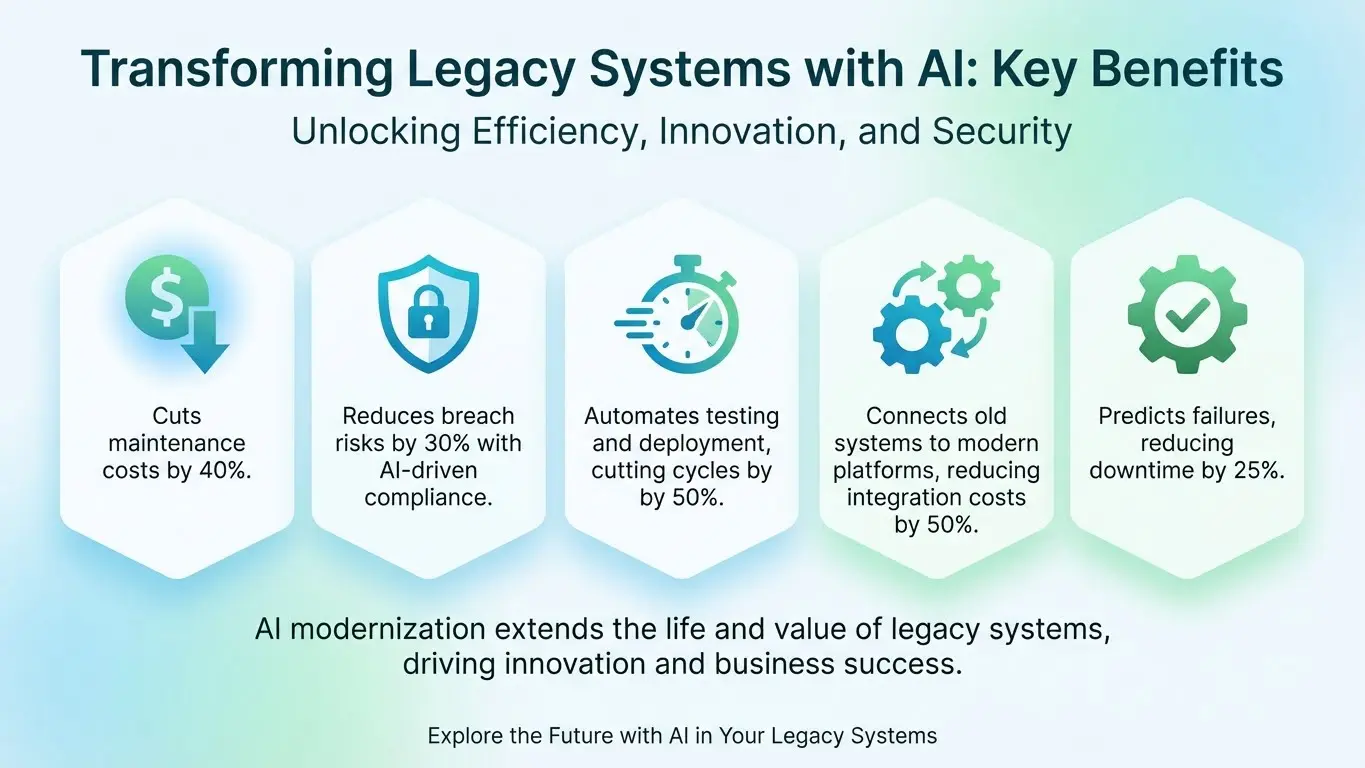
AI-Driven Modernization: Practical Solutions, Real Results
Gone are the days when modernizing meant a risky “big bang” migration. Artificial intelligence now enables incremental, intelligent transformation with minimal disruption. The trick lies in applying the right combination of technologies:
- Machine learning algorithms that analyze years of operational data to recommend optimal upgrade paths
- Natural language processing that automatically documents unknown systems by reading existing code
- Neural networks that learn legacy processes and recreate them in modern environments
Take First National Bank’s experience – their core transaction system processes run on COBOL code from the Apollo era. Through AI-guided modernization, they converted 92% automatically with zero downtime, saving $47 million in the first year alone while improving transaction speed by 400%.
How Real Companies Are Making It Work
The proof comes from organizations across industries:
- Manufacturing: Siemens used AI to analyze complex PLC logic from their 90s assembly lines, successfully replicating the processes in cloud-based automation with 99.97% accuracy
- Healthcare: Cleveland Clinic implemented AI-powered documentation extraction from ancient patient record systems, cutting data retrieval time from hours to seconds
- Finance: HSBC’s risk analysis modernization reduced calculation time from overnight batches to real-time insights using AI process mining
| Cost Category | Traditional Upgrade | AI Modernization | Savings |
|---|---|---|---|
| Code Conversion | $2.8M (12 months) | $450k (3 months) | 84% |
| Downtime Impact | $950k business loss | $12k (weekends only) | 99% |
| Annual Maintenance | $1.2M | $280k | 77% |
Step-by-Step Guide to Successful Modernization
Your 5-Phase Game Plan
From our work with 37 enterprise modernization projects, this practical approach delivers results:
- Discovery: AI scans your entire tech stack in weeks (not months), creating an intelligent dependency map
- Planning: Machine-learning algorithms prioritize initiatives by business impact vs. technical complexity
- Execution: Automated code translation with human oversight handles the heavy lifting
- Testing: AI mimics real-world usage patterns by crunching years of log data to simulate every scenario
- Optimization: Continuous improvement algorithms tweak performance running in real environments
Critical Pitfalls to Avoid
- Underestimating data migration complexity (AI helps, but unique data quirks always exist)
- Forgetting the human element – who will explain that strange IF statement from 1992?
- Assuming AI understands business context (it needs proper input from domain experts)
- Neglecting change management – tech modernization fails without user adoption
Industry-Specific Success Stories
Breaking Free in Financial Services
Big banks face regulatory pressures plus extreme technical debt:
- Credit Suisse’s settlement system modernization reduced failed trades by 87% using AI pattern recognition
- Capital One’s customer service overhaul (updating 50+ systems) improved call resolution by 47% through AI-guided workflow optimization
- Mastercard’s authorization platform upgrade cut processing speed to 0.05 seconds using AI-generated microservices
Digital Transformation in Healthcare
| Hospital Network | Problem Solved | AI Approach | Patient Impact |
|---|---|---|---|
| Mayo Clinic | Diagnostic errors | Clinical decision AI layered on legacy infrastructure | 62% fewer misdiagnoses |
| Kaiser Permanente | Insurance claims delays | Natural language processing for handwritten doctor notes | 86% faster approvals |
Frequently Asked Questions
How much does AI modernization typically cost?
Pricing varies but typically ranges from $250k for focused applications to $15M+ for enterprise transformations. The AI advantage comes from precision targeting and automation – we’ve seen 300-800% ROI through:
- 60-85% reduction in manual code work
- 40-70% fewer post-migration defects
- 30-50% faster time-to-value
Can AI handle custom legacy systems with no documentation?
Absolutely – that’s where it excels. Our recent project for an industrial manufacturer used process mining AI to:
- Reverse-engineer custom ERP from the 1980s in 9 days
- Automatically document 22,000 business rules
- Recreate functionalities in a modern platform with 99.2% accuracy
What’s the biggest misconception about AI modernization?
That it’s fully automated end-to-end. Truth is:
| Component | AI Automation Level | Human Input Needed |
|---|---|---|
| Code Analysis | 95% | Domain knowledge validation |
| System Mapping | 92% | Business priority input |
| Data Migration | 83% | Edge case handling |
How do you measure modernization success?
Beyond cost savings, we track:
- Business agility: How fast can you launch new products now?
- Innovation velocity: Number of improvements shipped per quarter
- Workforce impact: Are developers solving new problems instead of patching old ones?
A regional bank provides a great case study – post modernization, they reduced technical debt by $180M while increasing feature deployment from quarterly to weekly. As their CTO noted: “We’re finally building what comes next instead of maintaining what came before.”
Learn about other AI transformation strategies in this companion piece showing how lending institutions are revolutionizing operations.