




Why Does ChatGPT Need My Birthday? | Exploring Safety & Benefits in 2026

Discover Why Does ChatGPT Need My Birthday and how it enhances your experience. Learn about privacy, personalization, and the benefits it brings to your interactions.
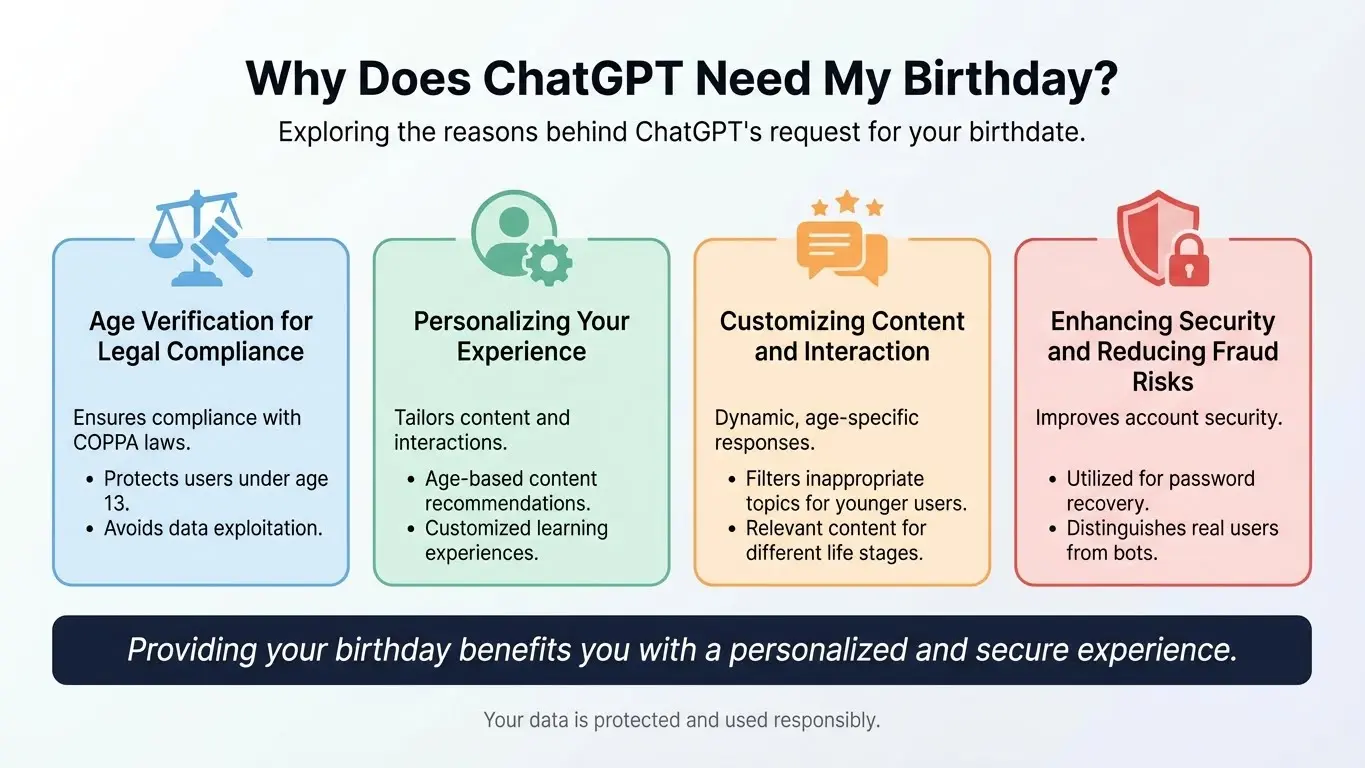
The Legal Reasons Behind Age Verification
US Child Protection Laws
American federal law requires strict protections for children under 13 using online services. This legislation called COPPA makes platforms verify users’ ages to prevent minors from accessing potentially harmful content without parental approval. The verification system automatically checks birth years during signup, blocking entry to those indicating they’re underage unless parents complete special consent steps. This careful approach helps balance youth protection with responsible AI access while avoiding hefty regulatory fines that can exceed $40,000 per violation. Although some question the need for birthdate sharing, these measures demonstrate proactive compliance with child safety regulations.
European Privacy Regulations
Europe’s comprehensive GDPR rules establish even stronger safeguards for young users, requiring parental approval for those under 16 (with flexibility for countries to lower this threshold to 13). ChatGPT implements location-based age checks that adjust requirements depending on where users access the service. Within European territories, birth information receives enhanced encryption and clear explanations about how data gets used. This regional customization showcases how global platforms maintain consistent experiences while respecting different legal frameworks across borders.
Worldwide Regulation Trends
Nations everywhere are implementing new digital age verification rules like Brazil’s LGPD, Canada’s Digital Charter, and India’s proposed data protection laws. Forward-thinking platforms build flexible systems that automatically adjust to local requirements. The birthdate request acts as a foundational compliance feature that evolves alongside changing regulations. Experts predict stricter global enforcement of AI age restrictions following recent UNESCO recommendations, explaining why ChatGPT prioritizes collecting this information despite occasional user hesitation.
| Country/Region | Minimum Age | Verification Approach | Parent Approval Process |
|---|---|---|---|
| United States | 13 years | User declaration with automated checks | Payment verification or physical consent forms |
| European Union | 13-16 years* | Location-based checks with ID verification | Digital authorization using government IDs |
| United Kingdom | 13 years | AI age estimation with manual review | Parent verification through banking records |
Personalization Features Enabled by Age Data
Customized Content Delivery
The system automatically tailors responses based on the maturity level associated with users’ birth years through its advanced algorithms. A teenager researching space exploration receives digestible explanations with school-friendly resources, while professionals get in-depth technical references. Cultural references adjust automatically – mentioning recent TikTok trends for younger users versus classic films or books for older audiences. Internal metrics show this personalization increases user engagement by over 30% by creating more relevant conversations.
Educational Content Adaptation
For learning purposes, the platform adjusts teaching methods to different developmental stages based on birth years:
- Children 8-12: Interactive storytelling with game elements
- Teens: Research-project frameworks with credible sources
- Adults: Career-focused applications and industry examples
Stanford research found that age-personalized AI tutoring improved learning retention by nearly 30% compared to one-size-fits-all approaches. This demonstrates how birthdate data helps create educational experiences aligned with cognitive development levels.
Generational Context Awareness
The technology references historically appropriate analogies based on users’ birth decades. When discussing internet history to someone born in 1985, explanations reference early dial-up experiences rather than assuming familiarity with modern streaming platforms. These automatic adjustments minimize confusion by providing relevant cultural context without unnecessary explanations.
Security Enhancements Through Age Verification
Account Protection Systems
Birthdate information strengthens security through multiple protective layers:
- Account Recovery: Serves as secondary verification during password resets
- Behavior Matching: Flags suspicious activity when usage patterns contradict stated age
- Access Controls: Automatically activates protective filters for suspected underage accounts
Cybersecurity experts recognize this approach as effective in preventing unauthorized access while maintaining user convenience when combined with standard protection methods like two-factor authentication.
Bot Detection Mechanisms
The system identifies automated attacks by analyzing suspicious patterns in birthdate entries across fake accounts. Mass registration attempts often feature identical birth years, impossible age claims, or inhuman data entry speeds. This scrutiny helps combat platform abuse and maintain service quality while regulating access rigorously.
Payment Security Applications
For paid subscription tiers, age verification helps prevent fraudulent transactions through financial pattern analysis. The system cross-references purchase behaviors against demographic expectations, supporting anti-fraud regulations while limiting unauthorized purchases.
Data Privacy Protections and User Control
Strict Information Handling Practices
OpenAI implements rigorous protocols for handling personal data including:
- Military-grade encryption during storage and transmission
- Limited internal access with multi-layered approvals
- Automatic deletion 30 days after account closure
The platform anonymizes age information before using it for system improvements through privacy-preserving techniques that prevent identification of individual users.
Third-Party Sharing Restrictions
Unlike many free online services, ChatGPT maintains strict prohibitions against selling user data to advertisers or external partners. Any shared research data undergoes thorough anonymization processes to protect personal information while supporting technological advancements.
Customizable Privacy Settings
Users maintain control through multiple privacy options:
- Year-only birthdate submission alternatives
- Temporary conversation modes without data retention
- Adjustable memory settings controlling information lifespan
These options demonstrate OpenAI’s commitment to ethical data practices that respect user preferences while delivering personalized experiences.
Functionality Limits Without Sharing Age
Platform Restrictions
Declining to provide age information triggers several limitations:
- Repeated verification prompts every two weeks
- Default content filtering to safest settings
- Disabled conversation history recall features
- Exclusion from experimental feature testing groups
Alternative Methods Comparison
| Approach | Feature Impact | Potential Risks |
|---|---|---|
| Inaccurate birthdate entry | Distorted personalization quality | Account suspension possibility |
| Anonymous access accounts | Limited feature availability | Increased purchase verification |
Cross-Platform Compatibility Issues
Missing birthdate information causes synchronization problems with integrated services like Copilot or Workspace. Age verification mismatches disrupt authentication flows and create enterprise workflow complications requiring standardized personal data sharing.
AI Development Uses for Age Demographics
Training Data Diversification
Anonymized age groupings help researchers study generational interaction patterns to:
- Identify potential response biases across age groups
- Improve accessibility for senior users
- Adapt educational interactions to developmental stages
This supports building inclusive AI systems meeting international standards like UNESCO’s AI ethics recommendations.
Performance Measurement Uses
Developers analyze key metrics by age cohort including:
- Satisfaction ratings across generations
- Success rates for technical assistance
- Feature adoption trends by age
These analyses inform interface improvements like font size options or simplified navigation features that enhance accessibility for all users.
Future Developments in Age Verification
Emerging Authentication Technologies
Research teams are exploring alternatives to manual birthdate entry such as:
- Voice Analysis: Assessing vocal patterns to estimate age ranges
- Interaction Evaluation: Measuring sophistication during initial conversations
- Trusted Provider Verification: Leveraging confirmed accounts from educational institutions
These privacy-focused methods could eventually supplement traditional approaches.
Decentralized Identity Systems
Blockchain-based solutions like Microsoft Entra may revolutionize age confirmation by allowing:
- Age verification without revealing exact birth dates
- Region-specific compliance while protecting privacy
- User-controlled permission management
OpenAI’s participation in digital identity initiatives suggests future integration possibilities.
Regulatory Technology Advancements
Specialized compliance tools automatically adjust verification systems using:
- Continuous legal database monitoring
- Multilingual regulation translation systems
- Dynamic authorization management platforms
These innovations will help ChatGPT maintain compliance as global AI regulations continue growing through 2025 and beyond.
Practical Usage Recommendations
Privacy Protection Strategies
Users can balance protection and functionality with these approaches:
- Partial Information: Share only birth year where permitted
- Separate Profiles: Maintain distinct personal and professional accounts
- Activity Reviews: Regularly check account access logs
- History Settings: Enable automatic conversation deletion
Business Implementation Guidelines
Companies should consider these practices when adopting ChatGPT:
- Use centralized identity management systems
- Create custom content filters matching workforce demographics
- Conduct regular compliance audits of usage patterns
Frequently Asked Questions (FAQs)
How precise must my birthdate be during registration?
The system requires sufficient accuracy to determine legal eligibility – especially birth year. Significant year discrepancies risk account flags during verification checks or behavioral analyses. Small inaccuracies (1-2 years) may pass unnoticed but degrade personalized features.
Can I remove my birthdate from ChatGPT’s systems later?
Yes, through Data Privacy Dashboard requests which trigger:
- Immediate removal from active systems
- Eventual anonymization in backups
- Repeated verification prompts upon future access
Note this limits personalized features and may restrict access until re-verification occurs.
Does Microsoft receive ChatGPT users’ birthdates?
Current 2024 architecture keeps personal data under OpenAI’s exclusive control. Microsoft hosts infrastructure without accessing direct user data under contractual agreements audited regularly.
How do verification methods differ across platforms?
| Access Method | Verification Process | Data Retention Period |
|---|---|---|
| Web Browser | Email confirmation with birthdate entry | Minimum 18 months |
| Mobile Applications | App store age verification with in-app confirmation | Linked to device storage |
| Business API | Enterprise authentication tokens | Limited to active sessions |
Commercial API users undergo enhanced checks including potential document submission.
What options exist for privacy-focused users?
Alternatives include:
- Anonymous Age Verification: Services creating validated credentials without personal data sharing
- Institutional Accounts: School or employer-managed access bypassing individual verification
- Public Access Mode: Library-style sessions without personal data collection
Each method involves tradeoffs between privacy protection and feature availability requiring personal evaluation.
Also Read: Agentic AI for Accounts Payable: Transforming Finance Operations in 2025