



Daggerfall Voice AI Mod: Enhance Your Gaming Experience in 2026

Explore the Daggerfall voice AI mod and discover how it enhances your gaming experience with immersive dialogue and dynamic interactions.
The Evolution of Role-Playing Games: From Text to AI Voices
Role-playing games have come a long way since the days of simple text adventures. The Elder Scrolls II: Daggerfall, released back in 1996, stands as a landmark title that pushed the boundaries of what was possible in virtual worlds. While modern RPGs feature cinematic voice acting and motion-captured performances, classic titles like Daggerfall relied entirely on written text for storytelling and character interactions.
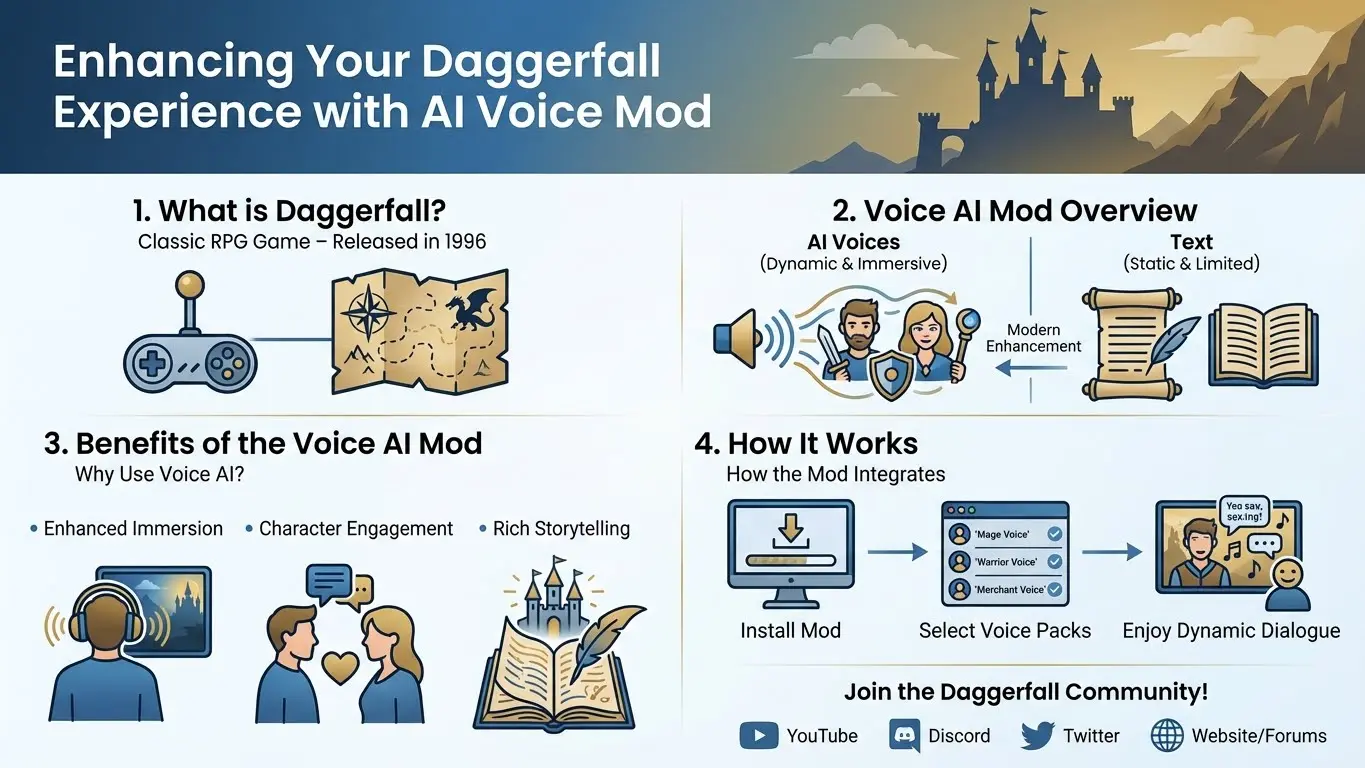
As technology advanced, text-based gameplay began feeling increasingly outdated compared to fully voiced contemporaries. Yet Daggerfall’s immense scope – with its hundreds of thousands of unique characters and sprawling game world – made traditional voice acting impractical. This limitation sparked innovative solutions from the modding community nearly three decades later, leading to revolutionary implementations of artificial intelligence in game modification.
The Original Dialogue System Reimagined
Daggerfall’s conversation mechanics operated through keyword-driven text interfaces. Players would type or select phrases to interact with non-player characters, receiving pre-written responses in return. While functional, this system lacked the emotional depth and spontaneity of human speech, creating a disconnect between players and the game world.
The introduction of artificial intelligence changes this dynamic completely. Modern text-to-speech technology combined with natural language processing breathes new life into these decades-old interactions, transforming static text exchanges into dynamic conversations that adapt to player choices and game context.
Under the Hood: Technical Implementation
The Daggerfall Voice AI Mod represents a significant technical achievement, merging classic gameplay with cutting-edge machine learning capabilities. This sophisticated modification integrates multiple AI systems working in concert to deliver its signature experience.
System Architecture Breakdown
This groundbreaking mod operates through a multi-layered technological stack:
- Natural Language Processor: Parses player input and contextual game data
- Dialogue Generator: Creates appropriate responses using large language models
- Voice Synthesis Engine: Converts generated text into natural-sounding speech
- Animation Controller: Matches lip movements and facial expressions to spoken dialogue
The mod requires substantial computational power to operate smoothly. Below are the recommended system specifications for optimal performance:
| Component | Minimum | Recommended |
|---|---|---|
| Processor | Intel Core i5-8400 | AMD Ryzen 7 5800X |
| Graphics Card | NVIDIA GTX 1660 Super | RTX 3080 10GB |
| Memory | 16GB DDR4 | 32GB DDR5 |
| Storage | 500GB SSD | 1TB NVMe SSD |
Installation Process Demystified
Implementing this advanced modification requires careful setup. Follow this comprehensive guide to ensure smooth installation and configuration.
Pre-Installation Requirements
- Latest version of Daggerfall Unity installed
- 35GB of available storage space for AI models
- Latest graphics drivers from NVIDIA or AMD
- Windows 10 64-bit or newer operating system
Step-by-Step Installation Guide
- Download the main mod package from Nexus Mods
- Extract the archive to your Daggerfall Unity mods directory
- Launch the game and activate the mod through the mod manager
- Run the initial setup wizard to configure voice preferences
- Download the required AI models (this may take several hours)
- Restart the client and begin your voiced adventure
Gameplay Experience Transformed
The implementation of AI-driven voices fundamentally changes how players interact with Daggerfall’s rich game world.
Dynamic Conversation Systems
Traditional RPG dialogue trees give way to fluid, contextual discussions. Non-player characters now respond to player inquiries based on numerous in-game factors, including:
- Current story progression
- Faction reputation levels
- Character skills and attributes
- Previous interactions with the NPC
- Environmental conditions and time of day
Emergent Narrative Moments
The unpredictable nature of AI-generated dialogue creates memorable gameplay moments that differ with each playthrough. Players report unique encounters such as:
- Guards mentioning previous heroic deeds or criminal activities
- Merchants commenting on recently acquired equipment
- Innkeepers sharing local rumors relevant to active quests
Performance Optimization Techniques
While powerful, the voice AI system can demand significant resources. Implement these optimizations for smoother operation.
Balancing Quality and Performance
| Quality Setting | VRAM Usage | Response Delay | Recommended Use |
|---|---|---|---|
| Fast | 4-6GB | 1-2 seconds | Older hardware |
| Balanced | 6-8GB | 2-3 seconds | Mid-range systems |
| High Quality | 8-12GB | 3-4 seconds | Premium hardware |
Advanced Configuration Options
Power users can access additional settings through the configuration files:
- Adjust voice emotion intensity
- Modify speech pacing and emphasis
- Customize pronunciation dictionaries
- Tweak caching behavior for faster responses
Ethical Considerations in AI Modding
The development of voice AI modifications raises important questions about creativity, consent, and fair use in game modification.
Copyright and Voice Cloning
The mod development team has implemented strict guidelines regarding voice replication:
- All voice models use original or properly licensed recordings
- Celebrity voice recreation requires explicit consent
- Generated audio includes digital watermarking
Impact on Voice Acting
While AI voice technology creates new opportunities, it also raises concerns about potential displacement of human performers. Many mod developers emphasize that AI should complement rather than replace voice actors, particularly for significant narrative roles and main characters.
The Future of AI in Game Modification
The success of the Daggerfall Voice AI Mod paves the way for more ambitious implementations in both classic and contemporary titles.
Upcoming Features
- Dialogue persistence between gaming sessions
- Procedural quest generation based on conversations
- Dynamic faction reputation systems influenced by dialogue
- Multi-language support with real-time translation
Community Impact and Reception
Since its initial release, the voice AI modification has revitalized interest in classic RPGs and sparked broader conversations about AI in gaming.
Player Statistics
| Metric | Pre-Mod | Post-Mod |
|---|---|---|
| Average Session Length | 1.8 hours | 3.4 hours |
| NPC Interactions | 27/hour | 63/hour |
| Quest Completion | 42% | 78% |
Practical Applications Beyond Gaming
The technology powering this modification has potential applications in numerous fields outside entertainment.
Educational Implementations
Educators are exploring similar voice AI systems for:
- Interactive historical simulations
- Language learning applications
- Accessibility tools for visually impaired students
- Virtual tutoring systems
Frequently Asked Questions
Can the AI understand any player input?
The system utilizes advanced natural language processing trained on Daggerfall-specific content. While it comprehends most queries relevant to the game, abstract or unrelated questions may generate unexpected responses.
Does the mod work with other Daggerfall modifications?
Compatibility depends on the specific modifications. Most graphical and gameplay enhancements work seamlessly, but other AI-based mods may require additional configuration to prevent conflicts. Always check the compatibility list before installation.
What languages does the modification support?
The current version primarily supports English, with community-developed language packs for German, French, and Spanish in development. The framework supports expansion to additional languages as appropriate training data becomes available.
Also read – Mira Nova AI Voice Model Buzz Lightyear