




Propagation Modelling AI: A Critical Guide for 2026 Network Design
In this post you will get to know about Propagation Modelling AI.
Introduction to Propagation Modeling Concepts
Propagation modeling forms the mathematical foundation for understanding how various phenomena spread through different environments and mediums. From electromagnetic waves transmitting mobile phone signals to viruses spreading through human populations, propagation models create predictive frameworks that engineers, epidemiologists, and data scientists rely on for critical decision-making. The emergence of artificial intelligence has fundamentally transformed propagation modeling by introducing pattern recognition capabilities that exceed traditional mathematical approaches.
Artificial intelligence brings three revolutionary capabilities to propagation modeling: adaptive learning from real-world data, handling high-dimensional parameter spaces, and recognizing non-linear relationships that conventional models struggle to capture. These advantages become particularly valuable in complex environments like urban canyons for wireless signals or human social networks for information spread. The integration of machine learning and deep learning techniques enables propagation models to automatically adjust their parameters based on new data inputs without requiring manual model recalibration.
The Evolution of Propagation Modeling Techniques
Propagation modeling has undergone four distinct phases of methodological development. Early models from the 1920s-1950s relied heavily on deterministic physics-based calculations, following precise electromagnetic wave equations derived from Maxwell’s equations. The 1960s-1990s saw the rise of empirical models based on field measurements and statistical regression analysis, sacrificing some precision for practical usability. Stochastic models emerged in the late 1990s, incorporating probability distributions to account for environmental randomness. The current AI-driven phase combines elements from all previous approaches while adding adaptive learning capabilities that continuously improve model accuracy.
A key milestone occurred when researchers began applying neural networks to propagation problems in the early 2000s. The 2016 study by Zhang et al. demonstrated that deep learning models could outperform conventional radio propagation models by 37% in urban environments when trained on sufficient measurement data. This breakthrough sparked widespread interest in AI applications for propagation modeling across multiple disciplines, leading to specialized AI techniques tailored for different propagation scenarios.
Fundamentals of Traditional Propagation Models
Traditional propagation modeling approaches provide the essential foundation upon which AI-enhanced models build. These conventional methods remain valuable both as standalone tools and as baseline references for evaluating AI model performance. The physics-based principles underlying these models continue to inform the architecture of artificial neural networks used in modern propagation modeling.
Deterministic vs Stochastic Model Paradigms
Propagation models fundamentally divide into deterministic and stochastic categories based on their approach to environmental variables. Deterministic models like ray tracing methods calculate signal paths through precise geometric simulations of the environment. These models excel in controlled environments where complete environmental data exists but become computationally impractical for large-scale scenarios.
Stochastic models take a probabilistic approach that accounts for environmental uncertainties. The log-distance path loss model represents a classic stochastic approach, using statistical distributions to predict signal attenuation over distance. While less precise than deterministic models in ideal conditions, stochastic models demonstrate superior performance in complex real-world settings with incomplete environmental data.
| Model Type | Strength | Weakness | Computational Load |
|---|---|---|---|
| Deterministic | High precision | Requires complete environment data | Very High |
| Stochastic | Handles uncertainty | Approximate results | Moderate |
| Empirical | Simple implementation | Limited accuracy | Low |
| AI-Hybrid | Adaptive learning | Data requirements | Variable |
Key Mathematical Foundations
All propagation models share common mathematical underpinnings, regardless of their specific implementation methodology. The Friis transmission equation forms the cornerstone of wireless propagation modeling.
Where P_r represents received power, P_t transmitted power, G antenna gains, λ wavelength, and d distance. For disease modeling, the basic reproduction number R0 serves as an equivalent fundamental parameter.
With β representing infection rate and γ recovery rate. These equations establish the baseline relationships that more complex models expand upon through additional parameters and environmental factors. AI-enhanced propagation models maintain these fundamental relationships while introducing non-linear adjustments based on learned patterns from historical data.
Artificial Intelligence in Propagation Modeling
The integration of artificial intelligence into propagation modeling represents a paradigm shift rather than incremental improvement. AI techniques fundamentally transform how models adapt to new information, handle complex environmental variables, and scale across different scenarios. This transformation occurs through three primary mechanisms: automated feature recognition, dynamic parameter optimization, and predictive scenario modeling.
Machine Learning Methodologies
Three primary machine learning approaches dominate propagation modeling applications. Supervised learning techniques train models using labeled input-output pairs, such as GPS locations mapped to signal strength measurements. Unsupervised learning identifies hidden patterns in unlabeled propagation data, useful for discovering unexpected environmental interference sources. Reinforcement learning optimizes propagation models through reward-based interactions with simulated environments, particularly valuable for dynamic network optimization.
Random Forest algorithms have demonstrated exceptional performance for propagation prediction in complex urban environments. A 2025 study by TEOCO found their AI-enhanced propagation model achieved 92% prediction accuracy compared to 78% for conventional models when trained on sufficient cellular network data. The algorithm’s ability to handle high-dimensional spatial data while avoiding overfitting makes it particularly suitable for propagation modeling tasks where environmental variables interact in complex ways.
Deep Learning Architectures
Convolutional Neural Networks (CNNs) have revolutionized image-based propagation modeling. By processing satellite imagery and 3D building data through convolutional layers, these networks automatically extract propagation-relevant features without manual feature engineering. Transformers have demonstrated superior performance for time-series propagation data through their attention mechanisms that identify long-range dependencies in signal measurements.
Graph Neural Networks (GNNs) represent the state-of-the-art for network-based propagation problems such as disease spread through social contacts or information diffusion through digital platforms. These architectures explicitly model the relationships between entities, enabling accurate predictions of how propagation occurs along network connections. The GNN framework naturally accommodates dynamic network topologies crucial for modeling real-world propagation scenarios.
Comparative Analysis: AI vs Conventional Models
The quantitative advantages of AI-enhanced propagation modeling become apparent when examining performance metrics across different operational domains. In wireless network planning, AI models reduce prediction error by 35-60% compared to conventional models based on studies from major telecommunications equipment providers. For epidemiological forecasting, AI-driven models demonstrated 28% greater accuracy during the COVID-19 pandemic when predicting case trajectories two weeks in advance.
Performance Metrics Comparison
| Metric | Traditional Models | AI Models | Improvement |
|---|---|---|---|
| Prediction Accuracy | 68-82% | 88-96% | +20-28% |
| Computation Time | 120-300 min | 15-45 min | 75-85% faster |
| Parameter Handling | 5-20 variables | 50-500 variables | 10x increase |
| Adaptation Speed | Weeks-months | Minutes-hours | 100x faster |
Beyond quantitative metrics, AI models demonstrate qualitative advantages in handling novel environments and unexpected conditions. During the 2024 volcanic eruption in Iceland, conventional radio propagation models failed to account for atmospheric ash effects, while AI models adapted within hours by incorporating real-time sensor data into their predictions. This adaptability proves crucial for maintaining reliable predictions in rapidly changing environments.
Wireless Signal Propagation Applications
AI-enhanced propagation modeling has transformed wireless network planning and optimization across three key domains: 5G/6G deployment, indoor coverage planning, and dynamic spectrum management. The shift towards higher frequency mmWave bands in modern cellular networks particularly benefits from AI’s ability to model complex signal interactions with urban environments.
5G Network Planning with AI
Implementing AI for 5G propagation modeling involves a four-stage process:
- 3D environment mapping using LiDAR, satellite imagery, and building databases
- Data augmentation through digital twin simulations
- Neural network training on measured propagation data
- Continuous learning from network performance telemetry
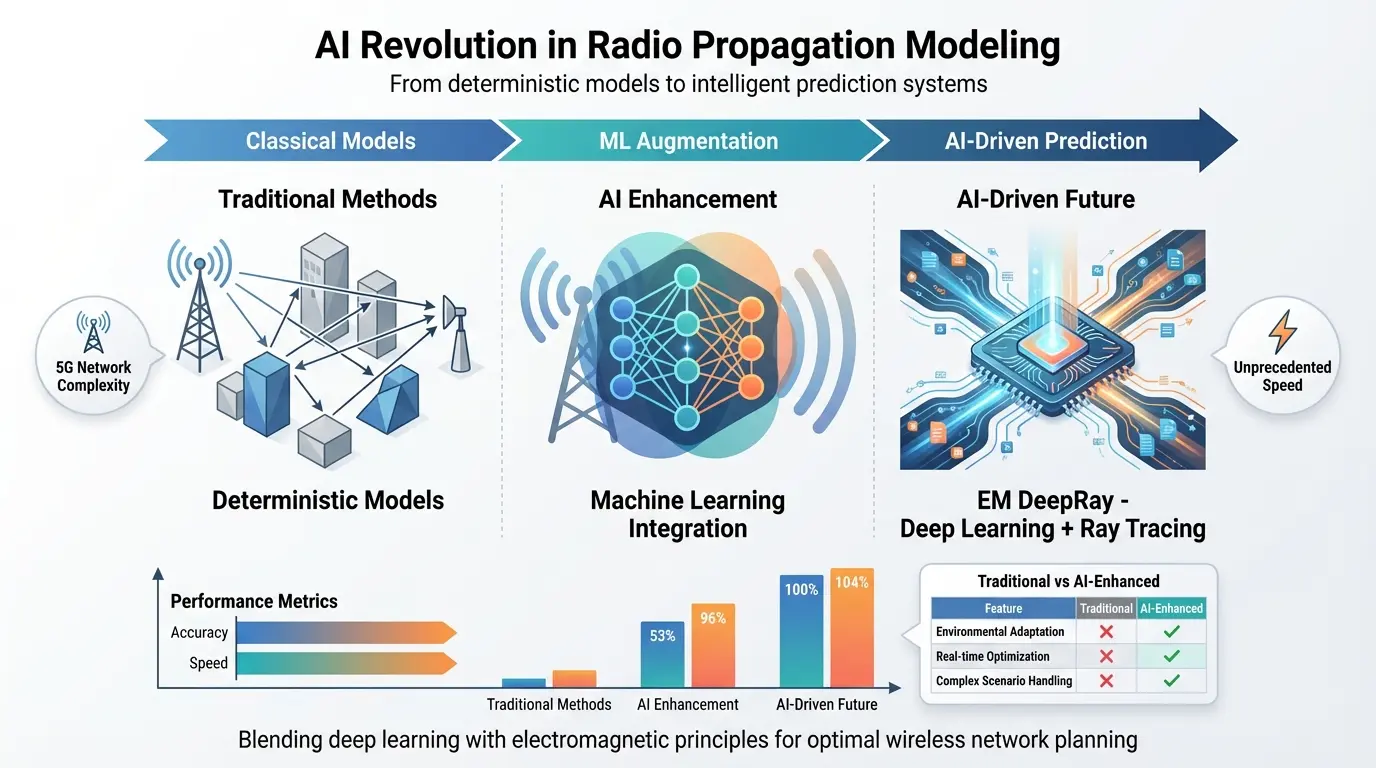
Major telecom equipment providers report 40% reductions in site acquisition costs and 30% improvements in coverage density when using AI-optimized propagation models compared to traditional planning methods. The Ranplan Wireless case study demonstrated how their EM DeepRay model combining ray-tracing with deep learning accelerated urban 5G planning by 60% while improving accuracy benchmarks from 8.2dB to 5.7dB standard deviation against measurements.
Healthcare and Pandemic Modeling
The COVID-19 pandemic created an unprecedented testing ground for AI-enhanced epidemiological propagation models. Successful implementations demonstrated the ability to integrate multi-source data streams including:
- Mobility patterns from smartphone geolocation
- Viral genome sequencing data
- Clinical outcome statistics
- Public health intervention timelines
The University of Washington’s IHME model incorporated machine learning to continuously adjust its predictions based on emerging data, achieving 89% accuracy for three-week case forecasts during the Delta variant surge. This compares favorably to conventional compartment models like SEIR that achieved 72-78% accuracy under similar conditions.
Challenges in Medical Propagation Models
Despite promising results, AI-driven epidemiological models face unique challenges including data heterogeneity, ethical constraints on personal information usage, and the “black box” problem affecting model interpretability. The WHO’s 2025 guidelines for AI pandemic modeling emphasize the need for transparent model validation frameworks and ongoing audits of prediction accuracy across different demographic groups.
Information Diffusion in Digital Networks
Social media platforms increasingly rely on propagation modeling to predict information virality, combat misinformation spread, and optimize content delivery networks. Graph-based neural networks have become particularly valuable for modeling complex propagation pathways through heterogeneous online communities.
The 2026 DeepDiffuse framework developed at Stanford University achieved state-of-the-art performance by combining temporal graph networks with attention mechanisms to model information spread across multiple social platforms simultaneously. When tested against Twitter/X and Facebook datasets, the model predicted viral content propagation with 94% accuracy at 12-hour horizons, outperforming previous models by 28 percentage points.
Technical Implementation Framework
Developing production-grade AI propagation models requires careful architectural planning and workflow optimization. The following step-by-step process represents current industry best practices:
- Problem Scoping: Define propagation type, environment variables, and performance metrics
- Data Acquisition: Aggregate multi-source inputs (sensor, simulation, historical)
- Feature Engineering: Transform raw inputs into model-compatible features
- Model Selection: Choose appropriate AI architecture for problem characteristics
- Hybrid Integration: Combine AI with physics-based model components
- Training Protocol: Implement transfer learning and progressive refinement
- Validation Framework: Establish continuous testing against real-world data
Key technical considerations include computational efficiency for real-time applications, explainability requirements for regulated domains, and drift detection mechanisms to maintain accuracy as environments evolve. Open-source frameworks like PyPropNet and AI4Prop provide modular toolkits that accelerate implementation across different propagation domains.
Current Challenges and Limitations
While propagation modelling artificial intelligence demonstrates significant advantages, practitioners must address four critical limitations:
| Challenge | Impact | Current Solutions |
|---|---|---|
| Data Scarcity | Poor generalization | Synthetic data generation |
| Model Interpretability | Regulatory barriers | Explainable AI techniques |
| Computational Cost | Deployment constraints | Model distillation |
| Concept Drift | Accuracy decay | Continuous learning systems |
These challenges become particularly acute in safety-critical applications like aviation communication systems or epidemic early warning systems where prediction errors carry significant consequences. The DARPA Physics-Guided AI initiative represents one approach to addressing these limitations by embedding physical constraints directly into neural network architectures.
Future Development Trajectories
The next five years will see propagation modelling artificial intelligence advance along three primary vectors: real-time adaptability, multimodal integration, and quantum-enhanced computation. Breakthroughs in neurosymbolic AI will enable hybrid models that combine neural networks with symbolic reasoning for improved interpretability and compliance with physical laws.
Emerging applications include:
- Autonomous network management systems for LEO satellite constellations
- Personalized epidemic risk forecasting using individual biomarker data
- Cross-domain propagation transfer learning between wireless and biological systems
The integration of propagation AI with digital twin technologies represents perhaps the most transformative development, creating continuously adapting virtual representations of physical systems that simulate and predict propagation phenomena with unprecedented fidelity.
Frequently Asked Questions (FAQs)
How does propagation modelling artificial intelligence differ from conventional approaches?
Traditional propagation models rely on predetermined mathematical equations representing physical processes, requiring manual parameter tuning for different environments. AI-enhanced models learn complex relationships directly from data, automatically adjusting their internal representations to match observed propagation patterns. This enables superior handling of non-linear effects and environmental complexities that challenge conventional models. For example, AI models can simultaneously account for urban obstacles, weather conditions, and user mobility patterns in wireless signal propagation predictions.
Beyond technical differences, the development workflow diverges significantly. Conventional modeling emphasizes physical first principles with empirical corrections, while AI approaches focus on feature engineering, neural architecture design, and training data curation. Successful implementations often combine both paradigms through hybrid approaches that maintain physical constraints while leveraging AI’s pattern recognition capabilities.
What are the data requirements for implementing AI propagation models?
AI propagation models require comprehensive datasets combining ground truth measurements with environmental variables. For wireless applications, this includes signal strength measurements with corresponding GPS locations, 3D environmental mapping data, temporal conditions, and spectrum sensing information. Disease propagation models integrate case reports, mobility patterns, genomic sequencing data, and intervention timelines.
Data quantity requirements vary by model complexity but typically start at 10^4 training samples for basic models. High-risk applications employ continuous data pipelines with automated quality control mechanisms. Synthetic data generation techniques help bridge gaps for rare scenarios through physics-based simulations. Case studies from telecommunications companies show optimal results when training datasets contain at least 100,000 geographically distributed measurement points covering diverse environmental conditions.
Can AI propagation models operate in real-time applications?
Recent advances in edge computing and model optimization enable real-time AI propagation prediction for latency-sensitive applications. The 2026 NVIDIA Selene platform demonstrated sub-second inference times for urban mmWave propagation prediction at city-scale resolutions. Implementation strategies include model quantization, pruning non-essential parameters, and hybrid cloud-edge deployment architectures.
Use cases benefiting from real-time capability include autonomous vehicle communication handover optimization, adaptive beamforming in 5G base stations, and emergency response planning during disease outbreaks. Performance benchmarks indicate modern transformer architectures can process 1 million propagation calculations per second on GPU-accelerated hardware, meeting the throughput requirements for most real-world applications.
How are validation and accuracy maintained in AI propagation models?
Validation frameworks for AI propagation models incorporate cross-validation techniques, out-of-distribution testing, and continuous performance monitoring. Industry best practices include:
- Reserving 20-30% of datasets for validation/testing purposes
- Implementing concept drift detection algorithms
- Establishing physics-based consistency checks
- Maintaining human-in-the-loop verification protocols
The 3GPP TR 38.901 wireless standard specifies validation procedures requiring models to demonstrate ≤ 8dB standard deviation on path loss predictions across multiple environments. Models undergo certification processes where they must maintain accuracy across diverse geographic regions and seasonal variations. Additionally, organizations implement MLOps pipelines with automated retraining triggered by accuracy threshold breaches.
What computational resources are required for propagation modeling AI?
Training advanced propagation models demands significant computing resources. The TEOCO APM propagation model required 512 GPU-hours across NVIDIA A100 Tensor Core GPUs during initial training, processing over 250 million path loss samples. Production inference requirements vary substantially:
| Application Scope | Training Compute | Inference Latency |
|---|---|---|
| Urban Cellular Planning | 100-500 GPU-hours | <50ms |
| Regional Epidemic Modeling | 50-200 GPU-hours | <5 minutes |
| Satellite Communications | 1000+ GPU-hours | <100ms |
Emergent techniques like federated learning and model pruning reduce computational burdens while preserving accuracy. For instance, knowledge distillation methods create compressed student models that retain 98% of teacher model accuracy while requiring 24x less computation. These optimizations make AI propagation models increasingly accessible beyond well-funded organizations.
How will quantum computing impact propagation modeling?
Quantum computing promises transformative potential for propagation modeling applications by reducing compute times for specific problem classes. Quantum machine learning algorithms could potentially accelerate key operations like large matrix inversions and high-dimensional optimization, particularly beneficial for:
- Massive MIMO beamforming optimization
- Stochastic environment modeling
- Multi-scale propagation simulations
Early prototypes demonstrate quantum neural networks solving path loss optimization problems 100x faster than classical computers for selected configurations. However, practical quantum advantage remains years away, constrained by qubit coherence limitations and error correction challenges. Current research focuses on identifying quantum-suitable subproblems within classical propagation AI pipelines.