



Genetic Engineering AI Driven Bioinformatics Learning: Key Benefits for 2026
Explore how Genetic Engineering AI Driven Bioinformatics Learning, is unlocking new potentials for learning and innovation in biotechnology.
Building Blocks of Modern Genetic Engineering and Bioinformatics
Have you ever wondered how scientists can redesign life at its most fundamental level? Genetic tinkering and computational biology form two pillars revolutionizing how we understand and manipulate living systems. While one directly alters genetic codes, the other analyzes biological information through advanced computing. The marriage of AI-powered bioinformatics with genetic engineering is creating unprecedented opportunities – imagine algorithms that learn to predict gene behaviors while designing custom organisms. This isn’t science fiction; it’s happening right now in labs worldwide.
Historical Journey of Genetic Manipulation
The roots of genetic engineering stretch back surprisingly far. Picture 19th-century monasteries where Gregor Mendel patiently observed pea plants, uncovering basic inheritance patterns no one else could see. Fast-forward to 1953’s iconic double helix discovery in a Cambridge lab. What followed was a series of game-changing innovations:
- Cohen and Boyer’s 1973 experiment that first combined DNA across species
- Kary Mullis’ late-night inspiration leading to PCR’s creation
- International collaboration completing the Human Genome Project
- Jennifer Doudna’s CRISPR revelation during yogurt bacteria studies
| Era | Innovation | Consequence |
|---|---|---|
| 1970s | Gene splicing techniques | Birth of genetic modification industry |
| 1980s | Automated sequencers | Faster genetic data collection |
| 2000s | Massive parallel sequencing | $1000 genome becomes reality |
| 2010s | CRISPR refinement | Precision genetic surgery tools |
These advances coincided with computing power growing exponentially – a perfect storm enabling today’s AI revolution. Modern geneticists process genomic datasets that would have overwhelmed entire research departments a decade ago.
Core Concepts Driving AI-Genetics Integration
Behind every groundbreaking genetic engineering project lies fundamental molecular biology – knowledge that fuels AI systems predicting biological outcomes.
DNA’s Architectural Wonders
DNA stores biological information like nature’s ultimate flash drive. Understanding its intricate design – complementary base pairs, directional strands, chromosome packaging – helps scientists instruct AI models effectively. Tech giants like Google DeepMind exploit this patterning to train neural networks detecting genetic anomalies.
Biology’s Information Flow
Just as computers process code through strict protocols, cells follow molecular biology’s central dogma. DNA blueprints become RNA messengers that build protein machines – operations AI now simulates with startling realism.
- DNA transcription into messenger RNA templates
- RNA translation into functional protein chains
- Precise DNA replication maintaining genetic integrity
AI Analysis Techniques Transforming Genomics
Specialized machine learning methods now decode genomic mysteries that once baffled researchers.
| AI Technique | Genomic Function | Success Metrics |
|---|---|---|
| Convolutional Nets | Identifying gene promoter patterns | Near-perfect prediction rates |
| Recurrent Networks | Analyzing gene expression timing | High temporal resolution |
| Transformer Models | Genome-wide feature annotation | Comprehensive mapping |
Prediction Engines Revolutionizing Design
Predictive AI models now aid genetic engineers like CAD software assists architects:
- Forecasting protein shapes from genetic codes
- Anticipating CRISPR tool performance
- Modeling whole-organism trait development
Computational Power – Genomics’ Secret Weapon
Cutting-edge computational resources drive modern genetic engineering breakthroughs.
Hardware Demands for Genetic AI
Processing human genomes requires specialized computing systems including:
- GPU clusters for parallel processing
- Petabyte-scale storage solutions
- High-speed data transfer networks
| Data Type | Processing Requirement | Time Reduction |
|---|---|---|
| Whole Genome | 500+ computational hours | 60x faster than 2010 |
| Cell Atlas | Distributed computing | 90% time saved |
Essential AI-Genetics Tools
Specialized software platforms democratize once-impossible analyses.
Next-Gen CRISPR Designers
- SmartGuide – AI-optimized targeting
- EditSight – 3D modeling DNA changes
- CRISPR.AI – Community prediction engine
| Platform | Developer | Strategic Feature |
|---|---|---|
| DeepVariant | Google Health | Population-level variant analysis |
| AlphaFold 3 | DeepMind | Multi-protein interaction modeling |
Practical Applications Changing Our World
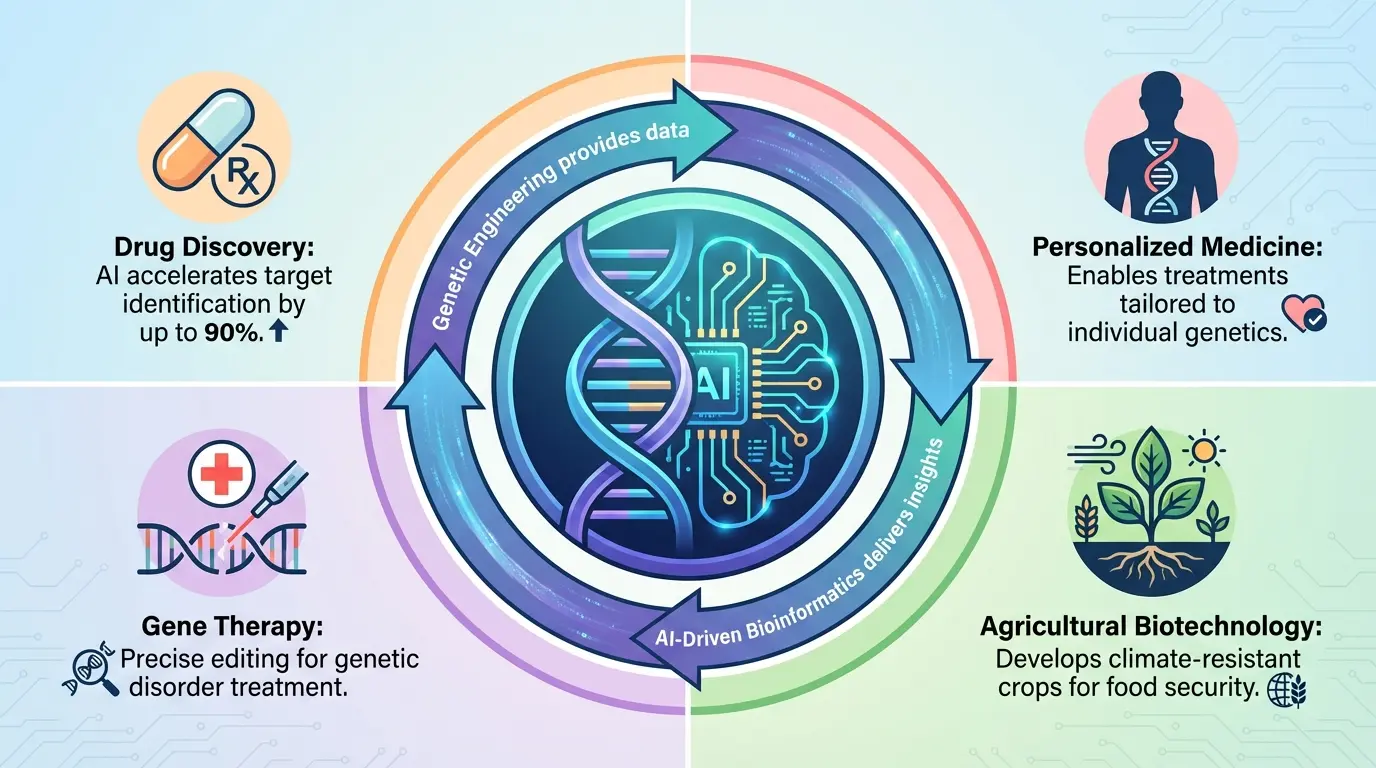
Medical Breakthrough Accelerator
- AI-designed gene therapies entering trials
- Personalized medicine based on genetic profiles
- Disease detection years before symptoms
Agricultural Enhancements
| Crop Modification | AI Contribution | Global Impact |
|---|---|---|
| Drought-resistant corn | Stress adaptation modeling | Increased food security |
| Nutrition-enhanced wheat | Metabolic route optimization | Combating malnutrition |
Ethical Dimensions of AI-Genetic Fusion
Dual-Use Dilemmas
- Benign research becoming weaponizable
- AI-accelerated pandemic risks
- Global biosecurity responses lagging
Privacy Challenges
Genomic data requires careful protection through:
- DNA firewall systems
- Zero-knowledge computation
- Strict access governance
Educational Evolution for AI-Genetics Era
Next-Generation Skill Sets
| Academic Discipline | Emerging Career Paths | Industrial Demand |
|---|---|---|
| Bioinformatics Research | Computational Biologist | High growth sector |
| Data Science Applications | Genomics Pipeline Architect | 70% more job postings |
Future Frontiers in Intelligent Genetic Design
Quantum Leap Possibilities
- Molecular simulations atom-by-atom
- Ultra-precise genome editing navigation
- Evolutionary pathway redirection
Automated Research Platforms
- Experiment design and simulation
- Robotic lab implementation
- Data-driven conclusion generation
Frequently Asked Questions (FAQs)
How does AI actually improve genetic editing tools?
AI transforms genetic editing by predicting outcomes before experiments begin. Imagine software suggesting the most efficient gene-cutting guide RNAs like choosing optimal words for search engine queries. These systems analyze previous editing attempts, recognize patterns linking RNA designs to successful edits and off-target effects, then produce optimized solutions.
What computer specs do DIY genetic engineers need?
| Project Scale | Minimum Requirements | Cost Estimate |
|---|---|---|
| Educational Projects | Gaming laptop with 16GB RAM | $1,200-1,800 |
| Small Lab Research | Workstation + Single GPU | $5,000-8,000 |
Could AI automate scientists out of jobs?
Industry leaders largely dismiss this concern. Current AI excels at specialized tasks but can’t replicate human instinct and creativity. “These tools make discoveries possible, not obsolete,” explains MIT bioengineer Dr. Lena Torres. “I spend less time on routine analysis and more on conceptual breakthroughs.”
What prevents AI genetics technology misuse?
- DNA synthesis screening requirements
- International research ethics standards
- Biosecurity education programs
Is developing world access increasing?
The African BioGenome Project now provides continent-wide sequence analysis through distributed AI models. “We’re bypassing traditional infrastructure limitations,” notes project head Dr. Kwami Adebayo.
Also Read: How AI Hiring Tools Reshape Job Markets – Implications for 2026