




Generative AI SaaS Guide Principles: Key Benefits and Risks for 2026

Explore the core principles of Generative AI SaaS Guide Principles and learn how this technology can automate workflows, enhance creativity, and drive innovation for your business.
Understanding Generative AI in the SaaS Ecosystem
Generative AI SaaS represents a paradigm shift in how software delivers value through artificial intelligence capabilities hosted in the cloud. Unlike traditional SaaS platforms that operate based on predefined rules and static algorithms, generative AI SaaS leverages large language models (LLMs) and machine learning to create original content, generate insights, and automate complex processes dynamically. The fundamental differentiator lies in these systems’ ability to produce unique outputs – whether text, code, images, or data patterns – based on continuous learning from massive datasets rather than executing predetermined operations.
The integration of generative AI transforms SaaS platforms from passive tools into active collaborators. This technology has evolved rapidly since the introduction of transformer architectures like GPT-3 in 2020, with current models demonstrating unprecedented capabilities in understanding context, maintaining conversation threads, and producing human-quality outputs. Modern generative AI SaaS offerings typically combine proprietary algorithms with cloud-native architectures to deliver these capabilities at scale, enabling businesses of all sizes to access cutting-edge AI functionality without infrastructure investments.
The Architecture of Generative AI SaaS Platforms
A robust generative AI SaaS platform comprises several interconnected components that work in harmony to deliver intelligent functionality. The foundation consists of the base model layer – typically built on open-source frameworks or proprietary LLMs – which handles core content generation capabilities. This is complemented by fine-tuning mechanisms that allow customization for specific industries or use cases, often achieved through techniques like reinforcement learning from human feedback (RLHF).
The middleware layer includes APIs and integration tools that connect the AI engine to various data sources, enterprise systems, and third-party applications. Important components in this layer include:
- Vector databases for efficient similarity searches and contextual understanding
- Prompt engineering frameworks that optimize user inputs for better AI responses
- Content moderation systems to ensure output safety and compliance
At the user experience layer, generative AI SaaS platforms provide intuitive interfaces ranging from chat-based consoles to full integration points within existing workflows. The entire architecture operates on cloud infrastructure that allows automatic scaling to handle fluctuating demand while maintaining security standards through encryption, access controls, and audit logging.
| Architecture Layer | Key Components | Functionality |
|---|---|---|
| Foundation Models | LLMs, Multimodal AI | Core content generation capabilities |
| Customization Engine | Fine-tuning, RAG, RLHF | Domain-specific optimization |
| Integration Layer | APIs, Webhooks, SDKs | System connectivity |
| Governance Module | Access Control, Audit Logs | Security & compliance |
The Evolution of Generative AI in Software Platforms
The journey of generative AI in SaaS began with simple rule-based automation and has evolved into sophisticated systems capable of creative problem-solving. Early implementations in the 2010s focused primarily on chatbots and basic content suggestions, leveraging limited machine learning models with constrained capabilities. The breakthrough came with the development of transformer architectures in 2017, which enabled models to process entire sequences of data simultaneously rather than sequentially.
Major milestones in this evolution include:
- 2018: Introduction of BERT models for natural language understanding
- 2020: Release of GPT-3 with 175 billion parameters
- 2022: Wide adoption of multimodal models handling text and images
- 2024: Emergence of agents capable of complex workflow automation
The past two years have seen particularly rapid advancement as generative AI transitions from experimental feature to core functionality within SaaS platforms. Companies like Salesforce, Adobe, and ServiceNow have fundamentally reshaped their product architectures around AI-first principles, embedding generative capabilities throughout their ecosystems rather than offering them as peripheral add-ons.
From Traditional SaaS to AI-Native Platforms
The transformation from conventional software service models to AI-native platforms represents more than just technological advancement – it fundamentally changes how businesses interact with software. Where traditional SaaS focused on digitizing manual processes, AI-native platforms proactively suggest optimizations, generate creative solutions, and automate entire workflow sequences without human direction.
This shift manifests in several ways:
- Natural language interfaces replacing traditional GUI navigation
- Predictive features anticipating user needs before explicit requests
- Dynamic content generation that adapts to individual context
Companies demonstrate this evolution, having transformed their document collaboration platform into an AI-powered workspace capable of drafting content, summarizing meetings, and managing projects through conversational interaction.
Key Applications Transforming Enterprises
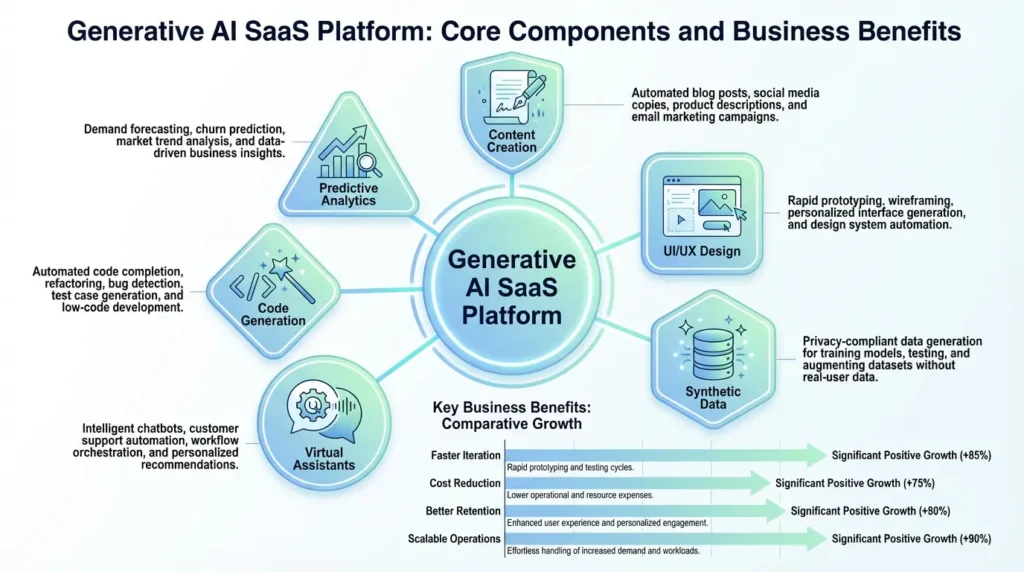
Generative AI SaaS solutions are revolutionizing business operations across every department and industry vertical. Their applications extend far beyond content creation, though this remains one of the most visible use cases. The true transformational power emerges when these tools integrate deeply with business processes to enhance productivity and decision-making.
In marketing operations, generative AI enables hyper-personalization at scale. Platforms now automatically generate customized email campaigns, social media content, and landing pages while optimizing messaging based on performance data. Sales teams leverage AI-powered conversation intelligence tools that analyze customer interactions, suggest next-best actions, and even draft follow-up communications.
Revolutionizing Software Development Lifecycles
The impact of generative AI on software development deserves special attention, as it fundamentally changes how products are conceived, built, and maintained. Leading SaaS solutions enhance every stage of the development lifecycle:
- Requirement Generation: AI analyzies user feedback and market data to suggest feature priorities
- Code Generation: Tools automate up to 40% of routine coding tasks
- Testing Automation: AI creates comprehensive test cases and self-healing test scripts
- Documentation: Automatic generation of technical docs and API references
The table below compares traditional vs AI-augmented development workflows:
| Development Phase | Traditional Approach | AI-Augmented Process | Productivity Gain |
|---|---|---|---|
| Requirement Gathering | 2-3 weeks manual analysis | Automated insights in 48 hours | 75% reduction in time |
| Coding | Manual implementation | 40-60% AI-generated code | 30-50% faster development |
| Testing | Manual test creation | 90% automated test coverage | 80% defect reduction |
Real-world implementations demonstrate remarkable outcomes. Financial services company Capital One used generative AI SaaS tools to reduce their application development cycle time by 34% while improving code quality.
Monetization Models Powering the AI Economy
As generative AI becomes central to SaaS offerings, companies are developing innovative monetization strategies that reflect the unique value proposition of these technologies. Traditional per-user pricing models struggle to capture the dynamic value AI delivers, leading to more sophisticated approaches aligned with real business outcomes.
Three dominant pricing frameworks have emerged:
- Outcome-Based Pricing: Customers pay based on measurable results rather than usage
- Consumption Models: Prices scale with usage metrics like tokens processed
- Hybrid Licensing: Combines fixed subscription fees with variable components
Companies pioneered consumption-based pricing for their API services, while others innovated outcome-based pricing by charging per customer service ticket resolved rather than per agent seat. Leading SaaS providers are now adopting tiered approaches where base subscriptions cover core functionality while premium AI features command additional fees.
Value Metrics and Pricing Strategies
Successful monetization requires identifying the appropriate value metric – the unit that best captures the benefit delivered to customers. For generative AI SaaS, common value metrics include:
- Generated content units
- Workflow automations executed
- Processing time saved
- Business outcomes achieved
Pricing strategy depends heavily on customer profile and use case. Enterprise customers typically prefer predictable annual contracts with volume discounts, while SMBs benefit from usage-based models with low entry barriers. Emerging best practices suggest starting with simpler per-user pricing for early adoption phases then gradually introducing more sophisticated value metrics.
Implementation Challenges and Risk Mitigation
While offering extraordinary potential, generative AI SaaS implementations present unique challenges that require careful planning. Technical hurdles often include data integration complexities, model customization difficulties, and infrastructure scaling issues. More critically, enterprises must address strategic concerns around security, compliance, and workforce transformation.
Key implementation challenges include:
- Data Privacy: Ensuring sensitive data remains protected through AI processing
- Output Accuracy: Mitigating risks of hallucinations and incorrect information
- Integration Debt: Managing proliferating API connections across systems
- Skill Gaps: Addressing shortages in AI-literate personnel
Building Responsible AI Governance Frameworks
Successful generative AI adoption requires more than technical implementation – it demands comprehensive governance frameworks to ensure ethical and compliant usage. Leading organizations implement AI governance through three key pillars:
- Policy Development: Creating clear guidelines for acceptable AI usage
- Technical Controls: Implementing monitoring systems for model outputs
- Human Oversight: Maintaining review processes for critical workflows
The most sophisticated implementations combine automated monitoring tools with human expert review. For example, global consulting firms developed AI governance platforms that automatically flag high-risk outputs for human review and maintain audit trails for all generative AI activities.
The Future Landscape of AI-Driven Software
As generative AI matures, we’re transitioning from augmentation of human capabilities to true automation of knowledge work. Emerging innovations suggest several key trends that will shape the next generation of SaaS platforms:
- Autonomous Agent Ecosystems: Networks of specialized AI agents collaborating to complete complex tasks
- Multimodal Capabilities: Smooth integration across text, voice, video, and data formats
- Self-Evolving Systems: Platforms that continuously improve through usage feedback
Industry leaders anticipate that within five years, generative AI will move from being a feature within existing SaaS products to becoming the core architectural principle underpinning next-generation platforms. This shift will manifest in several ways:
- UI Renaissance: Natural language interfaces replacing traditional menus
- Pricing Transformation: Value-based pricing models tied to business outcomes
- Vertical Specialization: Industry-specific AI models with deep domain expertise
Forward-thinking companies are already preparing for this future by building organization structures around AI capabilities. Established tech giants and startups alike focus on developing controllable AI systems for enterprise use.
Frequently Asked Questions (FAQs)
What are the primary cost components when implementing Generative AI SaaS Guide Principles?
Implementing generative AI in SaaS environments involves several direct and indirect cost factors. Direct costs include model training/compute expenses, infrastructure scaling to handle AI workloads, and API call charges for third-party services. Industry benchmarks show AI compute costs ranging from $0.0005 to $0.006 per token, with model fine-tuning adding approximately 20-30% to base platform costs.
Indirect costs often prove more substantial long-term. These include:
- Integration expenses connecting AI tools to existing data sources
- Compliance costs for regulatory requirements
- Workforce retraining programs
- Ongoing monitoring and governance expenses
How do generative AI SaaS platforms ensure data security and compliance?
Leading generative AI SaaS providers implement multi-layered security architectures designed specifically for AI workloads. Core components include:
- Data Isolation: Customer data compartmentalization
- Input Processing: Real-time data anonymization
- Model Security: Regular vulnerability scanning
- Compliance Frameworks: Certified systems meeting industry standards
Architecturally, enterprises can choose between different deployment models to balance control and maintenance requirements.
What metrics effectively measure ROI from generative AI adoption?
Quantifying generative AI’s business impact requires tracking both operational efficiency gains and strategic outcomes. Essential metrics include:
- Productivity Ratios: Output per employee
- Acceleration Metrics: Time-to-market improvements
- Quality Indicators: Error reduction rates
- Economic Value: Cost savings and revenue impact
| Perspective | Key Metrics | Measurement Frequency |
|---|---|---|
| Financial | Cost savings, Revenue impact | Quarterly |
| Customer | Satisfaction scores | Monthly |
| Process | Cycle times, Output quality | Weekly |
| Innovation | New capabilities launched | Quarterly |
How can enterprises overcome implementation barriers for generative AI?
Successful enterprise adoption requires addressing both technical and organizational challenges through systematic approaches:
Technical Implementation Roadmap:
- Conduct AI readiness assessment of current infrastructure
- Establish robust data pipelines feeding AI systems
- Implement model lifecycle management practices
- Develop comprehensive testing frameworks
Organizational Change Strategy:
- Create cross-functional AI centers of excellence
- Develop detailed workforce transformation plans
- Establish ethical AI governance committees
- Implement continuous learning programs
What industries demonstrate the most advanced generative AI adoption?
While generative AI adoption accelerates across sectors, five industries lead in production implementations:
- Financial Services: Banking and insurance firms deploy AI for risk modeling
- Healthcare: Providers leverage AI for clinical documentation
- Technology: Software companies integrate AI across development
- Retail: Merchants utilize AI for personalized marketing
- Legal Services: Firms implement AI for contract analysis
| Industry | Adoption Rate | Primary Use Cases |
|---|---|---|
| Technology | 78% | Code generation, IT support |
| Financial Services | 65% | Risk analysis, Personalized banking |
| Healthcare | 56% | Clinical documentation, Research |
| Manufacturing | 42% | Predictive maintenance, Design |
Also Read: n8n Free Alternatives Guide: Smart Choices for Powerful Automation