



Frames in Artificial Intelligence: Essential Guide for 2026
Explore the role of frames in artificial intelligence. Learn how this key concept structures knowledge for reasoning, problem-solving, and smarter AI systems.
Understanding Frame Theory’s Foundations
When we talk about artificial intelligence, the idea of frames acts like building blocks for how machines store and use information. Back in the 1970s, Marvin Minsky introduced this concept to mimic how humans organize thoughts. These structures let AI break down complicated data into understandable pieces – helping computers think more logically, make better choices, and grasp real-world situations. Imagine it like mental filing cabinets where each folder connects to related concepts, complete with default assumptions and contextual links.
Why Frames Revolutionized Machine Thinking
The genius behind Minsky’s framework lies in overcoming rigid rule-based limitations. Traditional AI systems stumbled when faced with ambiguity, but frames introduced flexible organization:
- Creating knowledge clusters that mirror human categorization
- Establishing parent-child relationships between concepts
- Using educated guesses when information gaps exist
- Building bridges between different knowledge areas
| AI Knowledge Method | Core Strength | Real-World Use |
|---|---|---|
| Semantic Webs | Mapping connections | Language processing tools |
| Conditional Rules | Clear decision paths | Specialized advisory systems |
| Frame Systems | Adaptive knowledge trees | Smart home assistants |
Essential Components of AI Frames
Every functional frame contains specific elements working together:
1. Unique Identification Markers: Like digital nametags that sort knowledge (“Transportation” vs “Healthcare”).
2. Attribute Containers: Organized data compartments holding three information types:
- Fixed Facts: Unchangeable truths (water_freezing_point: 0°C)
- Default Settings: Assumed values without direct input (avg_heart_rate: 72 bpm)
- Action Triggers: Response protocols (IF smoke_detected THEN activate_alarm)
Healthcare applications showcase this beautifully:
- A “Symptom” frame tracks intensity/duration
- Related “Condition” frames inherit symptom patterns
- High fever + persistent cough triggers “Respiratory Infection” framework
- Age-based treatment suggestions auto-generate
Hierarchical Organization in Practice
Knowledge isn’t flat – it needs layered organization. Frame systems implement this through three structural approaches:
Single-Parent Inheritance Models
Simple vertical knowledge transfer works best for clear-cut classifications:
- Biological taxonomies (Canines → Dogs → Breeds)
- Product specifications (Electronics → Computers → Laptops)
- Medical hierarchies (Body Systems → Cardiovascular → Heart Conditions)
Multi-Parent Inheritance Systems
Real-world complexity often demands blended knowledge sources:
| Hybrid Concept | Primary Source | Secondary Source | Combined Features |
|---|---|---|---|
| Electric Bike | Cycles | E-Drive Systems | pedal_assist, battery_life |
| Fitness Tracker | Wristwear | Biometric Tech | step_counter, sleep_monitor |
Conflict Management Protocols
When inherited data clashes, smart resolution steps in:
- Direct inputs override generic assumptions
- Closer relatives dominate distant ancestors
- Contextual rules prioritize critical factors
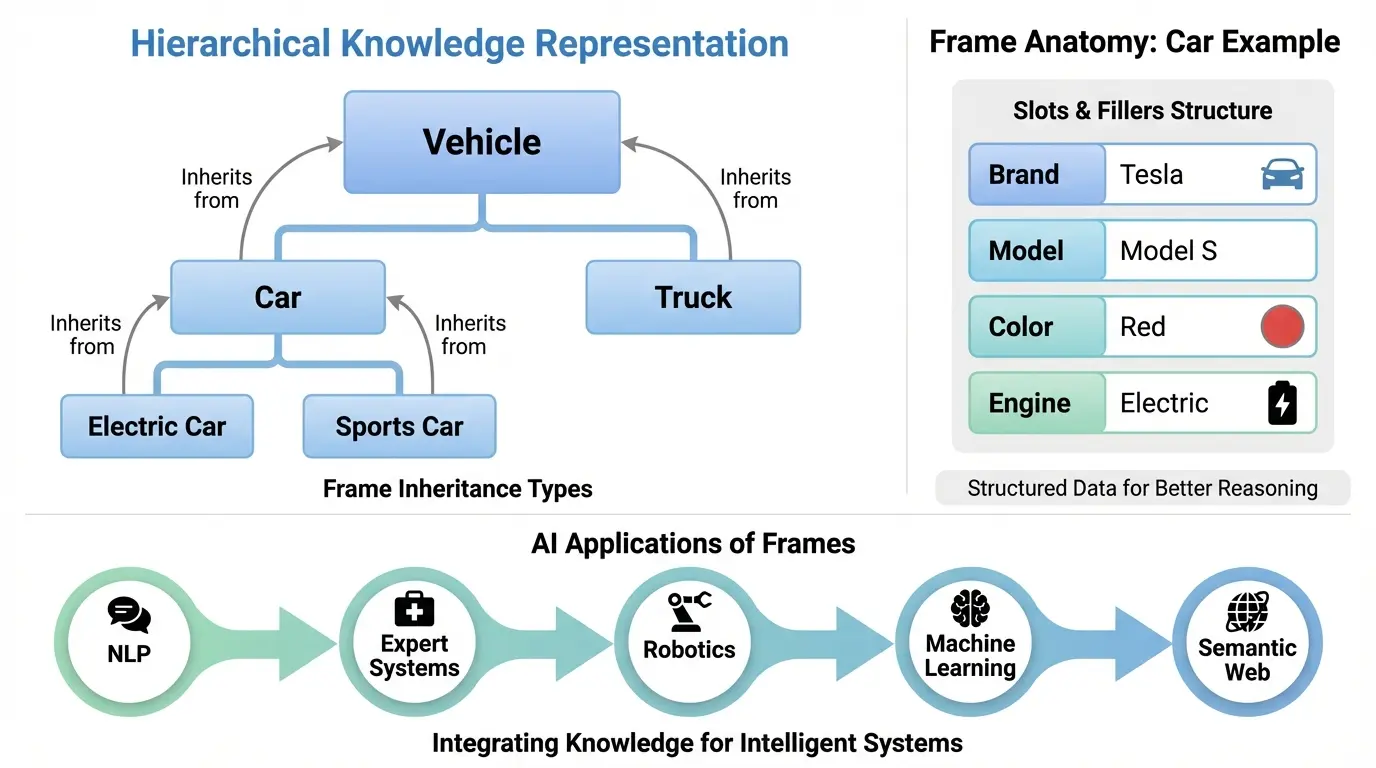
Visual representation of frame inheritance mechanisms showing parent-child relationships and attribute propagation
Real-World Applications Across Industries
Frame systems power countless AI implementations we interact with daily:
Language Processing Engines
Natural language understanding depends on frame architectures:
- Breaking sentences into logical components
- Matching verbs to action templates (“buy” → Retail_Transaction)
- Populating transaction details (quantity, product, payment method)
This allows digital assistants to interpret “Schedule 3 back-to-back meetings” as:
- Action: Calendar_Blocking
- Number: 3
- Parameters: consecutive=true, buffer_time=0
Medical Diagnostic Platforms
Healthcare AI leverages frames for patient assessments:
| Frame Network | Data Points | Clinical Value |
|---|---|---|
| Patient_Background | genetics, history, lifestyle | Personalized risk analysis |
| Symptom_Cluster | timing, severity, triggers | Disease pattern matching |
| Treatment_Response | dosage, outcomes, side effects | Therapy optimization |
Modern Frame-Learning Integration
Next-gen AI blends structured frames with adaptive learning:
Neuro-Symbolic Fusion Systems
Cutting-edge frameworks integrate both approaches:
- Neural networks identify patterns in messy data
- Frames organize findings into logical structures
- Symbolic reasoning draws practical conclusions
Self-Adjusting Frame Architectures
Smart systems now refine their own knowledge structures:
- Adding new attributes from emerging patterns
- Updating default values using statistical trends
- Rewiring connections based on usage analytics
Comparison with Other Knowledge Systems
Frame systems occupy unique space among AI knowledge tools:
| Approach | Structure | Reasoning Style | Setup Difficulty |
|---|---|---|---|
| Frame Models | Nested containers | Property inheritance | Medium |
| Formal Ontologies | Strict taxonomy | Logic deduction | Complex |
| Semantic Graphs | Network nodes | Connection tracing | Simple |
Combined Framework Opportunities
Industrial systems often pair complementary techniques:
- Ontologies establish formal category relationships
- Frames implement practical reasoning procedures
- Continuous validation maintains system integrity
Addressing Frame System Challenges
While powerful, these systems present implementation hurdles:
Conflict Mediation Strategies
Knowledge clashes require intelligent arbitration:
- Situational priority rules
- Context-sensitive weighting
- Exception tracking mechanisms
Scalability Solutions
Large systems employ performance optimizations:
| Optimization Technique | Implementation | Efficiency Gain |
|---|---|---|
| Frame Cataloging | Quick-reference indexing | 80%+ faster access |
| Attribute Caching | Pre-loaded inheritance paths | Near 50% compute reduction |
| Distributed Architecture | Multi-server knowledge sharding | Near-linear expansion |
Future Developments in Frame Technology
Emerging innovations continue evolving frame applications:
Quantum Computing Applications
Experimental systems apply quantum principles:
- Multi-state attribute handling
- Instant cross-system updates
- Probability-based inheritance
Neural-Frame Interfaces
Advanced hybrids combine learning and reasoning:
- Neural nets process unstructured inputs
- Frames structure meaningful outputs
- Validation feedback improves both components
This powerful combination creates AI that continuously learns while maintaining structured reasoning – enabling systems that understand real-world nuance and can explain their decisions in human terms. Such advancements through companies like DeepMind push boundaries in what artificial intelligence can achieve.
Frequently Asked Questions (Frames in Artificial Intelligence)
How do frames differ from standard databases?
Frame systems fundamentally expand what databases can achieve through:
- Parent-child knowledge relationships
- Intelligent missing data assumptions
- Automated action triggering
- Context-aware predictions
A retail database might track purchases, but a customer frame could predict future needs based on purchase patterns, demographic data, and similar customer profiles – impossible with traditional database structures alone.
Can frames handle incomplete or uncertain data?
Modern implementations adapt using:
- Probability-based attribute ranges
- Flexible inheritance pathways
- Confidence-scored information
Medical frames might represent symptom severity not as fixed values, but probability distributions based on patient history and population data – crucial for real-world diagnostic accuracy.
What computational challenges exist for large systems?
Performance depends on managing:
| Complexity Factor | Performance Impact | Engineering Solution |
|---|---|---|
| System Size | Slower queries | Smart indexing |
| Inheritance Depth | Exponential resource use | Path optimization |
| Interconnections | Cascading updates | Selective evaluation |
Advanced solutions use graph databases and distributed computing to maintain responsiveness in massive knowledge systems like those powering enterprise IBM Watson applications.
How do frames integrate with machine learning?
Contemporary synergy occurs through:
- Structuring neural network outputs
- Enabling hybrid decision pathways
- Generating human-readable explanations
Image recognition systems exemplify this – neural networks identify objects that populate frames, which then deduce contextual relationships and implications.
Where do frames deliver maximum business value?
Key industries benefiting include:
- Healthcare: Patient-specific diagnostic models
- Retail: Hyper-personalized recommendations
- Manufacturing: Intelligent product lifecycle management
- Finance: Dynamic risk assessment engines
- Legal: Precedent-based case analysis
Healthcare particularly thrives with comprehensive patient frames combining medical histories, genetic data, lifestyle factors and treatment responses for precision care solutions.
Also Read: What is Robotics? A Comprehensive Beginners Guide to Understanding Robotics