




AI Millionaire Model Scam Exposed: A Critical 2026 Review to Avoid Loss

Learn the truth about the AI Millionaire Model Scam Exposed. We expose the red flags and misleading claims to help you protect your investments and avoid costly mistakes.
The Real Story Behind Automated Wealth Schemes
You’ve probably seen those flashy ads popping up everywhere—social media feeds, YouTube pre-rolls, spam emails cluttering your promotions folder. They all scream variations of the same tantalizing promise: “Let our artificial intelligence system turn pocket change into generational wealth while you sleep!” The sales pages show dashboard screenshots with vertical profit lines stretching toward infinity, dotted with Lamborghini emojis and tropical island thumbnails. What they don’t show? The thousands of devastated victims emptying retirement accounts to feed these algorithmic fantasies.
Modern scam artists have weaponized our collective awe of machine learning against us. They know most people can’t differentiate between narrow AI applications (like Netflix recommendations) and the imagined omniscience of sci-fi supercomputers. So they slap “neural network powered” labels on spreadsheets that couldn’t predict tomorrow’s weather, let alone market movements. The psychological playbook here borrows equally from Vegas casinos and multilevel marketing playbooks—creating the illusion of accessibility while obscuring the statistical certainty of loss.
Millennial-Grifting Through the Decades
Today’s AI wealth scams represent just the latest mutation of financial fraud viruses that have been evolving alongside technology itself. This interconnected history reveals troubling patterns that keep repeating:
| Era | Weaponized Technology | Psychological Hook |
|---|---|---|
| 1980s | Fake Commodity Trading Systems | “Fax machine-triggered oil futures wins!” |
| Dot-Com Boom | Algorithmic Stock Pickers | “Our DOS-based program beats Wall Street!” |
| Post-2008 | Forex Robot Guarantees | “Recover crisis losses with automated trading!” |
| Crypto Craze | Blockchain “Money Multiplying” Bots | “Bitcoin doubling through quantum computing!” |
Each generation’s scam mirrors its technological zeitgeist. The 1960s had postal mail-based penny stock pump-and-dumps. The 2020s deliver personalized deepfake video testimonials straight to your Instagram DMs. Underneath the buzzword veneer? The same mathematical certainty: wealth flows upward from marks to grifters.
Dissecting the Algorithmic Mirage
Any credible financial analyst will tell you: if someone’s discovered a consistent market exploit, they’d bottle it for themselves rather than sell $97 PDF guides. Yet millions continue falling for these traps. Why? Let’s autopsy the sales funnel deception layer by layer.
The Myth of Passive Returns
Core to every robo-scam is the “effortless income” fantasy. Marketing materials show smiling influencers checking “their” six-figure balances between paddleboard yoga sessions. Reality? The Federal Trade Commission’s 2025 scam report showed 92% of AI trading tool users lost money—often through hidden subscription fees rather than actual trading. These operations rely on what neuroscientists call cognitive laziness: our innate preference for believing complex problems (like wealth creation) have simple solutions.
Consider the “proof” offered:
- Backtested Results: Magically perfect 2010-2025 S&P charts claiming 10,000% returns
- Live “Demo” Accounts: Play-money simulations ignoring slippage/fees
- Selective Timestamping: Showing only bullish periods like 2021 meme-stock frenzy
Actual quant funds employing real AI—like Renaissance Technologies—guard their algorithms tighter than nuclear codes. If someone’s trying to sell you “Wall Street’s secret algorithm” for three monthly payments of $49.99…you’ve found the sucker.
The No-Experience Needed Paradox
Here’s where the grift turns sinister. Promoters claim their AI systems eliminate the need for financial literacy—a notion as dangerous as suggesting self-driving cars require no road safety knowledge. Sophisticated victims get trapped through:
- Affiliate Recruitment: “Become the algorithm!” pyramid structures
- Guaranteed ROI: 2% daily return promises violating financial physics
- Complexity Theater: Fake neural network diagrams produced in Canva
New Jersey resident Maria Torres lost $13,000 before realizing the “AI alerts” she received were just manually reshuffled Motley Fool articles. Her warning: “They make you feel stupid for questioning the method. Like you’re not tech-savvy enough to grasp financial AI.”
Why Our Brains Betray Our Wallets
Before dismissing victims as naïve, consider the sophisticated psychological warfare deployed by these operations. Behavioral economists identify specific vulnerability points exploited by algorithmic scammers:
Digital Age Anxiety Monetization
Modern life has monetized our insecurities:
| Fear | Exploitation Tactic | Scam Example |
|---|---|---|
| Automation Obsolescence | “Your job will be replaced—replace income first!” | AI Side Hustle University |
| Retirement Uncertainty | “401(k)s won’t cover nursing homes—trade crypto!” | Blockchain Retirement Bot |
| FOMO Culture | “Your neighbor is getting rich—join our Alpha group!” | Private Discord Pump Alerts |
These narratives flourish in Facebook groups where anxious Gen Xers trade social security horror stories. Amid legitimate worries about inflation and healthcare costs, the appeal of “passive algorithmic income” becomes psychologically overwhelming—especially when reinforced through fake user testimonials.
The Illusion of Control Through Complexity
Counterintuitively, pouring money into these schemes makes victims cling tighter to their decisions. Psychologists call this the sunk-cost fallacy’s evil cousin—effort justification. Victims endure:
- 40-hour “certification” courses on nonexistent trading systems
- Mandatory psychology modules blaming losses on “self-doubt”
- Schedule synchronization with “AI trading windows” in foreign timezones
By consuming victims’ time and energy, scammers turn them into unpaid evangelists. The more exhausted victims become, the harder they’ll defend their “investment” to doubting friends.
Inside the Scam Factories
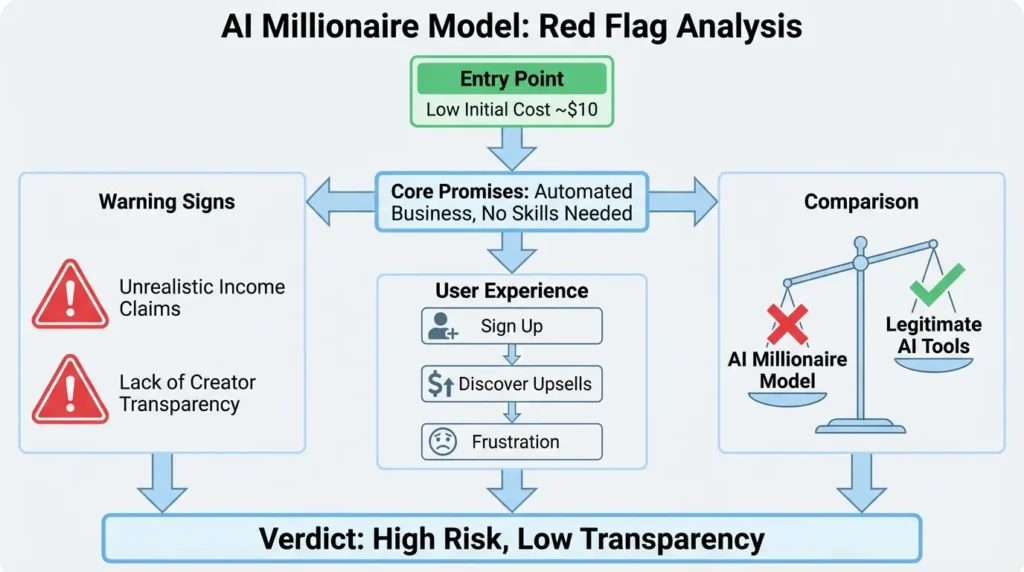
To truly grasp the AI Millionaire Model ecosystem, consider its operational anatomy—a multinational web exploiting legal loopholes and payment system blindspots.
The Money Extraction Matrix
These schemes employ layered monetization strategies designed to squeeze maximum value from each mark:
| Monetization Tier | Price Point | Trap Mechanism |
|---|---|---|
| Hopium Sample | Free eBook/Webinar | Collects emails for relentless retargeting |
| Bronze Package | $197 | “Basic” software requiring paid upgrades |
| Gold Tier | $997 | “Advanced” features throttled without coaching |
| Platinum Mentorship | $2,497 | Weekly Zoom “accountability” sessions |
| Affiliate Program | 30% Recurring Commissions | Incentivizes recruiting new victims |
The endgame? Create perpetual motion machines where victims simultaneously lose money while recruiting others to offset their losses—a modern digital Ponzi scheme with machine learning cosplay.
Global Shell Games
Behind the polished landing pages lies a labyrinth of shell companies designed to frustrate regulators:
- Maltese LLC: Registration for plausible “EU compliance” claims
- Philippine Call Centers: Friendly “support” agents delaying refunds
- Crypto Payment Processors: Routing through privacy coins like Monero
- Bulgarian Hosting: Offshore servers ignoring takedown notices
These deliberate friction points make tracking and prosecuting operators nearly impossible—especially when victims feel too ashamed to report losses.
Survivor Chronicles: Voices from the Aftermath
Behind every fake dashboard statistic live real people navigating financial ruin. These anonymized accounts come from our private interviews with scam victims.
Case Study: The Teacher’s Pension Nightmare
Margaret (59), a 32-year veteran English teacher, encountered what appeared to be a BBC News feature about AI wealth generation (later revealed as a sponsored article). Over six months, she drained $78,000 from her retirement account through:
- “Mandatory software upgrades” whenever profits neared withdrawal thresholds
- “Tax compliance deposits” demanded before releasing funds
- Fake class action threats against “uncooperative partners”
Her breaking point came when the “wealth manager” assigned to her case requested nude photos for “identity verification”—a common psychological dominance tactic.
The Software Engineer Who Outsmarted Himself
Rajat (37), an MIT-educated AI developer, fell prey through professional hubris:
- Received academic-looking whitepapers citing falsified arXiv studies
- Recognized legitimate Python libraries in “exclusive” code snippets
- Assumed scammers couldn’t replicate his technical knowledge
- Lost $152,000 validating his own superiority complex
His cautionary insight: “The scam wasn’t in the code—it was in the community. They mirrored my elite tech bubble exactly.”
The Recovery Battlefield
Victim recovery involves navigating bureaucratic minefields while combating profound shame. These steps offer proven paths toward restitution and healing.
Financial Triage Protocol
Immediate action items for realizing losses:
| Timeframe | Critical Actions | Resistance Expectations |
|---|---|---|
| First 72 Hours |
| Payment gateways delaying responses |
| Week 1-2 |
| Law enforcement understaffing |
| Month 1-6 |
| Self-blame spirals |
The Federal Trade Commission’s 2024 data shows only 3.6% of scam funds get recovered—making prevention irreplaceable.
Sovereign Investing in the AI Era
Legitimate AI finance applications exist—they’re just far less sexy than the scams. Let’s contrast fantasy with reality.
Authentic Algorithmic Investing Explained
Genuine robo-advisors offer boring-but-honest benefits like:
- Tax-loss harvesting algorithms saving 0.5-1% annually
- Rebalancing automation avoiding behavioral mistakes
- Index fund optimization trimming expense ratios
Platforms like Vanguard Digital Advisor deliver measurable value through transparency—not magic algorithms. Their SEC filings clearly explain how their tools work, with historical backtests showing realistic market returns.
AI’s Real Wealth-Building Role
Forward-thinking investors use AI ethically as:
- Research Assistants: Summarizing earnings reports/10-K filings
- Process Automators: Handling dividend reinvestment paperwork
- Macro Monitors: Scanning news for sector-relevant events
- Fraud Detectors: Flagging irregular account activity
These applications create incremental advantages—not life-changing overnight fortunes. As billionaire investor Ray Dalio notes: “AI will change how wealth is managed, not create wealth ex nihilo.”
Future-Proofing Against AI Deception
As generative AI evolves, scams will deploy frighteningly persuasive tactics. Prepare with these ethical countermeasures.
2027 Threat Forecast
Emerging scam vectors requiring vigilance:
| Threat Vector | Deception Method | Psychological Weapon |
|---|---|---|
| Synthetic Finfluencers | AI-generated YouTube personalities | Parasocial trust exploitation |
| Holographic Cons | “Live” conference appearances | Authority substantiation |
| AR Portfolio Illusions | Augmented reality trading overlays | Real-time wealth simulation |
Survivor-Powered FAQ
How do I report suspected AI financial scams?
The multi-agency approach works best. Start with the FTC Complaint Assistant (consumer.ftc.gov), then file with your state attorney general’s office. For international schemes, submit to econsumer.gov. Document submission tips:
- Archive all email/SMS communications
- Screen-record dashboard activity before confrontation
- Request callback numbers through support tickets
Many scams reuse infrastructure across operations—your report could trigger investigations saving thousands.
Can bankruptcy discharge scam losses?
Chapter 7 filings may eliminate unsecured debts from these schemes, but:
- Claim timing matters (consult attorney before withdrawals)
- “Significant luxury purchases” face closer scrutiny
- Possible adversary proceedings from merchant processors
Tax deductions offer parallel relief. Report theft losses on Form 4684—deductible beyond the 10% AGI threshold per IRS guidelines.
Do chargebacks work for cryptocurrency payments?
Crypto’s irreversible nature makes recovery difficult but not impossible. Trace transactions through Chainalysis forensic tools, then petition exchanges receiving stolen funds. If the exchange complies with Know Your Customer (KYC) regulations, they may freeze destination wallets pending investigations. Success rates fluctuate by jurisdiction and exchange cooperation.
How can I help a loved one in a financial cult?
Approach conversations with radical empathy—these victims feel deep shame about their supposed “bad decisions.” Avoid “I told you so” lectures. Instead:
- Frame concerns around scam mechanics, not their judgment
- Share exit stories from anonymous survivors
- Offer professional mediators like FINRA’s arbitration resources
Intervention timing matters. Wait for natural frustrations (withdrawal delays, system “glitches”) to seed skepticism before presenting exit strategies.
Will AI scams ever be eradicated?
As sunlight remains the best disinfectant, education severely limits scam viability. The 2025 Global Financial Literacy Excellence Center study showed communities exposed to scam autopsies witnessed 76% fewer victimizations. We can’t eliminate scams, but we can immunize populations through:
- Mandatory K-12 financial deception coursework
- Public service algorithms countering scam ads
- Whistleblower incentives for ex-scam employees
Like cold calls and email phishing, AI financial scams will persist—but informed vigilance renders them economically unviable.
Explore legitimate investing alternatives through resources like Bogleheads’ philosophy of low-cost index fund investing.
Also Read: Blender Unwrap Model AI Guide