




AI GIS applications: Boost Spatial Insights for Smarter Decisions in 2026
Explore AI GIS applications that transform spatial analysis, improve decision-making, and boost efficiency in urban planning and environmental monitoring through deep integration of machine learning and spatial data.
Understanding the Shift Toward AI GIS Applications
The world of mapping and spatial analysis is currently undergoing a massive shift that rivals the invention of the GPS itself. For decades, Geographic Information Systems (GIS) operated as digital filing cabinets for maps, requiring highly specialized professionals to manually digitize boundaries, clean overlapping datasets, and perform rigid calculations. While these systems were powerful, they were essentially reactive and static. Today, the rise of AI GIS applications has transformed these digital maps into living, breathing ecosystems that can anticipate problems before they occur.
The primary reason this shift matters is the sheer volume of data being generated every second. Between high-resolution satellite constellations, IoT sensors in smart cities, and mobile device pings, the human brain simply cannot process the spatial relationships fast enough. Artificial Intelligence acts as the bridge, allowing us to interpret millions of data points simultaneously to find patterns that would remain invisible to even the most seasoned cartographer. It is no longer just about where things are, but about what they are likely to do next.
Consider a modern urban planner in a rapidly growing city like Bangalore or Austin. In the past, they would look at historical traffic charts and perhaps a five-year-old land-use map to decide where to build a new transit line. With AI GIS applications, that same planner can now run simulations that account for real-time traffic flow, predicted population density based on housing permits, and even environmental heat island effects. This move from descriptive mapping to prescriptive intelligence is the core of the current technological revolution in geography.
To truly grasp the impact of this technology, we must look at the specific ways it solves traditional bottleneck problems in the industry. The integration of artificial intelligence geographic information systems is built on several foundational pillars that redefine our relationship with spatial data.
- Automated Feature Extraction:
Traditional mapping required hours of manual “tracing” over satellite imagery to identify roads or building footprints. AI models now use computer vision to identify these features in seconds across entire continents, which is why maps today update almost in real-time after a new subdivision is built. - Predictive Spatial Modeling:
Instead of just showing where a flood happened, AI analyzes topography, soil moisture, and historical rainfall to show where a flood will likely happen next week. This foresight allows local governments to stage emergency resources in the exact zones where they will be needed most. - Dynamic Data Integration:
AI GIS platforms can pull in disparate data sources like social media feeds, weather sensors, and shipping logs. By layering this information, a logistics company can reroute a fleet not just because of a traffic jam, but because an AI predicted a slowdown based on a local festival or a sudden change in humidity affecting road grip.
The Evolution of Spatial Intelligence Through Machine Learning
To understand the depth of modern AI GIS applications, one must look at how machine learning specifically has changed the game. Machine learning is the engine that allows a GIS to “learn” from its environment. If you feed a system ten thousand images of a healthy forest and ten thousand images of a forest infested with bark beetles, the system begins to recognize the subtle spectral signatures of a dying tree long before a human eye can spot the browning needles. This level of granular insight is what makes machine learning spatial analysis so valuable for environmental conservation.
The significance of this evolution cannot be overstated. We are moving away from a world where a GIS specialist spends 80 percent of their time cleaning data and only 20 percent analyzing it. AI flips that ratio. By automating the mundane tasks of coordinate correction and layer alignment, the technology allows professionals to focus on high-level strategy. For instance, in the energy sector, AI can identify the optimal placement for solar panels across a 50,000-acre tract by calculating the sun’s angle, local cloud patterns, and proximity to existing power grids simultaneously.
A relatable example of this is the way global logistics giants manage their last-mile deliveries. Imagine a delivery driver navigating a dense urban center. In a traditional system, the route is static. However, AI-powered GIS technology constantly learns from every trip. If several drivers consistently slow down at a specific intersection on Tuesday mornings, the machine learning model identifies a hidden pattern—perhaps a local school drop-off—and automatically adjusts the routes for the entire fleet without a manager ever having to intervene.
The progression of these systems is often categorized by the complexity of the tasks they handle. As we move deeper into the integration of AI and GIS, the capabilities become increasingly sophisticated and autonomous.
- Object Detection and Classification:
At this level, the AI acts as a digital scout. It scans drone footage to find specific objects like cracked insulators on power lines or potholes on a highway. This saves thousands of man-hours that would otherwise be spent on physical inspections. - Change Detection Analysis:
This is critical for tracking urban sprawl or illegal deforestation. The AI compares satellite images from two different dates and highlights exactly what has changed, filtering out seasonal variances like snow or leaf fall to focus only on permanent structures or land clearing. - Spectral Analysis for Agriculture:
By looking at light wavelengths that humans cannot see, AI GIS applications can determine the nitrogen levels in a field of corn. This allows farmers to apply fertilizer only where it is needed, which drastically reduces costs and prevents harmful chemical runoff into local water supplies.
Deep Learning and Neural Networks in Mapping
Deep learning takes the capabilities of machine learning even further by mimicking the neural pathways of the human brain. This is particularly useful in AI GIS applications involving complex imagery. While a standard algorithm might struggle to tell the difference between a dark roof and a paved parking lot in a low-resolution photo, a deep learning model looks at context, shadows, and surrounding textures to make an accurate determination. This is the tech behind the self-driving car’s ability to understand its 3D environment in real-time.
Why does this matter for the average professional? It lowers the barrier to entry. You no longer need a PhD in remote sensing to get high-quality data. Developers are building “low-code” or “no-code” AI-powered GIS technology platforms where a user can simply ask a question like “Show me all the swimming pools in this neighborhood that are not properly fenced” and the neural network handles the visual processing. This democratizes spatial data, putting power into the hands of community activists and small business owners.
However, a common mistake many organizations make is assuming the AI is infallible. An insight often overlooked is that AI is only as good as its training data. If a neural network is trained on satellite images from the United States, it might fail to recognize “roads” in a rural village in sub-Saharan Africa because the visual cues are entirely different. This “geographic bias” is one of the most critical challenges professionals face when deploying AI GIS applications on a global scale.
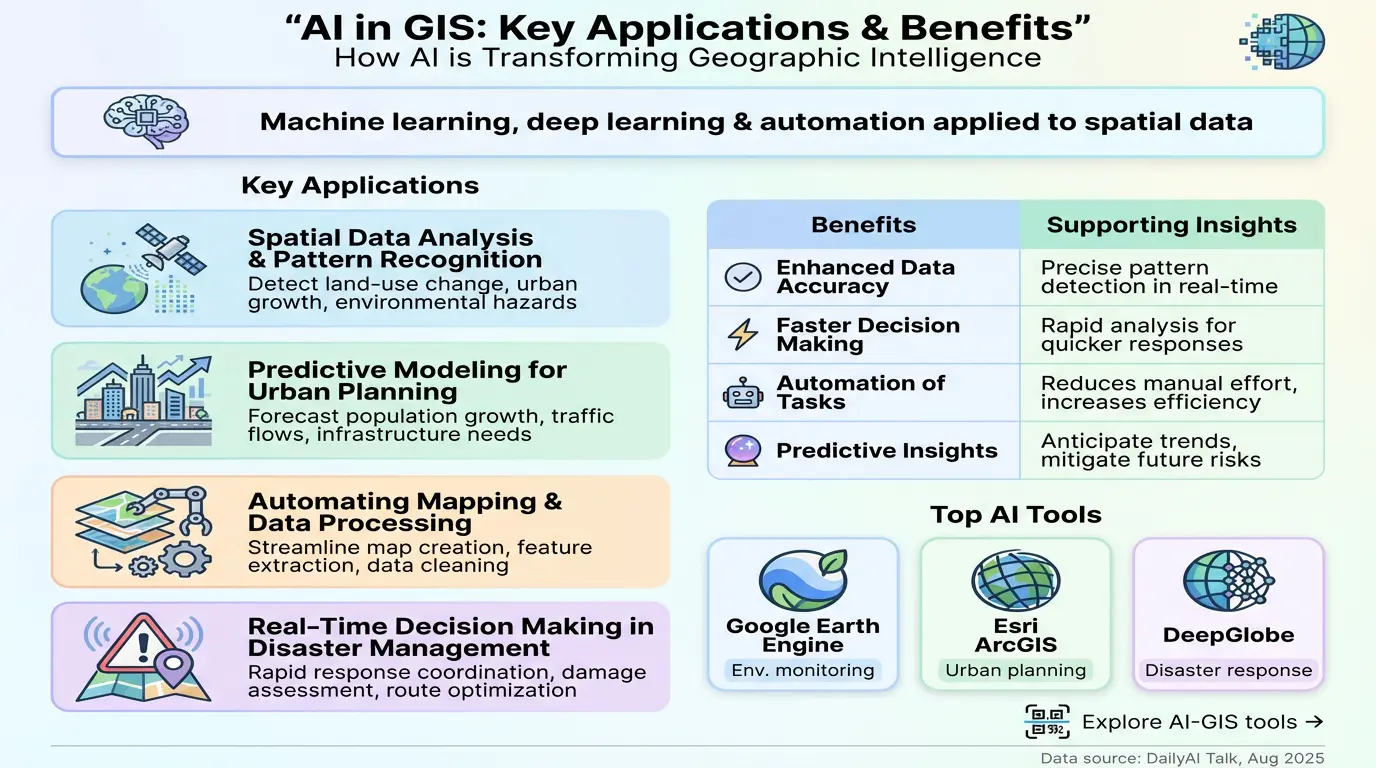
AI GIS Applications in Urban Planning and Infrastructure
Urban planning is perhaps the most visible arena for AI GIS applications today. As cities grow toward “smart” status, the need for a cohesive digital twin becomes vital. A digital twin is a virtual 1:1 map of a city that reflects real-time conditions. When you integrate AI into this model, the city stops being a collection of concrete and steel and starts acting like a living organism. For example, the city of Singapore uses these technologies to model wind flow between skyscrapers to determine where to plant trees for maximum cooling.
This matters because the stakes in urban infrastructure are incredibly high. A misplaced bridge or a poorly timed traffic light can cost millions in lost productivity and environmental damage. By using machine learning spatial analysis, planners can run thousands of “what-if” scenarios. They can simulate how a new 50-story building will affect shadow patterns on a local park, or how a subway closure will impact the bus system three miles away. This prevents expensive mistakes before they are ever cast in concrete.
Imagine a local city council meeting where residents are complaining about a dangerous intersection. Instead of a heated debate based on anecdotes, the city engineer pulls up an AI-powered GIS dashboard. The system has automatically analyzed three years of dashcam footage and sensor data, identifying that the sun’s glare at 4:00 PM is the primary cause of accidents. This insight changes the conversation from “we need more police” to “we need to adjust the timing of the left-turn signal and plant a row of trees to block the glare.”
The following areas represent the most significant breakthroughs where artificial intelligence geographic information systems are currently being deployed to build more resilient cities.
- Predictive Traffic Management:
AI systems analyze historical bottlenecks and real-time sensor data to adjust traffic light durations. This reduces idling time at red lights, which in turn lowers carbon emissions and saves commuters hours of frustration every month. - Utility Asset Management:
Water and gas companies use AI to predict which pipes are most likely to burst based on age, soil acidity, and pressure fluctuations. By replacing a pipe just before it breaks, they avoid the massive costs and logistical nightmares of emergency repairs and water shutoffs. - Emergency Response Optimization:
When a 911 call comes in, AI GIS applications analyze the current location of all ambulances, the severity of traffic, and even the current weather to recommend the fastest route. In medical emergencies where every second counts, this technology is quite literally a lifesaver.
Environmental Monitoring and Climate Resilience
If urban planning is about building the future, environmental AI GIS applications are about saving it. The scale of climate change is so vast that traditional field surveys are insufficient. We cannot send scientists to count every tree in the Amazon or measure every iceberg in the Arctic. AI-integrated GIS allows us to monitor the entire planet’s health from orbit, providing data-driven evidence for policy changes and conservation efforts.
This is crucial because our response to natural disasters has historically been reactive. We wait for the wildfire to start or the hurricane to hit before we act. With machine learning spatial analysis, we can now identify “high-risk signatures” in the landscape. AI can scan thousands of miles of forest to find patches of dry vegetation that are most likely to ignite, allowing forest services to conduct controlled burns in the exact spots that will prevent a catastrophic blaze.
Consider the real-world example of coral reef protection. Scientists are using AI-powered GIS technology to process underwater drone footage. The AI can identify different species of coral and detect early signs of bleaching that are invisible to the naked eye. Because the system can process images 24/7, it provides a level of constant vigilance that humans could never achieve. This allows conservationists to deploy cooling curtains or move sensitive species before an entire reef system collapses.
The application of AI in environmental science generally focuses on three main objectives: observation, prediction, and mitigation of climate-related risks.
- Deforestation Tracking:
AI algorithms can distinguish between legal logging and illegal clear-cutting by analyzing patterns of road development in protected jungles. Governments receive automated alerts the moment a new, unauthorized road is detected by a satellite. - Wildlife Conservation:
By analyzing the movement patterns of tagged animals and correlating them with terrain and vegetation maps, AI can predict where poachers are likely to set traps. This allows park rangers to patrol more effectively across massive wildlife reserves. - Flood and Storm Surge Modeling:
As sea levels rise, AI GIS applications help coastal cities visualize exactly which streets will be underwater during high tide in the year 2050. This data is essential for designing sea walls and making difficult decisions about managed retreat from the coastline.
Precision Agriculture and Resource Management
The global food supply is under immense pressure from a growing population and shrinking arable land. This is where AI GIS applications in agriculture, often called “Precision Ag,” become a necessity rather than a luxury. Farmers are no longer just laborers; they are data scientists managing high-tech operations where every square meter of land is treated as a unique data point. By using machine learning spatial analysis, a farmer can optimize their entire harvest from a tablet in their tractor.
The core benefit here is efficiency. Traditional farming involves blanket spraying an entire field with water, pesticides, or fertilizer. This is incredibly wasteful and harmful to the environment. AI-powered GIS technology allows for “variable rate application.” The GIS maps out the exact nutrient levels across a field, and the AI-controlled sprayer delivers a precise dose to each individual plant. This can reduce chemical usage by up to 40 percent while simultaneously increasing the total crop yield.
Imagine a large-scale vineyard in California. During a heatwave, the vines are at risk. Instead of watering everything and hoping for the best, the vineyard manager uses an AI GIS application that pulls data from thermal sensors on a drone. The AI identifies a specific hillside where the soil is retaining less moisture and the vines are beginning to “stress.” The manager can then target that specific area, saving water and ensuring that the quality of the grapes remains consistent across the entire estate.
To understand how AI is revolutionizing the agricultural landscape, we can look at the specific tools and workflows currently used by modern agribusinesses.
- Automated Crop Scouting:
Drones equipped with AI can fly over hundreds of acres in a single afternoon, identifying signs of pest infestation or fungal disease. The system marks the GPS coordinates of the problem areas, allowing the farmer to treat the issue before it spreads to the rest of the field. - Yield Prediction Models:
By correlating historical weather data, current soil conditions, and satellite imagery of plant growth, AI can predict exactly how many bushels a farmer will produce months before the harvest. This allows farmers to better negotiate prices with buyers and manage their finances. - Soil Health Mapping:
AI analyzes the spectral signature of the soil to determine its composition and organic matter content. This helps in “carbon farming,” where land managers are paid to sequester carbon in their soil, providing a new revenue stream while helping the planet.
A Comparative Analysis of Traditional vs. AI GIS
When evaluating the current state of AI GIS applications, it is helpful to see how far we have come from traditional methods. The shift is not just about speed; it is about the fundamental way we perceive spatial relationships and make decisions. The following table highlights the core differences between the legacy systems and the new, AI-integrated era of geographic intelligence.
| Feature | Traditional GIS | AI-Powered GIS |
|---|---|---|
| Data Processing | Manual entry and digitizing by human technicians. | Automated feature extraction and imagery analysis. |
| Analysis Type | Descriptive: Tells you what happened in the past. | Prescriptive: Predicts what will happen in the future. |
| Update Frequency | Slow: Maps updated every few months or years. | Real-time: Constant streams from IoT and satellites. |
| Scalability | Limited by the number of human analysts available. | Infinite: Algorithms can process whole continents at once. |
| User Accessibility | Required years of specialized technical training. | Moving toward natural language and low-code tools. |
Real-Time Disaster Response and Public Safety
In the wake of a natural disaster, the environment changes so rapidly that old maps become useless. This is where AI GIS applications shine by providing “situational awareness” when it is needed most. During a hurricane, for instance, traditional maps won’t show you which roads are currently under two feet of water or which bridges have been washed away. AI-powered systems can process satellite pings and social media images in real-time to generate a “live” disaster map for first responders.
This matters because the “golden hour” in emergency response is the difference between life and death. If search and rescue teams can see exactly where the flooding is worst and which buildings are still standing, they can deploy their limited resources far more effectively. Machine learning spatial analysis can even analyze pre-disaster building codes and correlate them with storm intensity to predict which homes are most likely to have collapsed, allowing teams to prioritize those locations.
Insight from a real-world scenario: During a major earthquake, an AI system was used to scan thousands of “before and after” satellite images within minutes. It automatically identified every blocked road in a 100-mile radius. A common mistake in these situations is relying on ground reports, which are often fragmented and delayed. By trusting the AI-powered GIS technology, the command center was able to redirect supply trucks to an alternative mountain pass that everyone assumed was closed, but the AI confirmed was clear. This saved 48 hours in the delivery of clean water to a stranded town.
The success of AI in public safety depends on a few critical functions that distinguish it from the slow, manual mapping of the past.
- Rapid Damage Assessment:
Immediately following a storm, AI compares satellite imagery to identify damaged structures. This allows insurance companies and government agencies to process claims and release aid in days instead of months. - Evacuation Route Simulation:
AI models simulate how thousands of people will move through a city’s road network during a disaster. This helps planners identify potential bottlenecks and set up “contraflow” lanes to prevent gridlock during a crisis. - Social Media Geospatial Intelligence:
AI can scan public posts for keywords like “flood” or “fire” and map the coordinates of those posts. This provides a “human sensor network” that can report on conditions in areas where physical sensors may have been destroyed.
Overcoming Data Bottlenecks and Geographic Bias
While the potential of AI GIS applications is nearly limitless, we must address the hurdles that prevent widespread success. The biggest challenge is not the code, but the data. Many parts of the world lack high-quality, historical spatial data. If you try to build a machine learning spatial analysis model for a city that has never been properly mapped, the AI has no baseline to learn from. This creates a digital divide where wealthy nations get smarter and more efficient while developing nations struggle with inaccurate models.
Another major issue is “black box” algorithms. In critical sectors like public health or law enforcement, we need to know why an AI made a certain prediction. If an AI-powered GIS says a specific neighborhood is a high-risk zone for a disease outbreak, but the logic is hidden, it’s hard for officials to justify spending millions on an intervention. The industry is now moving toward “Explainable AI” (XAI), which provides a transparent trail of how spatial factors like proximity to water, population density, and temperature contributed to a final decision.
A mistake often made by young professionals is assuming more data always equals better results. In reality, “noisy” data can confuse an AI. For example, if you are using mobile device data to track human movement, you have to account for “GPS drift”—the few meters of error that occur in dense cities with tall buildings. An AI GIS application that isn’t properly calibrated for this noise might report that hundreds of people are walking through walls, leading to completely useless transit models.
To ensure long-term sustainability and accuracy in artificial intelligence geographic information systems, professionals must follow several best practices.
- Cross-Validation with Ground Truth:
Never trust the satellite alone. AI models should be regularly checked against physical field surveys to ensure that what the machine thinks is a “forest” isn’t actually a “green-painted roof.” - Diversity in Training Sets:
Models must be trained on data from different climates, cultures, and topographies. This prevents the geographic bias that makes AI less effective in non-Western regions. - Data Privacy Protocols:
As we use more mobile and personal data in GIS, protecting individual privacy is paramount. Robust “anonymization” processes are required to ensure that we can track population trends without tracking individual people.
The Future of AI GIS Applications: Autonomous Systems
Looking ahead, the next frontier for AI GIS applications is full autonomy. We are entering an era where the GIS won’t just wait for a human to ask a question; it will proactively monitor the world and take action. Imagine a global environmental GIS that detects a spike in methane levels in the Arctic and automatically notifies local authorities, tasks a high-resolution drone to fly over the site, and updates a global climate model—all without a single human click.
This level of automation is essential for managing the global supply chain and responding to the rapid pace of modern life. In logistics, AI-powered GIS technology is moving toward autonomous warehouse and port management. Large cranes and delivery robots will use real-time spatial intelligence to navigate complex environments, adjusting for shifting cargo containers and changing weather conditions instantly. This will drastically reduce shipping costs and make the global economy more resilient to local disruptions.
For the professional entering this field, the insight is clear: the value is no longer in knowing how to make a map. The value is in knowing how to manage the AI that makes the map. The role of the “GIS Analyst” is evolving into the “Spatial Data Scientist.” You will be responsible for ethical oversight, model training, and interpreting the complex outputs of autonomous systems. The map is no longer the final product; the insight derived from the map is the new currency of the industry.
As we wrap up our exploration of AI GIS applications, let’s look at the emerging trends that will define the next decade of spatial science.
- Edge AI in GIS:
Processing data directly on the drone or sensor rather than sending it to the cloud. This allows for instant decision-making in remote areas where there is no internet connection. - Augmented Reality (AR) Integration:
Utility workers will wear AR glasses that overlay AI-powered GIS data onto the real world, allowing them to “see” underground gas pipes through the pavement before they start digging. - Natural Language Spatial Queries:
The death of the complex software interface. Users will simply talk to their GIS: “Hey, find me the best location for a new hospital that is within 10 minutes of a highway but away from flood zones,” and the AI will generate the map instantly.
Frequently Asked Questions (FAQs)
How do AI GIS applications differ from traditional mapping software?
Traditional mapping software is a tool for humans to record and display geographic data manually. It relies heavily on a user’s ability to digitize shapes, align layers, and perform mathematical queries one step at a time. It is a “descriptive” tool, meaning it is excellent for showing you where things are right now or where they were in the past. If you wanted to see how a city grew, you would have to manually compare two different maps made years apart.
AI GIS applications, on the other hand, are “prescriptive” and “automated.” They use machine learning and deep learning to identify patterns that humans might miss. Instead of a human tracing a road from a satellite image, the AI identifies the road automatically across millions of images. Most importantly, AI can simulate future scenarios, like predicting which buildings will be flooded during a storm next week based on current soil saturation and upcoming weather forecasts. It transforms a static map into a dynamic intelligence system.
Furthermore, traditional GIS often requires significant manual labor to clean and format data. AI GIS can automate this “data prep” by identifying errors in coordinates or automatically aligning disparate datasets. This allows professionals to move from being data processors to being high-level decision-makers. The shift is effectively moving from a digital paper map to a living, digital brain of the environment.
What is the role of machine learning in spatial analysis?
Machine learning is the primary engine behind modern spatial analysis. Its main role is to find hidden relationships within massive geographic datasets. In a traditional setting, a researcher might look at a few variables—like elevation and rainfall—to understand landslide risks. A machine learning model can look at hundreds of variables simultaneously, including soil density, vegetation root depth, historical seismic activity, and even recent construction permits, to provide a far more accurate risk assessment.
In spatial analysis, machine learning excels at “classification” and “clustering.” For example, it can look at a satellite image of a vast agricultural region and automatically classify every single acre into categories like corn, soy, wheat, or fallow land. It can also cluster geographic features, such as identifying “heat islands” in a city where pavement and lack of trees cause temperatures to be significantly higher than in the surrounding suburbs. This helps urban planners target their interventions precisely where they are needed most.
Another critical role is “change detection.” Machine learning models can monitor a protected rainforest and alert authorities the moment a new road or clearing appears. By learning what a healthy forest spectral signature looks like, the AI can ignore seasonal changes or clouds and focus only on human-caused disturbances. This provides a level of constant vigilance that would be impossible for human monitors to achieve on a global scale.
Can AI-powered GIS technology help in disaster management?
Yes, AI-powered GIS is a cornerstone of modern disaster management, particularly because it provides real-time situational awareness. During a fast-moving crisis like a wildfire or a flash flood, traditional maps become obsolete within minutes. AI GIS applications pull in live data from social media, weather sensors, and emergency calls to create a “live” map of the disaster zone. This allows emergency commanders to see exactly where the danger is and where their resources are currently located.
In the “preparation” phase, AI uses historical data to run simulations. Planners can model thousands of different hurricane tracks to see which evacuation routes will likely become bottlenecks. This allows them to stage supplies and pre-position rescue teams in the exact zones that the AI identifies as most likely to be cut off from the main road network. It essentially gives disaster managers a way to “practice” for a crisis before it actually happens.
During the “recovery” phase, AI speeds up the process significantly. It can scan post-disaster satellite imagery and automatically identify every building that has been destroyed or severely damaged. This is critical for coordinating aid and allowing insurance companies to process claims quickly. By automating the damage assessment, AI GIS allows a city to move from chaos to organized recovery in a fraction of the time it would have taken in the past.
What are the challenges of using AI in geographic information systems?
The biggest challenge is “data quality and bias.” AI models are entirely dependent on the data used to train them. If an AI is trained only on data from urban environments in Europe, it will likely perform poorly when applied to a rural area in South America or Africa. This is known as “geographic bias,” and it can lead to inaccurate or even harmful predictions if the AI fails to account for local nuances like different building materials, vegetation types, or road structures.
Another major challenge is the “black box” problem. Deep learning models are incredibly complex, and it is often difficult to understand exactly why an AI made a specific recommendation. In fields like public safety or urban planning, where millions of dollars and human lives are on the line, “because the computer said so” is not an acceptable answer. Professionals are currently working on “Explainable AI” to ensure that the logic behind a spatial prediction is transparent and defensible to stakeholders and the public.
Finally, there is the issue of “noise” and privacy. Geographic data can be messy—GPS drift, sensor failures, and outdated records can all introduce noise that confuses an AI model. Additionally, using high-resolution mobile device data for transit planning raises serious privacy concerns. Ensuring that data is properly anonymized so that individual movements cannot be tracked while still providing useful aggregate insights is a constant ethical struggle for those in the field.
Is specialized training required to use AI GIS applications?
The field is currently in a transition phase. Traditionally, GIS required years of technical training in complex software suites and a deep understanding of coordinate systems and remote sensing. While those foundational skills are still valuable, the rise of AI GIS applications is actually making the technology more accessible to non-experts. Many new platforms are “low-code” or “no-code,” meaning they use simple interfaces or even natural language queries to perform complex spatial tasks.
However, while it is easier to use the tools, it is harder to manage them. A new type of professional is emerging: the Spatial Data Scientist. This role requires a mix of traditional geography, data science, and ethics. You need to understand how to train a model, how to identify bias in your training data, and how to interpret the AI’s output in a real-world context. Simply knowing where the buttons are in a software program is no longer enough; you need to understand the underlying logic of the AI.
For young professionals or students, the focus should shift from manual cartography toward data management and programming (especially in languages like Python). Understanding how to integrate various APIs and manage cloud-based data streams is becoming the industry standard. While the AI handles the “boring” parts like tracing roads, the human professional is expected to provide the “strategic” oversight, ensuring that the AI’s insights are used effectively and ethically.