




AI Bubble Burst: How to Spot the Warning Signs in 2026

Is the AI bubble burst imminent? Explore the signs, data, and expert insights on the sustainability of the current artificial intelligence boom and what comes next. We’re living through what future economic historians might call the Great AI Gold Rush – an unprecedented surge of capital, hype, and technological aspiration that’s reshaping global markets. But beneath the surface of stunning growth projections and daily AI breakthroughs, serious questions emerge about sustainability. This comprehensive analysis examines the structural parallels to previous bubbles, assesses current risk factors, and provides actionable strategies for navigating uncertain times ahead.
The Anatomy of the AI Investment Frenzy
Let’s start by putting numbers to the AI investment tsunami. Corporate spending on AI technologies has exploded from $19 billion eight years ago to an astonishing projected $320 billion by next year, according to macroeconomic research firm MacroStrategy Partnership. If these figures don’t shock you, consider this: current AI investment represents seventeen times the peak spending levels of the dot-com era when adjusted for inflation. The collective market value of AI-focused companies now tops $15 trillion – that’s nearly a third of the entire global stock market’s worth as we enter the fourth quarter of 2025.
What makes this technological boom different from previous cycles? Three critical factors stand out. First, we’re witnessing unprecedented concentration among the so-called “AI Seven” – Nvidia, Microsoft, Google, Meta, Amazon, OpenAI, and TSMC – who collectively account for 35% of the S&P 500’s value. Second, AI’s dual-use potential (civilian and military applications) creates complex entanglements between private enterprise and government interests. Third, the infrastructure demands of AI development have sparked secondary bubbles in semiconductors, data centers, and energy infrastructure that could prove systemically risky.
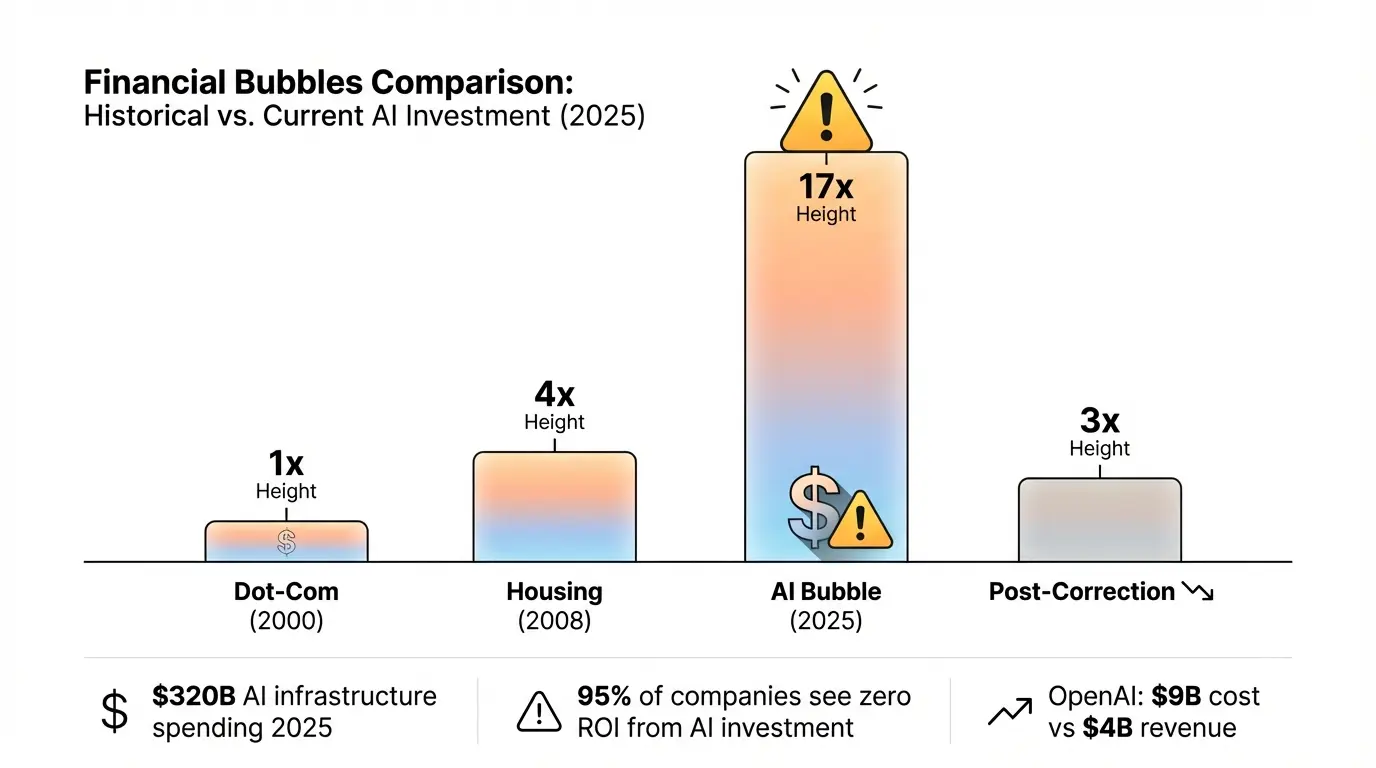
Economic Indicators of Bubble Conditions
The International Monetary Fund’s recent analysis identified three classic bubble warning signs flashing red in the AI sector:
- Price-to-Earnings ratios for AI-focused companies average a staggering 148:1 versus the broader market’s 25:1
- Pure-play AI firms trade at enterprise value-to-revenue multiples exceeding 40 times
- Venture capital funding is being burned through at alarming rates – 78% of raised capital disappears before reaching profitability
When MIT researchers analyzed 4,200 AI implementations across industries in 2025, they uncovered concerning adoption patterns:
| Performance Metric | Enterprise AI Adoption | Dot-com Era Technology Adoption |
|---|---|---|
| Successful Implementation Rate | 17% | 32% |
| Average ROI Timeframe | 3.5 years | Under 2.5 years |
| Employee Utilization Rate | 39% | 71% |
Comparative Bubble Analysis Through History
To understand where we might be heading, we must first look to history’s cautionary tales. Consider these infamous bubbles and their eventual collapses:
- 1637’s Tulip Mania saw single flower bulbs trade for ten times an artisan’s annual salary
- 1720’s South Sea Bubble erased £4 billion in today’s currency equivalents
- The dot-com crash of 2000-2002 vaporized $1.7 trillion in market value
AI Bubble vs. Previous Tech Booms
How does today’s AI investment frenzy stack up against history’s most notorious bubbles?
| Characteristic | Dot-com Era (1999) | Housing Bubble (2007) | Crypto Boom (2021) | AI Investment (2025) |
|---|---|---|---|---|
| Core Assets | Internet Companies | Mortgage-Backed Securities | Cryptocurrencies | AI Infrastructure & Models |
| Peak Market Value | $2.9 Trillion | $10.5 Trillion | $3.0 Trillion | $18.3 Trillion |
| Rise to Peak Duration | 5 Years | 6 Years | 3 Years | 4 Years |
| Mainstream Adoption Rate | 36% | 68% | 18% | 49% |
What truly differentiates the AI bubble is its physical infrastructure demands. Data centers supporting AI now consume 3% of global electricity – triple cryptocurrency mining’s energy footprint. This creates real-world constraints that purely digital bubbles never faced. Three unique dimensions further complicate the AI investment landscape:
- Ongoing US-China tech competition creating geopolitical tensions
- Energy requirements dwarfing previous technological revolutions
- Potential labor market disruptions surpassing prior industrial shifts
Core Drivers of AI Overvaluation
Capital Markets’ Unchecked Techno-Optimism
Venture capital’s love affair with AI reached $92 billion in committed funding last year alone – accounting for 58% of all venture investments according to Pitchbook’s 2024 data. Institutional investors demonstrate classic FOMO (Fear of Missing Out) mentality combined with TINA (There Is No Alternative) thinking. Pension funds now allocate 14% of holdings to AI-focused funds versus just 3% for traditional tech funds in 2020.
The “paradigm shift” narrative around AI has fueled valuation distortions not seen since the 1850s railway boom. Pure-play AI companies currently trade at 39 times revenue compared to 8 times for established tech firms. This optimism persists despite only 6% of public companies reporting AI-related profits exceeding implementation costs – a gap reminiscent of Amazon’s early years when profitability took a backseat to growth.
Geopolitical Arms Race Dynamics
National security concerns are distorting market mechanisms worldwide. Western governments have committed $210 billion in AI subsidies through 2030, while China’s ambitious “AI 2030 Plan” allocates $150 billion toward achieving technological parity. This government intervention creates moral hazard risks, exemplified by the US CHIPS Act’s $54 billion semiconductor subsidies that effectively socialize corporate R&D risk.
The military-AI complex now consumes 38% of Pentagon R&D spending, creating guaranteed demand for certain applications regardless of commercial viability. Lockheed Martin’s recent $4 billion Project Sentinel AI contract typifies this dynamic – revenue streams guaranteed by national security priorities rather than market fundamentals.
Critical Warning Signs at the Infrastructure Layer
Looming Semiconductor Overcapacity
Fears of AI chip shortages have sparked a historic manufacturing expansion. TSMC, Samsung, and Intel have committed $420 billion to new foundries by 2030. However, Gartner projects actual 2026 demand at just 38% of planned capacity based on current trajectories – setting the stage for a potential 2027 price collapse similar to the 2012 solar panel glut.
Consider Nvidia’s meteoric rise – data center GPU revenue surged 438% year-over-year to $47 billion last quarter, propelling its market value to $4.9 trillion (surpassing Germany’s GDP). This valuation assumes long-term 80% gross margins despite intensifying competition from AMD, Intel, and Chinese challengers like Huawei.
Data Center Economics Under Siege
The AI boom has pushed commercial power rates to unprecedented levels. Electricity prices in California’s tech hub Santa Clara County have skyrocketed 172% since 2022. Data center construction costs now average $25 million per megawatt of capacity due to supply chain constraints – economics that only tech titans can sustainably navigate.
CoreWeave’s abandoned Nevada data center project serves as a cautionary tale – after raising $8 billion at a $61 billion valuation, the company walked away from its Reno facility facing $14 million monthly power bills exceeding projected revenues. Such overextension becomes systemically risky as $390 billion in AI-related commercial real estate debt matures in 2027.
Enterprise Adoption Reality Check
C-suite enthusiasm for AI often exceeds on-the-ground realities. McKinsey’s 2025 survey of Fortune 500 companies revealed:
- Nearly two-thirds of AI pilot programs never progress beyond prototype stage
- Average implementation costs hit $18 million with 27-month timelines
- Only 22% of deployed models achieve greater than 50% employee adoption rates
- Justifications increasingly cite “strategic necessity” rather than concrete ROI projections
The healthcare sector illustrates this implementation gap perfectly – while 78% of hospital systems publicly tout AI initiatives, just 12% have deployed clinical models beyond limited trials. Administrative AI tools show better penetration, but with questionable financial impacts. The Mayo Clinic’s $200 million Epic AI billing system reduced staffing needs by 17% only to increase denials processing costs by 23% due to AI decision errors.
Generative AI’s Monetization Challenge
OpenAI’s financial trajectory highlights fundamental industry obstacles:
| Financial Metric | 2023 Actual | 2024 Actual | 2025 Projection |
|---|---|---|---|
| Total Revenue | $1.6 Billion | $4.2 Billion | $11.0 Billion |
| Cost of Revenue | $3.8 Billion | $9.1 Billion | $22.0 Billion |
| Operating Loss | ($2.8 Billion) | ($5.6 Billion) | ($12.3 Billion) |
| Paid Subscribers | 15 Million | 38 Million | 85 Million |
With current per-query inference costs at $0.36 for enterprise ChatGPT usage, the business model remains fundamentally unsustainable. OpenAI would need to either triple prices (likely triggering massive cancellations) or slash costs by 80% (technologically improbable soon) to achieve profitability – a quandary facing most pure-play AI firms.
Capital Markets and Financing Risks
Private Credit’s Dangerous Gamble
The $2.3 trillion private credit market has become the AI sector’s shadow banking system, providing 63% of non-venture financing. Consider Apollo Global’s $14 billion loan to OpenAI – structured as a seven-year facility at 15% interest secured against future intellectual property royalties.
BlackRock estimates $380 billion in private AI debt maturing between 2027-2029, coinciding with projected revenue shortfalls. Moody’s downward adjustments of twelve AI credit facilities last quarter cite “unsustainable leverage structures” – reminiscent of warnings preceding the 2008 mortgage crisis.
Main Street’s Growing Exposure
Retail investors now have unprecedented AI market exposure through retirement funds and indices. The “Magnificent Seven” tech giants (Nvidia, Apple, Amazon, Meta, Tesla, Microsoft, Alphabet) comprise 32% of the S&P 500 versus just 13% for the top seven firms in 2015. Target-date retirement funds now hold average 24% AI-related equities compared to 9% tech exposure pre-pandemic.
Options markets show growing anxiety – AI sector put/call ratios reached 1.38 last month, the most bearish level since February 2020’s pre-pandemic markets. Implied volatility for AI stocks remains double the broader market’s at 62%, pricing in significant correction potential.
Potential Triggers and Contagion Pathways
Catalysts for AI Valuation Reset
Several potential catalysts could burst the AI investment bubble:
- Interest rate normalization: 93% of AI firms require continued low rates, yet Fed projections suggest 175 basis points in hikes through 2026
- Regulatory crackdowns: EU AI Act liability provisions could increase compliance costs by $28 billion annually
- Technological disruption: Open-source models like DeepSeek achieving performance parity at 1% of competitors’ costs
- Energy price spikes: Data center demands potentially pushing electricity beyond $0.42/kWh in key markets
- Systemic implementation failures: Major AI outage at institutionally important firms like Amazon Web Services
Contagion Risk Across Sectors
An AI sector collapse wouldn’t occur in isolation – ripple effects would spread through interconnected markets:
| Economic Sector | Direct Exposure | Potential Impact |
|---|---|---|
| Commercial Real Estate | $880 Billion in data center valuations | 30-45% valuation declines |
| Energy Markets | 14 Gigawatts AI-related power contracts | Wholesale electricity price collapse |
| Banking System | $490 Billion in AI-focused loans | Credit contraction across innovation economy |
| Labor Markets | 2.1 million direct AI employment | Tech unemployment potentially exceeding 15% |
Survival Strategies for Investors and Businesses
Investment Portfolio Defenses
Safeguarding wealth requires proactive strategies:
- Rebalance allocations: Reduce AI-heavy tech weightings from current 32% average toward historical 22% norm
- Adopt barbell strategy: Pair remaining AI positions with inflation-resistant assets and hard commodities
- Boost liquidity reserves: Maintain 12-18 months of living expenses in cash equivalents
- Rotate into defensive sectors: Healthcare, utilities, and consumer staples offer lower volatility
For maintaining measured AI exposure:
| High-Risk AI Investment | Lower-Risk Alternative | Rationale |
|---|---|---|
| Nvidia (NVDA) | ASML Holding (ASML) | Semiconductor equipment with diversified client base |
| Microsoft AI Cloud Services | Oracle Legacy Systems | Stable enterprise software revenue streams |
| AI-focused ETFs (BOTZ, AIQ) | Dividend Aristocrats ETFs | Companies with 25+ year dividend growth histories |
Corporate Contingency Planning
Businesses must develop comprehensive AI continuity plans addressing:
- Vendor diversification: Mandate multi-cloud strategies avoiding single-provider dependence
- Budget discipline: Cap AI spending at 15% of total digital transformation budgets
- Workforce resilience: Implement upskilling programs for AI-redundant roles
- Contract flexibility Negotiate usage-based rather than commitment-based AI service agreements
The 10-Step Business Continuity Framework:
- Conduct enterprise-wide AI dependency audit
- Determine maximum tolerable AI downtime per function
- Develop manual fallback procedures for critical systems
- Cross-train staff on legacy non-AI processes
- Diversify AI vendor portfolio across providers
- Stress-test finances against 40% AI cost increases
- Secure contingency credit facilities
- Establish dedicated AI incident response team
- Create stakeholder communication protocols for disruptions
- Implement real-time AI risk monitoring dashboards
Post-Bubble Market Landscape Projections
Plausible Scenarios After Correction
Historical patterns suggest three primary post-bubble trajectories:
| Scenario | Probability | Market Impact | Historical Precedent |
|---|---|---|---|
| Managed Correction | 35% | -40% valuations over 18 months | Dot-com crash (2000-2002) |
| Strategic Bailout | 25% | Government absorption of systemic losses | 2008 financial crisis bailouts |
| Prolonged Tech Winter | 40% | AI investment drop exceeding 80% for 5+ years | Historical AI winters (1974, 1987) |
Under a managed correction scenario, market forces would distinguish between fundamentally valuable applications (manufacturing automation, predictive maintenance) and speculative ventures (AGI development, humanoid robotics). A strategic bailout path would preserve national champions at market efficiency’s expense, risking international trade conflicts. A prolonged tech winter could delay beneficial AI adoption but force more sustainable development approaches.
Opportunities Amidst the Chaos
Post-bubble environments breed unique opportunities:
- Bargain acquisitions: Tech giants could acquire AI startups at 90% discounts to peak valuations
- Infrastructure repurposing
Read More: n8n Free Alternatives Guide: Smart Choices for Powerful Automation